Saturday, 19 April 2014

Vital Signs is a monthly program bringing viewers health stories from around the world.

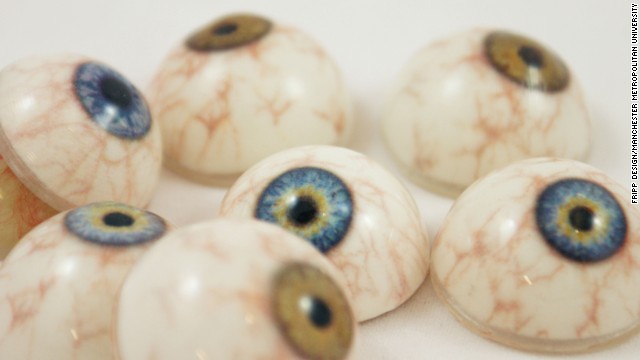
Scientists are 3-D printing body parts ranging from plastic skulls to artificial eyes. Fripp Design and Research and Manchester Metropolitan University say they are able to 3-D print up to 150 prosthetic eyes an hour.


Vital Signs is a monthly program bringing viewers health stories from around the world.
(CNN) -- The 21st century has seen the growth of 3-D printing, with well-known applications in architecture, manufacturing, engineering, and now increasingly in medicine.
The birth of 3-D scanning technologies combined with organic inks and thermoplastics has enabled the "bioprinting" of a range of human body parts to accommodate a wide range of medical conditions. Let's start form the top.
Skulls
Doctors at University Medical Center Utrecht, in Holland, have reported successfully performing the first surgery to completely replace a patient's skull with a tailor-made plastic version that was 3-D printed.
The patient had a chronic bone disorder that caused her skull to be 5cm thick. The hospital said the condition had caused her to lose her vision and ultimately would have killed her, but that three months after the operation the patient regained her vision and was able to return to work.
Doctors at University Medical Center Utrecht implant a printed plastic skull
Eyes
Batch-printing of up to 150 prosthetic eyes an hour has become a reality according to UK-based company Fripp Design and Research. The mass-production technique promises to speed up the manufacture of eye prostheses and drive down the cost. Printing each eye with slight variation in color is intended to produce better aesthetic results.
3-D printing for the human body
3-D printing gave her a chance at a normal life
Refugee amputee gets 3-D printed arm
The aim is to ensure more affordable eyes for the developing world with countries such as India reportedly showing interest in the products. The company, in collaboration with the UK's Manchester Metropolitan University, hopes to implement the use of its printed eyes within the next year.
Noses and Ears
Fripp Design has also collaborated with the University of Sheffield, in the United Kingdom, to produce facial prostheses such as ears and noses. 3-D facial scans of patients are used to print out prosthetics using pigments, starch powder and silicone for replica facial parts closely matching the patient's original nose or ear. The real benefit here is that once parts begin to wear, they can be re-ordered at a fraction of the cost as the technology and design will already be in place. The simpler process of scanning a patient's face, rather than more invasive face molds needed for traditional prostheses, also makes the process a lot more patient-friendly.
A team at Cornell University, in the United States, is doing things differently. It's printing 3-D molds of a patient's ear using ink gels containing living cells. The printed products are injected with bovine cartilage cells and rat collagen and incubated until they are ready three months later. Human transplants could be possible within three years, say researchers.
Synthetic Skin
James Yoo at the Wake Forest School of Medicine in the United States is developing a printer that will print skin straight onto the wounds of burn victims. The "ink" they're using consists of enzymes and collagen which once printed are layered with tissue cells and skin cells which combine to form the skin graft. The team plans on developing portable machines to print skin directly onto wounds in remote and war-torn settings.
The ideal synthetic skin graft needs to match the coloration of the patient as accurately as possible in order for the graft to look natural. Dr. Sophie Wuerger and her team at the University of Liverpool in the UK are working on using 3-D cameras, image processing and skin modeling to ensure the tone and texture of printed skin match up to the real thing.
Researching skin transplants on a fake hand, at Wake Forest School of Medicine.
Limbs
Thermoplastics have led the way in the growth of printable hands, arms and even individual fingers. Richard Van As is one of those producing affordable hand and finger prostheses with his company Robohand, based in South Africa. The team is creating functional fingers for use on amputated hands by combining the printing of the thermoplastic polylactide with aluminum and stainless steel digits to create a functioning mechanical finger.
Robohand recently collaborated with U.S. entrepreneur Mike Ebeling on a project providing affordable printed arms to war amputees in Sudan. The collaboration is known as "Project Daniel," named after 14 year-old Daniel Omar who lost both his hands and part of his arms after a bomb was dropped near his family home in Sudan's Nuba mountains. The team is enabling Robohands to reach the masses at costs as small as $100 for a basic hand.
Bones
One of the more established fields of 3-D printing is the bioprinting of human bone implants, and now replacement bones.

In 2011, researchers at Washington State University announced they had printed a bone-like structure that acts as a scaffold for new bone cells to grow on, before it degrades. The structure was printed using calcium phosphate and has been successfully tested in animals. The hope is to print customized grafts for use in patients with bone fractures.

Google sells out of white Glass model

Google made its Glass connected eyewear available online to the general public on April 15.
STORY HIGHLIGHTS
  • Google made its head-mounted Glass available to the general public for the first time on Tuesday
  • The $1,500 devices were only available for one-day to people in the U.S.
  • Google didn't release sales numbers, but said it sold out of the white model
San Francisco (CNN) -- Tuesday, for the first time, Google Glass was made available to the general public. As part of the one-day-only offering, anyone in the U.S. could buy the $1,500 face-mounted computers and get a free pair of glass or sunglass frames.
Google isn't sharing any sales numbers for the day, so it's difficult to divine how successful its first open-sales event has been. There were no reports of the Google Glass sales site crashing or customers being turned away.
Google did say it had sold out of the white, or "cotton" color of Glass. As of Tuesday afternoon there were still red, blue, gray and black options available.
"Wow, what a morning! We're happy to see so many new faces (and frames) in the Explorer Program," Google posted Tuesday to a Google+ page, announcing the unavailability of the Cotton model. The Explorer Program refers to early testers of the Glass connected eyewear, which is expected to become widely available by the end of the year.
Early on Wednesday Google posted an update saying, "All spots in the Explorer Program have been claimed for now, but if you missed it this time, don't worry. We'll be trying new ways to expand the Explorer program in the future."
A Google spokesperson later said in a statement, "While you can still access the site, Glass will be marked as sold out. We are leaving the site open so Explorers can still get any accessories they need."
The $1,500 headset was only available online, so there were no lines of buyers outside Google buildings. There also didn't appear to be any organized protests of the sale, despite isolated assaults against Glass wearers in this city amid recent tensions between longtime residents and a recent influx of tech-industry staffers.
Limited rollouts are a good way for Google to test the demand for its much hyped wearable product. Previously, the only people who could get Glass were developers or people who applied for the device through Google contests. (The Silicon Valley-based company is no stranger to creating hype for a new product. When it first rolled out Gmail 10 years ago, the service was invite only, making it seem exclusive.)
There are practical reasons Google has drawn out the product's launch. Glass is technically still in beta and it has been made significantly more consumer friendly since its launch a year ago. Since then, the hardware has been updated and on-staff designers created a line of sleek glass frames that can hold prescription lenses.
A day before opening up the online orders, Google announced the latest round of software updates for Glass, which will roll out later this week. The upgrade is expected to improve the device's battery life and make future software updates easier. There are minor tweaks related to photo sharing, submitting feedback to Google and voice commands. In response to dissatisfaction with the quality of video calls on Glass, Google has removed that feature until it can be improved.
Ben Farrell has wanted to buy Glass for a while but didn't pull the trigger until today. The San Francisco-based developer wants to wear the device while walking and running to get back into the habit of working out. He's also interested in developing location-based games for Glass, inspired by augmented reality games like Ingress.
"The annoying bit about designing games like this is having the user constantly looking down at their phone while trying to play the game in the real world," said Farrell.
On Twitter, many of the people expressing excitement about their orders for Glass, appeared to work in the tech industry. But some were just regular folks who wanted to see the technology's potential firsthand. Samantha Hutchison, a restaurant, hotel, and institutional management student in Texas, wants to find uses for Glass for students and travelers.
"I will be on the spring 2015 voyage of Semester at Sea and I hope to help develop the traveling apps to help capture my semester abroad," said Hutchison. (She's #teamshale.)
Nate Gilbert, a Glass customer who works for a rival company, thinks that the current price point is way too high. But that wasn't going to stop him from ordering a pair.
"I want to see how legit this is. What can it do," said Gilbert. "It seems like the future, but how close is it?"

There's also no way to tell if enthusiasm for Glass has been subdued by recent attacks on people wearing Glass in public or backlash over privacy concerns. Some fans might have decided to save their money and wait until Google releases the next version of Glass, expected by the end of the year. The next version of Glass will likely sport a reduced price tag.

Canadians arrest a Heartbleed hacker

canada heartbleed

Canadian mounties have arrested a teenager who, they say, used the Heartbleed Internet bug to hack into the country's tax agency.

Shortly after the Internet bug was revealed to the world last week, the Canada Revenue Agency suffered a data breach that leaked the Social Insurance Numbers of about 900 taxpayers. The agency was forced to shut down its website temporarily to prevent further theft of sensitive personal information.
On Wednesday, the Royal Canadian Mounted Police said it arrested 19-year-old Stephen Arthuro Solis-Reyes at his London, Ontario home a day earlier. During the police raid, agents seized computer equipment as evidence.
Solis-Reyes now faces two counts of computer-related crimes. He is scheduled to appear in an Ottawa courtroom on Thursday.
The arrest appears to be the first related to the Heartbleed bug since it was discovered last week.
Assuming Canadian mounties arrested the right person, Solis-Reyes could go down in hacking history. Whoever committed the breach single-handedly delayed the country's tax-return deadline by nearly a week. The country's taxing authority pushed back its tax-filing deadline from April 30 to May 5, a potentially costly wait.
The mounties, who function as federal law enforcement officers, were "working tirelessly over the last four days analyzing data, following leads, conducting interviews, obtaining and executing legal authorizations," Assistant Commissioner Gilles Michaud said in astatement.
In the meantime, the tax agency is carefully combing through its computer systems to determine the extent of the damage.
Heartbleed: 'Secure' internet wasn't safe
"We are currently going through the painstaking process of analyzing other fragments of data, some that may relate to businesses, that were also removed," the Canada Revenue Agency said in a statement.
To address similar concerns in the United States, the IRS assured taxpayers its systems were secure. The IRS last week told taxpayers to ignore Heartbleed and file their returns anyway. 

Google stock sinks as mobile struggles continue

android

Investors are getting impatient with Google' mobile marketing strategy.

Google (GOOGL) shares sank 3% in after-hours trading Wednesday after the company posted first-quarter earnings and sales that missed expectations. Of particular concern was a 9% drop in payments from marketers per ad on Google sites.
The challenge for Google is convincing marketers to pay as much for mobile ads as they do for desktop ads, a task that's become increasingly pressing as Web usage shifts to smartphones.
Google Chief Business Officer Nikesh Arora said in a conference call Wednesday afternoon that the company's mobile ad revenue is being held up in part because merchants haven't spent enough time developing their mobile sites, assuming that customers will make more purchases via desktop.
"The journey is just beginning for advertisers on the mobile side," he said. As advertisers begin to see the potential of mobile ads, including location targeting, Arora added that the gap between desktop and mobile ad rates would likely close.
"Right now we can lead the horse to water, but we can't make it drink," he said.
Part of the way Google is addressing this issue in the meantime is through the "enhanced campaign" strategy it introduced last year, which requires advertisers to buy across multiple platforms.
Google still reported $15.4 billion in sales for the first quarter, up 19% versus last year, as consumers clicked on 26% more ads than they did a year ago. Earnings came in at $3.45 billion, up slightly from last year.
These are Google's first quarterly results since instituting a controversial 2-for-1 stock split earlier this month. Google shareholders were issued two shares for every one share they owned at half the price.
The company's newly issued Class C shares trade under its old ticker, "GOOG," and do not give investors the right to vote at its annual shareholder meeting. Class A shares now trade under the ticker "GOOGL," and come with voting rights.
The split, which was held up in court after shareholders sued to block it, further consolidates control of the company among the leadership triumvirate of CEO Larry Page, chairman Eric Schmidt and co-founder Sergey Brin.
Google stock has fallen 5.5% in the past month, part of a broader slide in tech stocks. However, the drop lately has followed gains of more than 40% in the past year.
Why Google bought a drone company
Google, like rival Facebook (FBFortune 500), has been spending big on emerging technologies recently as it works to expand outside its core search business.
Earlier this week, Google announced the acquisition of Titan Aerospace, a start-up that makes high-altitude, solar-powered drones that Google hopes to use to deliver Internet service. The Titan team will operate separately from Google, but will collaborate with divisions including Google Maps and Project Loon, which has been working on delivering Internet service from high-altitude balloons.
The search giant has also invested billions of dollars in driverless carswearable gadgets,military robots and, through its $3.2 billion purchase of Nest earlier this year, connected home devices. To top of page

Heartbleed bug affects gadgets everywhere

server farm

The Internet bug Heartbleed doesn't just affect websites. It also has shown up in the gadgets we use to connect to the Internet.

Tech giants Cisco (CSCOFortune 500) and Juniper (JNPR) have identified about two dozen networking devices affected by Heartbleed, including servers, routers, switches, phones and video cameras used by small and large businesses everywhere. The companies are also reviewing dozens more devices to determine whether they're impacted by the bug as well.
That means for two years now, someone could have been able to tap your phone calls and voicemails at work, all your emails and entire sessions at your computer or iPhone. You also could have been compromised if you logged into work from home remotely. And you'll probably never know if you were hacked.
"That's why this is being dubbed the biggest exploit of the last 12 years. It's so big and encompassing," said Sam Bowling, a senior infrastructure engineer at the web hosting service Singlehop.
What does exposure actually mean? What could be hacked? Here is a rundown, provided by researchers at security provider SilverSky and Singlehop.
  • Work phone: At least four types of Cisco IP phones were affected. If the phones are not behind a protective network firewall, someone could use Heartbleed to tap into your phone's memory banks. That would yield audio snippets of your conversation, your voicemail password and call log.
  • Company video conference: Some versions of Cisco's WebEx service are vulnerable. Hackers could grab images on the shared screen, audio and video too.
  • VPN: Some versions of Juniper's virtual private network service are compromised. If anyone tapped in, they could grab whatever is on your computer's memory at the time. That includes entire sessions on email, banking, social media -- you name it.
  • Smartphone: To let employees access work files from their iPhones and Android devices, some companies opt for Cisco's AnyConnect Secure Mobility Client app for iOS, which was impacted by Heartbleed. An outsider could have seen whatever you accessed with that app.
  • Switches: One type of Cisco software that runs Internet switches is at risk. They're notoriously hard to access, but they could let an outsider intercept traffic coming over the network.
2014: The year of the mega breach
Cisco said it was being as transparent as possible with customers, providing a comprehensive list that shows the status of products. It asks that all those affected implement free software upgrades soon.
Juniper has provided a similar list and issued a statement to customers saying, "We are working around the clock to provide fixed versions of code for our affected products."
But fixing the bug on those devices won't be easy. Cisco and Juniper can't just press a button and immediately replace the vulnerable software running on the machines. The onus is on each person or company using those devices. And that's where the problem lies.
"Many small and medium businesses aren't likely to ever upgrade, and they're going to have a tremendous amount of exposure for a very long time," said John Viega, an Web security expert and an executive at security provider SilverSky.
That is why changing passwords isn't necessarily enough to overcome the potential damage caused by the Heartbleed bug. Even if a website isn't vulnerable when communicating with its customers, the company's servers might still be exposed.

The problem doesn't seem to be widespread on the consumer side, though. Linksys and D-Link make many of the routers we use to connect to the Web from home, and they say none of their devices are affected. Netgear (NTGR) said its in-home routers are not vulnerable to Heartbleed, but its business-class ReadyNAS storage products are -- so customers must update their firmware to be safe.

Ousted Yahoo exec gets $58 million golden parachute

castro

Former chief operating officer Henrique de Castro left Yahoo with a severance package worth $58 million, according to a regulatory document filed Wednesday with the SEC.

The golden parachute is among the most generous in history, and especially notable given that de Castro worked at Yahoo for only 15 months.
De Castro was shown the door in January by CEO Marissa Mayer, apparently due to disappointing performance in improving Yahoo's advertising revenue.
Mayer and de Castro -- two former Google executives -- were under tremendous pressure to revive Yahoo's battered core business.
Yahoo (YHOOFortune 500) said in its SEC filing that de Castro was not paid a bonus for 2013 because the compensation board "believed that he did not meet the performance standards."
How Marissa Mayer changed Tumblr
But de Castro was compensated in other ways.
The executive earned a base salary of $600,000 in 2013, while stock grants and options raised his total compensation to around $11 million.
In 2012, de Castro received a whopping $39 million, although he will forfeit much of that because some stock had not vested at the time of his departure.
Much of the $58 million severance package's value is attributable to Yahoo's rising stock price while de Castro was with the company.
The SEC filing indicates that the package was worth only $17 million in October 2012. By early 2013, the parachute had increased to its final size of $58 million.
Also on Wednesday, Yahoo shares surged 6% the company posted earnings and sales that came in slightly ahead of expectations.
Of particular note was the company's success in stemming declines in revenue from its search and display ads, which have flagged in recent quarters.
"We believe we've moved from our core business being in decline to stable to modest growth," Mayer said Tuesday in a presentation of the results. To top of page

Facebook launches friend-tracking feature

Facebook on Thursday rolled out a "Nearby Friends" feature, which uses location information to let users know which friends are near them in the real world. Read on for more stats about Facebook, which turned 10 in February.
(CNN) -- Your phone always knows where you are. And now, if you want, your Facebook friends will always know where you are, too.
Facebook is introducing a mobile feature called Nearby Friends that taps into that steady stream of location information so friends can track each other in real time.
The idea is to make it easy for people to meet up in real life, so they can have conversations in person instead of comment threads, temporarily replacing Likes and LOLs with eye contact and actual laughter. A live meet-up is also an excellent opportunity to grab a selfie with your pal and upload it to the Facebook owned Instagram.
In a refreshing change, the new Nearby Friends feature is notturned on by default.
New Facebook tool finds your friends
Friends will not be able to see where you are unless you decide live-tracking is something you want in your life and visit Facebook's settings to turn it on. Making a potentially invasive new feature opt-in suggests Facebook hasperhaps learned from some of its past mistakes and privacy problems.
You can choose to share your general location with all your Facebook friends, close friends or a customized list of people you feel most comfortable with. Further minimizing the potential stalking factor, your location is only shared with other people who are also using the feature and who have chosen to share their location with you.
When turned on, Nearby Friends shows a list of approved Facebook friends who also use the feature and shows their approximate location. A push notification can tell you how many of your friends are nearby. Open the app to see a list of pals, the neighborhood or city where they are, how many miles away that is from your current location, and a time stamp of when they where there.
There is an option to share your exact location with specific friends, which can be handy for coordinating large groups at concerts or finding someone in a crowded area. Your friends will see a little image of your face on a map for a set period of time.
Nearby Friends will be available on Facebook's iOS and Android apps, but will only work for select locations at first.
Facebook, Instagram and many other apps already include features that let people "check-in" to locations, but those location features are different because you decide if and when to share each specific location. You might check into a Starbucks downtown, but never into your home or other spot you'd rather keep private. Nearby Friends is continuously gathering details about where you are in the background instead of waiting for a manual check-in.
This is not the first time an app has used location information to physically connect friends. Similar apps such as Highlight, which got a flurry of attention in 2012, mapped out the locations of nearby strangers. Facebook also purchased a startup in 2012 called Glancee that also connected strangers. That technology evolved into this new, more private feature.
If you turn on the Nearby Friends feature, Facebook starts collecting data on your exact location and keeps details on where you've been in the past, not just places where you've used its app to check in. It also collects location information even when the Facebook app is closed.

But you can turn off this location history in the Facebook app's settings. It's possible to delete individual locations from a history, or clear the whole thing and start from scratch