Saturday, 19 April 2014

Apparently This Matters: Virtual soda drinking

Soda Drinker Pro lets gamers virtually walk through whatever this is and pretend to enjoy soda. Outstanding.
Editor's note: Each week in "Apparently This Matters," CNN'sJarrett Bellini applies his warped sensibilities to trending topics in social media and random items of interest on the Web.
(CNN) -- I haven't had a single Diet Coke in 2014. It was a conscious health decision, and the only real side effect, now, is that the world is awful and I hate everything.
Including puppies.
Quite frankly, my life was much better when I drank Diet Coke. It had purpose.
\
"Apparently This Matters" Is Jarrett Bellini's weekly (and somewhat random) look at social-media trends.
Mind you, that purpose was to spend seven hours a day in front of a urinal. But some really good ideas came out of that.
"Andrew, we should totally build an ark."
I've actually written before about my Diet Coke addiction. It was legitimately bad. There was even a short period where it was pretty much all I drank.
For instance, I would come home from a jog, tired and dehydrated having just spent a whole 20 minutes mildly exerting myself, and then I'd take long, deep pulls from a two-liter bottle, fresh and cold right out of the fridge.
Just do it.
Of course I miss Diet Coke, and I still get the urges. But it usually ends after about an hour when one of the neighbors sees me crying in the street without pants and calls the cops.
Thankfully, however, all that seems to be a thing of the past, because now there's a new virtual reality video game that lets youdigitally enjoy the greatest pleasure in all the world.
It's called Soda Drinker Pro. And it's totally real.
I played it.
The game was created by 33-year-old Will Brierly of Cambridge, Massachusetts, and, like all good innovations, it was inspired by laziness.
This is the title screen. It literally took minutes to make.
"I woke up in the middle of the night and needed a soda," he told me via e-mail. "Unfortunately, I didn't have one, so I decided to make a simulated soda."
Amazingly, over the course of one day, Brierly created the first five levels of Soda Drinker Pro. Which is probably why the graphics are what some experts might call complete and utter crap.
But that's part of the Soda Drinker Pro charm. It's purposefully absurd, and, remember, this thing was built in a day.
So, the game isn't exactly Rome.
It's more like Tulsa.
And the rules are pretty simple. You walk around different environments with a virtual soda in your hand, click left to put the straw up to your mouth, and then click right to simulate drinking.
You hear the sound of draining fluid, and your soda levels deplete as you hold down the click.
And that's pretty much it. May the odds be ever in your favor.
Truth be told, I didn't actually play long enough to get past levels one and two (the beach and the park, respectively), but I'm sort of hoping that one of the now 100-plus levels is a drainage ditch in Tijuana so I can recreate some of my darkest moments with Diet Coke.
Not sure if this is an old man with a chess board, or a young lady with a pizza. Either way, I have soda.
"Señor, usted está asustando a los niños."
Now, this might all sound a bit silly, and the bad graphics and simplistic game play are fine for goofing off on your Mac or PC, but Brierly has actually taken his "first person soda" to the next legitimate level of gaming.
He proudly boasts that it has Kinect support for Xbox One, and that console will also offer exclusive levels of drinking soda throughout time.
Like the Roaring 20s. Or, say, 1972.
And Soda Drinker Pro even has Oculus Rift support.
(Note to Dad: Oculus Rift is that incredible virtual reality software Facebook bought for $2 billion.)
(Note to Dad: Facebook is that website mom is always on.)
(Note to Dad: Virtual reality is ... oh, screw it. Never mind.)
Game designer Will Brierly with fans.
Beyond the fact that it's catching on at all -- albeit ironically -- it's also interesting that it's happening now. Brierly created the game six years ago, but it took a rather captive audience to get it off the ground.
He explains, "I didn't show anyone except some friends, but last year I did a presentation of Soda Drinker Pro at a soda drinking convention in Providence."
You read that correctly.
There's literally something called the Providence Soda Club, and apparently they hold a convention.
Which, I suppose, shouldn't be that unexpected. Rhode Island is so weird. It's not even an island.

The big-name smartphones

The Galaxy S5 is the latest in Samsung's line of big-screen, feature-laden phones.Considered an improvement, but not radical departure from, the S4, the phone features a 5.1-inch screen, 16-megapixel camera with ultra-fast shutter speed and a fingerprint sensor for added security. It sells for $199 with most mobile contracts.
(CNN) -- Here's a short message to smartphone makers before you try to wow us with a bunch of glitzy features in your next device: Don't do it.
It's been more than seven years since Apple introduced the original iPhone and reset our expectations for what a smartphone should be. But Steve Jobs was right on the money. It took some five years for the competition to catch up to the iPhone.
Now, with newly launched high-end devices like the HTC One and Samsung Galaxy S5, it almost doesn't matter which phone you buy anymore. The best ones are all pretty much on par with each other.
Recent reviews of the HTC One and Galaxy S5 had a common theme: They're both great devices, but neither has any sparkling features that make them worth upgrading to unless you're in dire need of a new smartphone.
Hands on with the Galaxy S5
Some critics have gone so far as to say smartphone innovation has stalled.
I think that's a good thing.
There's a reason the three best phones on the market -- the iPhone 5S, Samsung Galaxy S5 and HTC One -- seem boring on the surface. They all focus on simple stuff most people care about: screen size and quality, camera, design and battery life.
Meanwhile, the me-too smartphone manufacturers seem desperate when they try to stand out with absurd or gimmicky features like 41-megapixel cameras (Nokia), customized designs (Motorola) andawkward volume and power controls on the back of the device (LG).
After years of flashy phone launches, it's easy to feel jaded about the state of innovation today. "The new iPhone is boring!" the pundits scream with every new release. But they're missing the big picture.
The best smartphone makers know what matters most to users, and they focus on those items. And over the course of just a few years, our standards for what makes a good smartphone have gone way up. Innovation may not happen overnight, but that doesn't mean it has completely stopped.
If you step back and look at the evolution of smartphones as a whole, you can see we've come a long way in a relatively short time. It's not because manufacturers tried to reinvent the smartphone with every new release but because they focused on what matters.
For example, the original iPhone was a major dud by today's standards. It couldn't record video. It didn't have an app store. You could use the keyboard only in portrait mode. The screen was pixelated and dim. You had to sync it with your computer if you wanted to update the software. But with every new iPhone and release of iOS, those things got better.
Today's iPhone 5S, with its sharp screen and vibrant content ecosystem, feels like something out of a dream compared with its ancestor. Now, imagine what smartphones will be like after another seven years of iterative improvements.
Companies that try too hard to differentiate their new phones with "wow" factors end up hurting smartphone innovation in the long run. The best example of this is probably last year's Galaxy S4, which came packed with so many over-the-top features like touchless gestures and eye tracking that consumers complained it was too hard to use.
Samsung backtracked with the Galaxy S5 and either turned off many of those features or made them an optional download. The result was a streamlined phone that was much more refined.

It's easy for pundits like me to lament the end of smartphones with every major new release, but it's the so-called boring phones that are arguably driving innovation forward. They're focusing on what matters instead of trying random gimmicks and hoping one sticks

Atletico de Madrid, Elche, Atletico de Madrid vs Elche

Atletico Madrid defender Miranda
Getty
Miranda and Diego Costa were on target as Atletico Madrid beat plucky Elche 2-0 to go six points clear at the top of La Liga on Friday.

Brazilian defender Miranda grabbed his second goal of the season in the Spanish top flight 18 minutes from time, after David Villa had failed to convert a second-half penalty.

Costa, who missed a penalty at Getafe last weekend, then secured the points with his 35th goal of the season from the spot, after Cristian Sapunaru had brought him down - and received a second yellow card - in added time.

Diego Simeone's side had been frustrated by relegation-threatened Elche at a packed Vicente Calderon before Miranda and Costa secured an eighth consecutive La Liga victory.

With Barcelona not playing until Sunday and Real Madrid out of action this weekend, Atleti now have an ominous advantage at the summit with four games remaining as they attempt to win their first La Liga title since 1996.

They can head into Tuesday's Champions League semi-final first leg against Chelsea knowing they are in with a great chance of securing a famous double. Defeat for Elche, on the other hand, keeps them only four points above the relegation zone.

Costa suffered a leg wound in a collision with a post in the victory at Getafe last weekend, but the striker was passed fit to start.

And the Spain international was soon in the thick of the action when he fired into the side-netting after Adrian Lopez laid the ball off to him five minutes in.

Elche were not content to just make up the numbers, though, and Thibaut Courtois produced a fine save to keep out a left-footed strike from Javi Marquez before then having to be alert to thwart Damian Suarez when the defender was allowed a free header from the resulting corner.

Filipe Luis fluffed his lines at the other end when the ball fell kindly for him in the penalty area before the home side were given another scare just before the half-hour mark, as Carles Gil fired over the crossbar from inside the area.

Atleti were not at their best in the first half, but ought to have been in front four minutes before the break when Costa flicked on Juanfran's cross and David Villa prodded wide with the goal gaping. Villa had appeared to be in an offside position, but the flag failed to go up.

Simeone replaced Adrian with Raul Garcia at the break and the substitute took only four minutes to make an impact, as Sapunaru was adjudged to have bundled him over in the area and Carlos Clos Gomez pointed to the spot.

Villa stepped up to take the resulting penalty after Costa's miss against Getafe, but the former Barcelona man also failed from the spot as Manu Herrera kept out a tame effort diving to his left.

There was more frustration for Villa when he had a goal ruled out for offside and was then substituted to ensure Elche remain the only current top-flight team he has failed to score against.

Costa was booked following his reaction to two strong challenges, which sparked a melee that also saw Alberto Rivera go into the book.

An animated Simeone orchestrated the Atleti faithful and the opening goal they craved eventually arrived when Miranda rose highest to head home Jose Sosa's corner in emphatic fashion.

Costa then raced clear and was denied by Herrera, but made no mistake when he sent the keeper the wrong way from the spot after Sapunaru had upended him in the 90th minute. The defender was shown a second yellow card to compound his misery.

Twitter campaign highlights poverty in Saudi Arabia

A Twitter campaign highlights poverty in the oil rich country of Saudi Arabia.
STORY HIGHLIGHTS
  • Saudi Arabian Twitter users have flocked to a campaign bemoaning wages in their country.
  • The hashtag became the 16th most popular in any language.
  • High unemployment and government spending has fueled resentment in Saudi Arabia.
  • Many tweeters shared images and videos of impoverished Saudis.
(CNN) -- A few weeks ago, an Arabic campaign exploded on Twitter. The Arabic hashtag -- #الراتب_مايكفي_الحاجة (loosely translated as "the salary does not meet my needs") -- reached 17 million tweets in the first two weeks.
At its height, it registered 1.2 million tweets a day, and was not only the most popular hashtag in Arabic, but the 16th most popular in any language.
Somewhat unexpectedly, the campaign, which hints at a financially aggrieved populace, comes out of one of the world's wealthiest nations: Saudi Arabia.
"There's a feeling among some people that I guess you could characterize as anger. Others are disappointed, some think it's a question of (the Saudi government's) priorities," says Fahad Nazer, a Saudi political analyst with JTG Inc.
Poverty in Saudi challenges many people's assumptions, including some Saudis.
Fahad Nazer, JTG Inc.
The anger he refers to is fueled by growing unemployment and frustration at government spending. Nazer notes that the campaign gained particular traction following the Saudi government's announcement that it would give financial aid to Egypt's military regime.
"The government is giving handouts to Egypt, Jordan andTunisia, and using a third of the country's budget for this year to pay for the Riyadh metro. Meanwhile, Saudi's are paying most of their salary on rent, private schools, private hospitals -- because public ones aren't good -- while salaries have practically stayed the same," lamentsManal Al Sharif, a Saudi activist who gained notoriety for posting video of herself driving on YouTube. She is also one of the country's most vocal tweeters.
"There's a long list of things that are wrong," she adds.
Unemployment is higher than one might suspect in the oil-rich nation. Though official figures are hard to come by, there are approximately 1.8 million Saudis enrolled with Hafiz -- the country's unemployment benefits program -- according to Adam Coogle, a Middle East researcher with Human Rights Watch.
The campaign has also drawn attention to a topic that was once considered taboo: Saudi poverty. Accompanying many of the tweets are images and video supposedly depicting Saudis living in squalor; some show Saudi's beggar class while others reveal the existence of Saudi shanties.
Lynsey Addario, a photographer who documented Saudi poverty in Riyadh for Time Magazine, recalls how the assignment challenged her expectations.
"What you see on the surface are the shiny buildings and the shopping malls and the new universities being built -- the wealthy side. I was actually quite shocked when we went to the slums," she says. She recounted families struggling to pay the bills, and living in single-story, cockroach infested houses in the heart of Saudi Arabia's capital.
"Poverty in Saudi challenges many people's assumptions, including some Saudis'," admits Nazer. Poverty and unemployment are particularly rife among Saudi youths (Coogle estimates they make up anywhere between 18 and 35% of the unemployment rate), and even more so among women.
According to English-language newspaper the Saudi Gazette, an annual report put out earlier this year by the Ministry of Labor showed Saudi men in the private sector earn an average of $1,516, with women staffers pulling in half that sum. Al Sharif notes that working women are at a further disadvantage due to the many practices that are banned to them.
"A woman in Saudi is dependent on men to do just about everything in her life. If a man doesn't exist, she will have to pay for those services she can't do herself, like driving a car, starting her own business or going to court," she notes.
Despite its popularity, the campaign has attracted critics who argue Saudis are already too reliant on their government. Nazer himself notes that the campaign risks oversimplifying what is actually a very complex issue.
Several factors, he argues, have fed unemployment, including a population explosion -- since the '70s, Saudi has grown from 6 million people to nearly 20 million, with an additional 10 million expats competing with nationals for jobs. Adding to the problem is the fact that in the past, many Saudis chose to study religion and languages -- areas for which there is little demand.
"It's a complex situation, as is true of any economy. People who try to trivialize or simplify it miss a lot of variables," says Nazer.
Regardless of where one stands on the issue, what's been particularly surprising is the willingness of Saudis -- who traditionally value cultural privacy -- to air their grievances in an international forum.
"It's true, we are a very private nation, and we don't want the rest of the world to know anything about us," admits Al Sharif. However, she says, it's a price many Saudis are willing to pay.

"Saudis are realizing that you can't isolate yourself from the rest of the world, because the only way we can communicate and read each other's views is through social media. It's our kind of parliament, where we can go and debate, and do things we can't do in the real world."

Dinosaurs in the desert

An international team of scientists has discovered the first evidence of dinosaurs in Saudi Arabia. Dinosaur remnants are exceptionally rare in the Arabian Peninsula (enough "to fit inside a shoe box" according to Benjamin Kear, the study's lead author).
(CNN) -- For palaeontologists, the Middle East has long proven a bit of a blind spot.
Evidence of dinosaurs has proven scarce, and what little surfaces from time to time have been traditionally difficult to itemize. That changed recently when an international team of scientists uncovered the first evidence of dinosaurs in Saudi Arabia near the coast of the Red Sea.
The findings were published last month in the scientific journal PLOS ONE.
"To say that finds (in the Arabian Peninsula) are rare is an understatement. What's been discovered, you could almost fit inside a shoebox," notes Dr. Benjamin Kear, a palaeontologist at Uppsala University in Sweden, and the study's lead author.
"The problem in the past is that what's been found are just bone fragments, and you can say they're dinosaur, and vaguely what kind, but we've been unable to reconstruct and assemble them. This is therefore the first time that we can confidently identify an Arabian dinosaur fossil with any degree of accuracy," he says.
Kear and his team uncovered 72-million-year-old fossils. The first was of a series of vertebrae from the tail of a "Brontosaurus-like" sauropod called a titanosaur, the second, a few teeth from atheropod. The latter belonged to an abelisaurid -- a bipedal carnivorous dinosaur some 20 feet long.
Kear, who has excavated in the region before, says he was following up a lead on potential dinosaur fossils found by oil geologists who stumbled upon an outcrop.
"They had found an accumulation of fossils that mostly weren't from dinosaurs, but rather giant marine reptiles," he says.
As it happens, much of the Arabian Peninsula was underwater when dinosaurs roamed the Earth, and those rare remains that were discovered were washed downstream and out to sea by rivers, probably during a flash flood long ago in the Late Cretaceous period.
There are a handful of blank spots on the dinosaur map, and the Arabian Peninsula is among the very biggest
Dr. Anne Schulp, Naturalis Biodiversity Center
"We systematically worked this area over the last few years in the hope that a dinosaur would turn up. It was a matter of time to be honest; dinosaurs do often turn up in marine rocks washed out to sea," he says.
"There are a handful of blank spots on the dinosaur map, and the Arabian Peninsula is among the very biggest blank spots," notes Dr. Anne Schulp, a palaeontologist and researcher at the Naturalis Biodiversity Center in the Netherlands. In 2008, Schulp led a team that unearthed the first dinosaur tracks found in the region near Sana'a, Yemen.
"Even the tiniest scrap of bone is something to get excited about," he says. "The picture is slowly filling in, but it's a very large area and there remains much more to be discovered."
This fossilized tooth belonged to an abelisaur -- a carnivorous, bipedal animal that stood 20 feet tall
This fossilized vertebrae belonged once formed part of the tail of a \
This fossilized vertebrae belonged once formed part of the tail of a "Brontosaurus-like" sauropod called a titanosaur
Louis Jacobs, a vertebrate palaeontologist and professor at Southern Methodist University, explains that the discovery could also help find much sought-after answers about the history of the Earth and its land formations.
Jacobs explains that when the fossils were first buried, Saudi Arabia was part ofGondwana -- the subcontinent that made up the southern half of Pangaea, and included parts of modern-day Africa.
"India started out much further south, and through time it moved north and slammed into Asia, creating the Himalayas. But it passed by the Arabian Peninsula about the time that dinosaurs lived," explains Jacobs.
"Part of the interest in dinosaurs from Arabia is to get at that relationship between Gondwana and India during that time."
Several factors explain the scarcity of dinosaur-related material in the Arabian Peninsula.
One issue is that the richest sites aren't always the most accessible. Fragments have previously been found in Syria (currently a no-go zone) and Yemen, which discourages certain travelers. Meanwhile, visitors to Saudi Arabia need a sanctioned invite.
Kear notes that in Saudi Arabia part of the problem is that the most prevalent types of rocks aren't the right types for capturing millennia-old land-based animals. He also notes that until recently, the country suffered from a lack of interest in this type of research.
"Let's say the geological view has been skewed in the past towards oil exploration," he says. Still, he says, paleontological research is gaining more traction, as evidenced by the government-run Saudi Geological Survey recently adding a palaeontology division.
"For the first time, you can see the work is going somewhere, and leading to a lasting legacy. In the future, we can expect to see Saudi dinosaur displays and museums so people inside the country can understand the riches they possess."

Step inside the Kingdom Tower

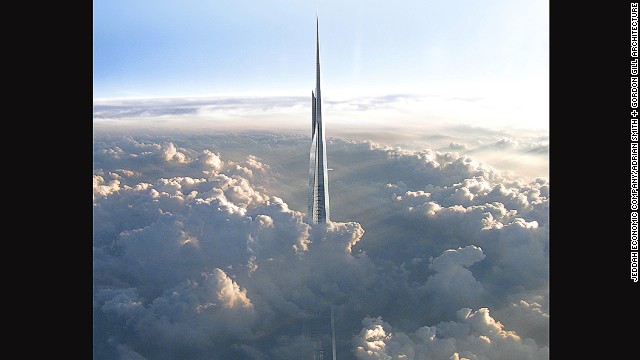
It is expected that construction of the tower will require 5.7 million square feet of concrete and 80,000 tons of steel.
According to Construction Weekly, construction will start on the Kingdom Tower -- slated to be the world's tallest at 1 kilometer (3,280 feet) tall -- next week.

(CNN) -- Dubai, long champion of all things biggestlongest andmost expensive, will soon have some competition from neighboring Saudi Arabia.
Dubai's iconic Burj Khalifa, the world's tallest building, could be stripped of its Guinness title if Saudi Arabia succeeds in its plans to construct the even larger Kingdom Tower in Jeddah -- a prospect looking more likely as work begins next week, according toConstruction Weekly.
Consultants Advanced Construction Technology Services have recently announced testing materials to build the 3,280-feet (1 kilometer) skyscraper (the Burj Khalifa, by comparison, stands at a meeker 2,716 feet, or 827 meters).
The Kingdom Tower, estimated to cost $1.23 billion, would have 200 floors and overlook the Red Sea. Building it will require about 5.7 million square feet of concrete and 80,000 tons of steel, according to the Saudi Gazette.
Building a structure that tall, particularly on the coast, where saltwater could potentially damage it, is no easy feat. The foundations, which will be 200 feet (60 meters) deep, need to be able to withstand the saltwater of the nearby ocean. As a result, Advanced Construction Technology Services will test the strength of different concretes.


Wind load is another issue for buildings of this magnitude. To counter this challenge, the tower will change shape regularly.
"Because it changes shape every few floors, the wind loads go round the building and won't be as extreme as on a really solid block," Gordon Gill explained toConstruction Weekly. Gill is a partner at Adrian Smith + Gordon Gill Architecture, the design architects for the project.
Delivering the concrete to higher floors will also be a challenge. Possibly, engineers could use similar methods to those employed when building the Burj Khalifa; 6 million cubic feet of concrete was pushed through a single pump, usually at night when temperatures were low enough to ensure that it would set.
Though ambitious, building the Kingdom Tower should be feasible, according to Sang Dae Kim, the director of theCouncil on Tall Buildings.

"At this point in time we can build a tower that is one kilometer, maybe two kilometers. Any higher than that and we will have to do a lot of homework," he told Construction Weekly.

Chinese engineer slapped by police official in Karachi

1111
Fourteen-member Chinese team including engineers and technicians has stopped all development work in protest as one of its members got slapped by local police constable Aejaz in Karachi.
The Chinese team arrived Pakistan over scheduled development project for installation and testing of imported locomotives recently bought by Pakistan Railways.
The embarrassing incident reportedly took place at Pakistan Railways’ Diesel Workshop situated in the metropolitan city of Pakistan.
The foreign team went on strike over the misconduct of police official deployed for their security by the local police department.
According to reports, the police constable Aejaz has been arrested by the security department and sent behind bars in the local police station.
Deputy DS Mehfooz Ali told media that the sorrowful incident took place while foreign team was working on Chinese locomotives in Karachi.
Railway SSP Robin Yameen said that the police official is under custody of law enforcement agency and a case has also been registered over his misconduct. He said that strict action would be taken against police official who slapped a Chinese engineer on field.
He added that eight security officials were deployed for the Chinese teams including engineers and technicians until they completed their ongoing project in Pakistan.

On the contrary, the constable who slapped a Chinese engineer at Cantt. Railway Station, said that he was under the influence of black magic.
The constable, Ejaz, was arrested immediately after he smacked the Chinese engineer at a workshop of Cantonment Railway Station.
The constable was infuriated after he was asked by the visiting engineer to leave the workshop.
Arif Mishwani, a railway staffer, said that constable was to hit the engineer with a hammer, but he was overpowered by fellow personnel.