Saturday, 15 March 2014

The problem with our drama industry and its depiction of Pakistani women

Somewhere, this over projection is making the idea of domestic violence socially acceptable as the constant exposure can make the society immune to it and further reiterate the patriarchal system.
The troubled image of modern Pakistani women conjured up by Pakistani dramas is extremely distorted and single dimensional. Stories, it is said, are a subtle yet are the most influential way of documenting the social evolution of a society. The story of a woman sells but the modern media has gone one step ahead by proving that the story of a woman being abused, tortured, beaten and humiliated sells faster.
The massive projection of domestic and women related violence might appear as an attempt to serve the cause but a closer look will reveal an entirely different and gross story. The disturbing image of woman being pushed, slapped, bad mouthed (mostly by close family) constantly overwhelms the TV screen. No matter how fast you switch channels, it is impossible to escape the harrowing images.
Domestic violence is a highly sensitive area and must be advocated in subtle and meaningful ways. If mishandled – the way it is on our dramas – it could create an impact far more unsettling than sexually explicit content. Such disturbing content must appear with prior warnings to avoid the uneasy situation in a family living room.
When children see family settings in a drama they instantly relate it to their own family and when it turns violent it certainly creates unfathomable effects of insecurity and fear in their subconscious. The sight of explicitly treated domestic violence creates embarrassing situation among the family as well.
Just to quote an example, Hum Tv’s Kisay Apna Kahen shows the character Iqra cutting her wrist and soaking in blood over little skirmish in the house.
What kind of message are we sending across to the young girls especially with newspaper already filled of such news?
Somewhere, this over projection is making the idea of domestic violence socially acceptable as the constant exposure can make the society immune to it and further reiterate the patriarchal system. It is lethal for an audience already overdosed on terrorism and violence.
Projection of reality is one thing but the exploitation of domestic abuse to gain ratings is inhumane. Special care is being taken to make these sensational visuals part of the advertisement, which makes it even more unnerving. Geo Tv’s drama serial Bewafae’s ad shows the husband slapping and abusing his wife. The popular Turkish drama serial Ferihas ad has the protagonist beaten by her father, brother and then by her husband. The drama has much more to it, like the ambition of a girl to do something better with her life, but these visuals are specially chosen to grab viewers’ attention.
The women in our contemporary dramas are objectified and the only purpose they serve is to win a man’s heart. The conflict is just one: how she could win this man and rest of the plot sails on her manoeuvres in this ordeal. It trivialises inter-woman relationship by pitting one woman against the other and that too for the sake of a man.
ARY’s Shukk spins the same formula by making the hero ending up with two wives and both of them are clinging to the man, unwilling to let go, as if it is impossible for them to survive on their own. ARY’s Kabhi Kabhi Pyar May starts with an independent, strong headed heroine Eshal but after being divorced by the love of her life, she tries to find refuge with another man.
There are no dilemmas, self-discovery and development of the female characters. The female leads are no more interesting, inspiring and awe worthy like they used to be; in fact, they have become repetitive, mindless, muted, predictable and flat.
The degeneration reminds me of strong female leads we used to have. I remember Shahnaz of Alpha Bravo Charlie, she chose Gul Sher over his stronger friends and his death led her to a profound road of self-discovery, instead of marrying one of the other friends. Zara of Tanhaiyan, turned an entrepreneur after her parents death and took care of her sister without looking for any fancy shortcuts. The character of Nazli in Dhuwan avenges her lover’s death independently, instead of sulking in the Bechari-syndrome.
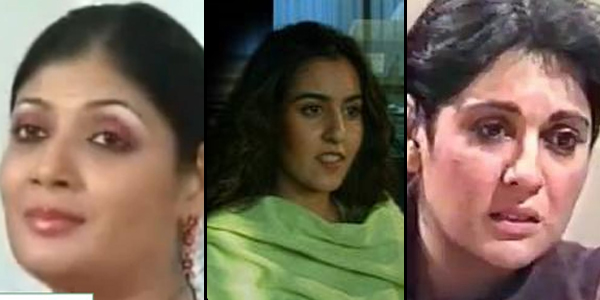
Nazli of Dhuaan (L), Shahnaz of Alpha Bravo Charlie (C) and Zara of Tanhayan (R)
We are psyched into believing that the violence is fed to us on our demand but the reality is, like a curse, the degeneration of society has seeped into our dramas. Drama industry is cocooned into the safe zone and not ready to venture out and experiment.
We are living in the exciting times of Sharmeen Obaid Chinoy, Samina Baig and Malala Yousafzai, so let them shine in our stories. Trust me, their stories will sell too.

Majority of youth does not seek employment: survey

download (1)
Around 33 percent of Pakistanis said that majority of unemployed individuals in the country do not try to find employment while 42 percent said this is not the case.
According to a Gilani Research Foundation survey carried out by GallupPakistan, a nationally representative sample of adult men and women from across the four provinces were asked about the ratio of unemployed individuals trying to find out employment.
Responding to this, 11 percent said they completely agree, 22 percent said they somewhat agree and 22 percent said they neither agree nor disagree.
Around 30 percent of the respondents disagreed with the statement whereas 12 percent said they completely disagree. Three percent did not respond.
A gender breakdown did not reveal a very high disparity between males and females. 11 percent of the male respondents completely agreed with the statement compared to 10 percent of women.
As many as 24 percent men said they agree, 21 percent said they neither agreed nor disagreed and 29 percent said they disagreed. 12 percent said they completely disagreed.
For women, 20 percent said they agree whereas 23 percent said they neither agree nor disagree and 32 percent said they disagree. Only 11 percent on the women said they completely disagree and 4 percent did not respond.
The recent survey was carried out among a sample of 2,587 men and women in rural and urban areas of all four provinces of the country, during February 17.

Malaysia PM says lost plane's movements indicate a deliberate act

Malaysia PM says lost plane\'s movements indicate a deliberate act
KUALA LUMPUR- Malaysian Prime Minister Najib Razak said today that the movements of a missing plane were consistent with a deliberate act by someone who turned the jet back across Malaysia and onwards to the west.
Investigators had confirmed that an aircraft tracked by military radar was the lost Malaysia Airlines flight MH370, after its communications were likely switched off before it reached the east coast of Malaysia a week ago, Najib told a news conference.
"Despite media reports the plane was hijacked, I wish to be very clear, we are still investigating all possibilities as to what caused MH370 to deviate," Najib said.
The PM said that Malaysia was ending a search in the South China Sea for a vanished jetliner after investigations indicated the missing plane likely turned far to the west.
"We are ending our operation in the South China Sea and reassessing the deployment of our assets," Najib told reporters.

Facebook COO seeks to ban ‘B’ word

Facebook COO seeks to ban ‘B’ word
ABC
NEW YORK-Can putting a ban on one school-yard word really change the way people think? Facebook COO Sheryl Sandberg (along with countless other familiar faces) says yes.
ABC News reports Sandberg, also the author of “Lean In,” is leading the charge to ban the word “bossy,” saying the negative word keeps girls from pursuing roles in leadership.
“We know that by middle school, more boys than girls want to lead,” Sandberg said, “and if you ask girls why they don’t want to lead, whether it’s the school project all the way on to running for office, they don’t want to be called bossy, and they don’t want to be disliked.”
Sandberg said these patterns begin when kids are young and can continue into their grown-up lives.
“We call girls bossy on the playground,” Sandberg said. “We call them too aggressive or other B-words in the workplace. They’re bossy as little girls, and then they’re aggressive, political, shrill, too ambitious as women.”
Sandberg’s organization, Lean In, is teaming up with former Secretary of State Condoleezza Rice and Girl Scouts USA CEO Anna Maria Chávez. They’re launching the public service campaign, “Ban Bossy,” which gives tips for parents, kids, teachers and others on how to push young women to embrace their desire to lead.
“Imagine a classroom in America where 50 kids are present: 25 girls, 25 boys,” Chávez said.
“And the teacher walks into this classroom and says: ‘Boys and girls, I have this really hard, difficult program that I need to solve that’s gonna impact this country.’ She writes the problem on the board and then turns around and escorts 24 of the 25 girls out of the room. ... She leaves one girl and 25 boys to solve that equation. That’s what’s happening every day in this country. Why wouldn’t we want more girls to be opting in to building the right solutions this country?”
The main mission of the campaign is to help females of all ages feel more confident and comfortable in leadership roles.
“I was called bossy when I was in ninth grade,” Sandberg recalled. “My teacher took my best friend Mindy aside and she said, ‘You shouldn’t be friends with Sheryl. She’s bossy.’ And that hurt.”
Sandberg said she and other women leaders have been able to rise above those taunts, but many girls can’t.
“If you look at the world, women do 66 percent of the work in the world. Woman produce 50 percent of the food. Women make 10 percent of the income and women own 1 percent of the property. We are 50 percent of the population. We are 5 percent of the Fortune 500 CEOs,” Sandberg said. “We are 17 percent of the board seats. We are 19 percent in Congress. That’s not enough for 50 percent of the population. We live in a world that is overwhelming run and owned by men.”
The ladies were quick to clear up the fact that they are not encouraging rude, mean-girl behavior or bullying.
“Leadership is not bullying and leadership is not aggression,” Sandberg said. “Leadership is the expectation that you can use your voice for good. That you can make the world a better place.”

Great Britain fight back to beat China for Paralympic curling bronze

Sochi 2014 Paralympic Games
British curlers Aileen Neilson, left, Bob McPherson, centre, and Jim Gault during the Paralympic Games in Sochi. Photograph: Sergei Chirikov/EPA
Skip Aileen Neilson inspired Great Britain's curlers to Winter Paralympic bronze with a 7-3 triumph over China. Neilson's rink, beaten 13-4 by the hosts Russia in their semi-final , regrouped superbly to fight back from an early 3-0 deficit. Victory took Britain's medal tally in Sochi to six.
Neilson was in tears at the finish as she celebrated with her team-mates, Angie Malone, Jim Gault, Gregor Ewan and alternate Bob McPherson. Britain had lost 6-3 to the Chinese in their final round-robin match on Thursday, but in the bronze medal match Neilson produced her best match of a tournament in which her all-Scottish rink have been inconsistent, mixing impressive wins with heavy losses.
It was thanks to Neilson they were not trailing by more than 3-0 after two ends, a rescue effort in the first limiting their opponents to a one-stone success. A pinpoint takeout from the 42-year-old in the third end made it 3-2 and in the next she forced an error from the China skip Wang Haitao to put her side 4-3 in front.
One-stone successes then followed in the fifth, sixth and seventh ends to leave China with too much ground to make up.
Neilson finished the match with an accuracy of 75%.
Malone, the only remaining member of the 2006 silver medal-winning team from Turin, who was brought in for McPherson for the match, also justified her inclusion with 75% accuracy.

Lewis Hamilton claims pole position for Australian Grand Prix

Mercedes driver Lewis Hamilton
Mercedes driver Lewis Hamilton flies round the Albert Park circuit during qualifying for the Australian Grand Prix in Melbourne. Photograph: Brandon Malone/Reuters
Lewis Hamilton showed just why he is favourite to win this year’s Formula One world championship when he won pole position for Sunday’s Australian Grand Prix.
It was his 32nd pole, drawing him level with another British champion, Nigel Mansell – and he is now just one behind two of the all time great drivers, Jim Clark and Alain Prost.
In a nail-biting finale to the first qualifying session under the radical new rules and regulations, pole was up in the air until the very end, with first Hamilton, then Mercedes team-mate Nico Rosberg, then Red Bull’s Daniel Ricciardo and finally Hamilton again toping the timings.
Alongside him on the front row will be local hero Ricciardo, a tremendous performance by him and Red Bull after all their difficulties in pre-season. But team-mate and four times world champion Sebastian Vettel had a miserable afternoon, failing to make it to Q3 for the first time since 2012.
Rosberg had to settle for third place in the end, one ahead of McLaren new boy Kevin Magnussen, with Fernando Alonso fifth.
Hamilton said: “It’s been an interesting weekend. It was so much harder in the wet conditions. It’s harder to drive these cars in the wet. It was a great showing for the team. There was a small hiccup on Friday morning but it was a quick fix. To get to the same number of poles as Nigel Mansell, who was one of the great British drivers, feels like a great achievement.”
Ricciardo said: “The weather added to the mix but it was very exciting. But this was just the start.”
Apart from Vettel, the other drivers not to make Q3 were Jenson Button, Kimi Raikkonen, who crashed his Ferrari at the very end of Q2, Adrian Sutil (Sauber), Sergio Perez (Force India) and Kamui Kobayashi (Caterham).
The big story in Q1 was that it claimed both Lotus drivers Romain Grosjean and Pastor Maldonado. Maldonado came off twice, not helped by the fact that rain started to fall 10 minutes into the session.
The other casualties at the first hurdle were the Marussia pair, Max Chilton and Jules Bianchi, Sauber’s Esteban Gutierrez and Caterham’s Marcus Ericsson.
But for Lotus, who beat McLaren to fourth place in last year’s constructors world championship, this was another desperate set-back following their difficulties in testing and with Friday’s opening practice sessions.
Grosjean, who qualified 21st, said afterwards: “We’re all very unhappy, but we will bounce back and learn and work. The guys were doing an amazing job [working through the night]. It’s been a painful first weekend but we will learn and make it better for the next race.”

Ireland clinch Six Nations crown after beating France in thriller

Ireland's hooker Sean Cronin celebrates
Ireland's hooker Sean Cronin celebrates. Photograph: Franck Fife/AFP/Getty Images
Ireland won the Six Nations by a matter of inches. With only 90 seconds to play in this extraordinary match, as thrilling as any in the recent history of the tournament, their players were sure that they had blown it.
France's No8, Damien Chouly, had just crossed in the corner. The referee, Steve Walsh, had asked the television match official to check whether or not the try was good. And … it wasn't. The pass that put Chouly through, delivered by Pascal Papé, had been forward. Only just. But just was enough. Moments later, the Irish won the ball back at a scrum. And then they could start to celebrate, they had secured the Championship with a win in Paris that will go down as one of the greatest in their history, alongside their last here, when Brian O'Driscoll scored a hat-trick in 2000.
It was a hard road to the title. It was obvious in the opening minutes that Ireland were feeling at least a little nervous. They offered little, firing only in fits and starts, flashing passes sparking passages of attacking that soon petered out. The French, on the other hand, eased their way into the match. Maxime Machenaud kicked a three points in the first minute after Chris Henry was penalised for hanging on to the ball. Machenaud added another from a similar position out on the right ten minutes later. That made it 6-0.
Matthieu Bastareaud kept battering his way through midfield, scattering Gordon D'Arcy and O'Driscoll as though they were just so many skittles in his way. All that was undone by the passes he provided afterwards, which were invariably wild and often forwards. And the one area where Ireland did have an obvious advantage was at the scrum. When their front row went to ground, Jonny Sexton sent the ensuing penalty down towards the French 22 for a lineout.
Ireland won it, and set off on wave after wave of short drives, working the ball across to the other wing and back again as they went. Cian Healy was particularly prominent, twice smashing his way through the line.
Finally, five yards out, Chris Henry picked up the ball and flicked it away to Sexton, who cut through towards the line, slicing past Bastareaud and through Chouly. A fine finish, but he missed the conversion.
Within five minutes Ireland had another. Back in his own half, Louis Picamoles made a slapstick attempt at catching Murray's clearance, knocking the ball on. O'Driscoll burst through off the ensuing scrum. Murray was on his heels. He sniffed a chance, sold Machenaud a dummy, and spat a pass out to Andrew Trimble, who was coming up at such a serious lick of pace that no one had a chance to catch him. All of a sudden, Ireland were in the lead.
And then things got really interesting.
The French kicked a penalty deep into the Irish 22, and took a drive off the lineout.They tried to batter their way through Paul O'Connell and his cohort, once, twice, three times, before Dimitri Swarzewski sent the ball out to fly half Rémi Talès. He had spotted Yoann Huget, almost alone out on the far wing, and booted a high, hanging kick in that direction. Huget and Rob Kearney leapt up together. Huget won, but instead of trying to take the catch he swatted the ball back infield with his fingertips. It fell into the path of the full-back Brice Dulin, who took it without breaking stride and sprinted in to the corner. Dave Kearney caught him, but could not stop him grounding the ball.
It was a wonderful try, the third scored in just ten minutes. Machenaud added the conversion, and France were back in front. Talès tried for a drop goal soon after, and missed. Ireland had one more opportunity to take the lead before the interval. They won yet another penalty at the scrum, and France were caught offside after the following lineout. It was a simple shot. But Sexton missed it, hooking the ball wide to the left. A poor kick, but perhaps not the worst of omens. Ireland had led at half-time in each of their three previous matches against France, and not won any of them.
Sexton soon made amends with his second try. Ireland won a turnover in midfield, and whipped the ball out along the line to Trimble. He bamboozled Maxime Médard, turning him this way and that with a shimmy and a step.
O'Driscoll was hot on his heels, and took an inside pass as the pair of them crossed into the French 22. The way to the line was open in front of him, but there wasn't enough speed left in those old legs. He was stopped short. But support arrived soon after, and Sexton sped through to score. He scored the conversion, and then kicked a penalty. Ireland were nine points up with thirty minutes to play. Fields of Athenry rang around the ground. That, surely, was that.
France, though, were working from a different script. They rallied, and redoubled their efforts. Huget diddled O'Driscoll, and the French flooded behind him into the Irish 22. From there, they smashed, bashed, crashed onwards. Drive after drive after drive. In the thick of it all, Healy caught Picamoles at a ruck, knocking him out cold. Play went on.
Eventually, after a penalty, Chouly drove into the padding around the post, and Swarzewski snaffled the ball up and got it down on the line. The referee Steve Walsh awarded the try, Machenuad kicked the conversion, and the game was set up for an excruciatingly tense finish.
By now players were starting to drop. Sexton was knocked out in a collision with Bastareaud. And Jean-Marc Doussain had replaced Machenaud, who had not yet missed a kick. Doussain duly did, pushing a penalty goal wide after France finally got on top of the Irish scrum. Even that, though, wasn't the end of it. The best was still to come.