Sunday, 5 January 2014

Alastair Cook: I will not resign as England captain after Ashes whitewash

• Cook vows to bounce back from humiliation in Australia
• 'I'm desperate to try to help England turn it round'
Alastair Cook  Australia v England - Fifth Test: Day 3
England captain Alastair Cook said his first act in Ashes defeat would be to have a drink with the Australia players. Photograph: Gareth Copley/Getty Images
England may have surrendered once again in Sydney, producing another wretched batting performance on the third day of the fifth Test as Australia completed only the third 5-0 whitewash in Ashes history, but even in bitter defeat Alastair Cook has again committed himself to staying on as the captain.
The ship may have sunk some time ago, but England's captain remains convinced that he is the right man to recalibrate this Test team. If there was some low comedy in the revelation at Cook's post-match press conference that the only message of support he has so far received from his employers came from a story on the England and Wales Cricket Board website that appeared on his smartphone on Sunday morning, then even in the wake of a 281-run defeat in Sydney it still seems likely that his desire to stay will be rewarded.
"I'm desperate to try to turn it round," Cook said. "I feel I'm the right man for the job. If I'm not, and people higher up want a change because they think that's the best way, then I'll have to take it on the chin. But in the dressing room, I feel as if I'm the right man to do it."
If Cook seems to be suffering a chronic case of competitive fatigue before England's one-day series, which starts next week, there was at least a flash of characteristically restrained fury in his response to his team's humiliation here.
"There is anger in me and frustration, because for whatever reason we haven't played very well, and the buck stops with me on that front. That's why it hurts so much. I suppose that's sport, isn't it?"
Asked what qualities he has to help revive this England team, Cook referred to his experience of England's last whitewash series in 2006-07. "I have a lot of experience as a player. I've seen a 5-0 before. And I've seen the drive and determination that that caused in the England team in a certain number of players. I know what that takes to do.
"So when you strip everything down, every single player needs to go away and have a look at themselves, have a look at their techniques, have a look at the way they bowl, and you start rebuilding again, and that real hunger and desire has to come from within to do it."
If loyalty to his line managers counts for anything then Cook remains an entirely steadfast lieutenant, defending, even in the aftermath of the whitewash, what has looked with every defeat an increasingly lopsided Ashes tour party.
"I wouldn't have argued too much with the squad we picked – certainly not at the time," he said. "In terms of moving forward, we've seen some very good stuff from Ben Stokes. He looks like he can balance our side – something we've been crying out for, for some time. I think he's been the find of the tour. What it does mean, when you lose 5-0, is that a lot of places are up for grabs again. That should be a real inspiration for people outside the team, but also for people inside the team."
Cook confirmed that his first significant act in defeat would be to go and have a drink with the victorious Australian team in their dressing room, a necessary balm after an occasionally rancourous series.
After which he will be required in the next few days to engage in some serious short- and medium-term planning with the assorted ECB management layers currently gathered in Sydney. Cook, at least, is convinced that coach Andy Flower is the right man to recondition this England team.
"There will be some conversations along those lines, we'll have to sit down and discuss it," he said. "I hope Andy is with us, I really do. His record suggests he is a fantastic coach, he is a great man and his heart is in it to turn it round. I hope it is me and him that do it."
There have been some – albeit rather spurious – suggestions that England's captain might have considered his own position during this series, but Cook was adamant he has never been close to resigning.
"If I feel my position in the side is not justified for the amount of runs I score and I don't feel I'm the right man for the job then I'll resign," he said.
"I'm very proud to be England captain, I think it is a huge honour and is not something I take for grantedby any stretch of the imagination and I'm desperate to help England turn it round."

Global economy set to grow faster in 2014, with less risk of sudden shocks

Advanced economies will expand at an annual rate of under 2% while emerging economies should achieve closer to 5%
A gas flare burns at a fracking site in rural Pennsylvania
A gas flare burns at a fracking site in Pennsylvania. 'In the US, economic performance will benefit from the shale energy revolution.' Photograph: Les Stone/Reuters
The global economy had another difficult year in 2013. The advanced economies' below-trend growth continued, with output rising at an average annual rate of about 1%, while many emerging markets experienced a slowdown to below-trend 4.8% growth.
After a year of subpar 2.9% global growth, what does 2014 hold in store for the world economy?
The good news is that economic performance will pick up modestly in both advanced economies and emerging markets.
The advanced economies, benefiting from a half-decade of painful private-sector deleveraging (households, banks, and non-financial firms), a smaller fiscal drag (with the exception of Japan), and maintenance of accommodative monetary policies, will grow at an annual pace closer to 1.9%.
Moreover, so-called tail risks (low-probability, high-impact shocks) will be less salient in 2014.
The threat, for example, of a eurozone implosion, another government shutdown or debt-ceiling fight in the US, a hard landing in China, or a war between Israel and Iran over nuclear proliferation, will be far more subdued.
Still, most advanced economies (the US, the eurozone, Japan, the UK, Australia, and Canada) will barely reach potential growth, or will remain below it.
Households, banks and some non-financial firms in most advanced economies remain saddled with high debt ratios, implying continued deleveraging.
High budget deficits and public debt burdens will force governments to continue painful fiscal adjustment. And an abundance of policy and regulatory uncertainties will keep private investment spending in check.
The outlook for 2014 is dampened by longer-term constraints as well. Indeed, there is a looming risk of secular stagnation in many advanced economies, owing to the adverse effect on productivity growth of years of underinvestment in human and physical capital.
And the structural reforms that these economies need to boost their potential growth will be implemented too slowly.
While the eurozone's tail risks are lower, its fundamental problems remain unresolved: low potential growth; high unemployment; high and rising levels of public debt; loss of competitiveness and slow reduction of unit labour costs (which a strong euro does not help); and extremely tight credit rationing, owing to banks' ongoing deleveraging.
Meanwhile, progress toward a banking union will be slow, while no steps will be taken toward establishing a fiscal union, even as austerity fatigue and political risks in the eurozone's periphery grow.
In Japan, prime minister Shinzo Abe's government has made significant headway in overcoming almost two decades of deflation, thanks to monetary easing and fiscal expansion.
The main uncertainties stem from the coming increase in the consumption tax and slow implementation of the third "arrow" of Abenomics, namely structural reforms and trade liberalisation.
In the US, economic performance in 2014 will benefit from the shale energy revolution, improvement in the labour and housing markets and the "reshoring" of manufacturing.
The downside risks result from: political gridlock in Congress (particularly given the upcoming midterm election in November), which will continue to limit progress on long-term fiscal consolidation; a lack of clarity about the Federal Reserve's planned exit from quantitative easing (QE) and zero policy rates; and regulatory uncertainties.
Emerging markets' difficult year in 2013 reflected several factors, including China's economic slowdown, the end of the commodity super cycle, and a fall in potential growth, owing to delays in launching structural reforms.
Moreover, several major emerging economies were hit hard in the spring and summer, after the Fed's signal of a forthcoming exit from QE triggered a capital flow reversal, exposing vulnerabilities stemming from loose monetary, fiscal, and credit policies in the boom years of cheap money and abundant inflows.
Emerging economies will grow faster in 2014 – closer to 5% year on year – for several reasons. Brisker recovery in advanced economies will boost imports from emerging markets.
The Fed's exit from QE will be slow, keeping interest rates low. Policy reforms in China will attenuate the risk of a hard landing.
And, with many emerging markets still urbanising and industrialising, their rising middle classes will consume more goods and services.
Still, some emerging markets – namely, India, Indonesia, Brazil, Turkey, South Africa, Hungary, Ukraine, Argentina, and Venezuela – will remain fragile in 2014, owing to large external and fiscal deficits, slowing growth, below target inflation and election-related political tensions.
Some of these countries – for example, Indonesia – have recently undertaken more policy adjustment and will be subject to lower risks, though their growth and asset markets remain vulnerable to policy and political uncertainties and potential external shocks.
The better-performing emerging markets are those with fewer macroeconomic, policy and financial weaknesses: South Korea, the Philippines, Malaysia and other Asian industrial exporters; Poland and the Czech Republic in Europe; Chile, Colombia, Peru and Mexico in Latin America; Kenya, Rwanda and a few other economies in sub-Saharan Africa; and the Gulf oil-exporting countries.
Finally, China will maintain an annual growth rate above 7% in 2014. But, despite the reforms set out by the Communist party's central committee, the shift in China's growth model from fixed investment toward private consumption will occur too slowly.
Many vested interests, including local governments and state-owned enterprises, are resisting change; a huge volume of private and public debt will go sour; and the country's leadership is divided on how quickly reforms should be implemented.
So, while China will avoid a hard landing in 2014, its medium-term prospects remain worrisome.
In sum, the global economy will grow faster in 2014, while tail risks will be lower.
But, with the possible exception of the US, growth will remain anaemic in most advanced economies, and emerging-market fragility – including China's uncertain efforts at economic rebalancing – could become a drag on global growth in subsequent years

Berlin's 'poor but sexy' appeal turning city into European Silicon Valley

Startups, venture capitalists and foreign workers descend on city with cheap rent and big investments from Google and Microsoft
The broadcast tower at Alexanderplatz, Berlin
The broadcast tower in Alexanderplatz in central Berlin, where one-bed flats are still available for under £400 a month. Photograph: Sean Gallup/Getty Images
A decade ago Berlin's mayor Klaus Wowereit tried to attract creative types to the city by declaring "Berlin ist arm, aber sexy" (poor but sexy).
It worked. The City's astonishingly low rents compared with other European capitals – a one-bed flat a short walk from Alexanderplatz in the centre of town can still be picked up for as little as €450-a-month (£373) – have helped draw arty people from across the world and made Berlin a major centre for artists, writers, musicians and, increasingly, technology and web entrepreneurs.
The city has already produced some globally recognised tech startup successes, including the music sharing service SoundCloud and games company Wooga – and Wowereit wants more.
"Berlin has caught the public's attention as a startup hub," he said. "We want to capture that momentum and drive Berlin's economy forward. [We] will fully dedicate ourselves to becoming Europe's leading startup hub."
The city already boasts 2,500 tech startups, and has attracted hundreds of millions of euros in investment from some of the world's biggest venture capital funds.
Wowereit admits that Berlin has some way to go in overtaking London as Europe's startup capital and has called in Chancellor Angela Merkel to help. She toured the city's new-tech clusters last year, told startups they were "the yeast that makes the industry grow" and promised to help make it easier for foreigners to register to work in the city.
The momentum behind Berlin has been building steadily in the past few months with Microsoft founder Bill Gates leading a $35m (£21m) investment in ResearchGate, a Berlin-based global network for scientists. Other big investments include famous Silicon Valley fund Sequoia Capital pumping $19m into 6Wunderkinder, maker of the popular to-do list app Wunderlist.As part of the investment Sequoia's Welsh partner Sir Michael Moritz will join the board of the three-year-old company that already boasts 6m users. New York fund Union Square Ventures led a $7m investment in the Football App, a mobile football news and information service downloaded by more than 12m people.
Gates's successor at Microsoft, Steve Ballmer, has opened an"accelerator" for startups in a grand building on Unter den Linden, Berlin's most famous boulevard.It joins a long list of other big established companies, including Deutsche Telekom, Deutsche Post, drugs company Bayer, media company Alex Springer and even supermarket chain Rewe and Coca-Cola.
Ballmer said he chose to locate the accelerator in Berlin – alongside Bangalore, Paris, Beijing, Tel Aviv and London – because he had been impressed by the "amazing emerging ecosystems" and "incredible startups" springing up in the city.
Microsoft's general manager for Germany, Christian Illek, said: "Why have we chosen Berlin? Berlin is the metropolis for creativity. Berlin has become the hotspot in Europe, alongside London, for founding IT companies and startups.
"There is no other city like Berlin where the spirit of pioneering and innovation is so strong. If we succeed in implementing the ideas of startups into successful business models, Berlin will become Europe's Silicon Valley."
Alexander Ljung, co-founder and chief executive of SoundCloud – which has attracted investment from Hollywood actor Ashton Kutcher's A-Grade Fund and a rumoured $50m from venture capitalists Kleiner Perkins Caufield & Byers – said he and co-founder Eric Wahlforss chose to move from their native Sweden to Berlin because of the city's internationally-acclaimed clubbing scene and because it was much cheaper than staying in Stockholm or moving to London. "The atmosphere and culture in Berlin is very unique," he said. "Since the costs for living are still low, people can afford to only work a few hours per week, and do the stuff they want the rest of the time.
"Some folks are like professional clubgoers. And the consequence is that people in the creative, media and internet world are much more understanding and tolerant when someone comes to a meeting a little bit later, and with a hangover. Nevertheless, if you want to create a company, you have to work hard, which means that you need a lot of discipline here not to get tempted too often to enjoy the Berlin nightlife."
Rising rents in London's Silicon Roundabout are also pricing out many startups, with some looking as far afield as Berlin. According to the estate agent Savills startups have made the area around Old Street roundabout so "fun, funky and trendy" that "boring corporates think: 'we want a bit of that'" and are sending the rents up to £40 per sq ft, and a single desk space in a shared office to £400 a month. By comparison, Berlin office rents can range from as low as €4 per sq ft in the trendy up-and-coming Neukölln district to €20 in Mitte, right in the centre.
Google is backing The Factory, a new 16,000 sq ft startup campus complete with apartments, gym and restaurants built into the remains of the Berlin Wall near the touristy Mauerpark flea market. Office space in the building costs €16 per sq ft and was fully let months before opening. Simon Schaefer, founder of The Factory, said people from the UK, Europe and the rest of the world were attracted by the rents but also the opportunity to help build a community.
"There is nothing that Berlin really stands for, except being cheap and cool, and drunk and druggie," he said. "It's the potential to shape something, that is why so many people are coming here."
Adam Haywood, the British chief executive of the photography location service Reccy, said his company chose to start in Berlin rather than London because "the rents and other costs are so much lower we can stretch money a lot further. It's also a really fun city and everyone speaks English".
Berlin's internationalism and the widespread use of English is another key draw for startups and investors.
Jens Begemann, founder and chief executive of Wooga and a mentor to dozens of other startups, says the office language of all startups in the city is English even in the few that have all German-speaking staff.
"You have to have everything in English, it is the only language we speak here," he said in Wooga's colourful offices near Alexanderplatz. "Because English is the official language here we can hire anyone from anywhere. There are talented young people across the world who can't get jobs; if they come here they can get a job.
"We have done interviews over Skype, and they've arrived the next day."
He jokes that the company canteen – which apes Google by giving away food and drink – is "like the United Nations" because the company employs staff from about 50 countries.
Foreign staff are not required to learn English, but they are offered lessons and encouraged "to try".
The influx of young well-paid non-German speaking people has not gone down well with everyone, mainly because it has pushed up rents for locals.
Monika Herrmann, the mayor of Friedrichshain-Kreuzberg, one of the areas most favoured by expats, has accused long-term visitors of treating the city as a "movie set".
"I expect them to participate. It's not just a cool place to live. It's not just a place to party. The coolness of the district has something to do with the fact that we want to live here together," she told the English-language magazine Ex-Berliner. "It has something to do with the fact that you meet in your pub at night, regardless of which language you speak. There's a danger that this will slowly disappear, because some people just want to invest in a cool area, which they don't really care about.

One thing's certain in 2014: bankers will get bigger payouts


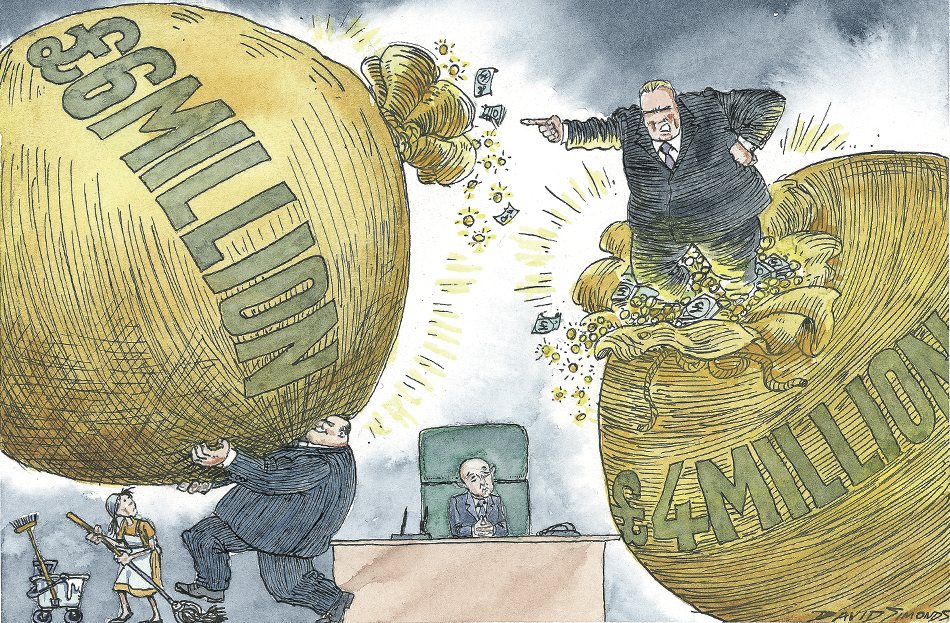
Dave Simonds cartoon on bankers' bonusesView larger picture
Click to see full cartoon.
Prepare for "an out-of-body experience". We have Sir Philip Hampton, the chairman of Royal Bank of Scotland, to thank for describing that memorable reaction to negotiating a £4m bonus with an employee of the bailed-out bank and the recipient's fury at the level of the payout, which he considered derisory. A rival of the unnamed banker was getting £6m. "This is absolutely outrageous to them, that somebody is getting 50% more," Hampton recalled.
The RBS chairman will no doubt be braced for a round of similarly awkward experiences in the weeks ahead, as banks around the City enter their annual bonus season. While Hampton will undoubtedly be doling out large sums – in 2012 RBS handed out at least £1m to 95 bankers – the figures will be dwarfed by rivals if history is any guide.
Take the US banks. In the coming fortnight the biggest players on Wall Street – Goldman Sachs, Morgan Stanley and JP Morgan – will all report results for 2013, which will determine the size of the payouts to their workforces. Data published just as the old year was ending provided a timely reminder of the pay deals on offer to top financiers.
In 2012, the average pay of 115 senior risk-takers at Goldman Sachs in London was more than £2.7m. At JP Morgan – in a year when it suffered the disastrous London Whale trading incident – the top 126 London-based staff were handed £2m each. At Bank of America Merrill Lynch the average stood at just under £1m.
In just the first nine months of 2013 the big US banks set aside $63bn (£39bn) to pay their staff. Analysts at Sanford Bernstein reckon that Morgan Stanley and Goldman Sachs will pour another $6.3bn into the pay and bonus pot when they report their full-year results next week. The brown envelopes outlining the size of each employee's bonus will he handed out shortly afterwards.
The US banks are not obliged to admit how many of their employees receive more than £1m, but the UK banks are starting to providing such information. Barclays has recently admitted that in 2012 it paid 428 staff more than £1m – which is more than double the number handed such a sum by HSBC, a bank twice as big. Recent data from the European Banking Authority, the pan-European regulator, showed that more than 2,700 London-based bankers received at least €1m (£830,000) in 2012.
With these numbers in mind it is little wonder that lawmakers in Brussels – representing individuals who have endured years of austerity, falling real wages and rising unemployment – set out to try to put to a lid on pay. As of the start of this year, top bankers will have their bonuses capped at a level equal to their salary – or double their salary if shareholders approve.
That has prompted a major scramble by banks to find ways to circumvent the new rules. Barclays, for instance, is handing its staff an extra allowance – a new, third payment, not classed as salary or bonus, to get round the restrictions. Even before the regulations come into force, Brussels has failed to stop bankers' pay spiralling further out of control.
Antony Jenkins, the boss of Barclays, has promised shareholders they will get a bigger share of the spoils in the years ahead in the form of dividends. But that will not tackle the level of bonuses. Jenkins said only last week that "to be in certain types of business, you have to accept the pay structures in those industries" – basically a message to shareholders and regulators that they will just have to suck it up. And a signal of more out-of-body experiences looming.

Next boss's results are their own reward

Justin King, chief executive of Sainsbury's, has been named the businessman's businessman not once but twice in the past few weeks. He snaffled the Management Today accolade of Britain's most admired leader in November, and on 3 January was picked as most impressive business leader in the Ipsos MORI annual captains of industry survey.
While not taking anything away from King's stewardship of Sainsbury's, it is remarkable that Next boss Simon Wolfson is not held in equal, if not higher, esteem.
On Friday Wolfson unveiled a Christmas trading update which smashed expectations – year-on-year sales up 12% in a supposedly grim market for clothing, powered by high-street sales up more than 7% and online sales rising more than 20%.
The shares rocketed to £60.85 – up 10% on the day and 57% on the year. When Wolfson took over 12 years ago they were around £10.
Next is now valued at some £2bn more than Marks & Spencer, even though its turnover is less than half that of M&S. This year, for the first time, Next is expected to make more profit than its rival: some £684m-£700m, compared with an expected £650m at M&S. When Wolfson, then just 29 years old, was made a director of Next in 1997, the chain was making £160m a year. In the same year M&S made more than £1bn.
Of course, part of the reason Next has made such advances on M&S is that the grand old lady of retail has made so many errors over the past few years – poor products, failure to invest in stores and distribution, failure to get ahead of the curve online. Next has also made mistakes – it has just recovered from them better.
Both businesses are fishing in the same tough, mass-market, mid-priced, middle-England, own-brand pool. But while M&S has flailed around, Wolfson's quiet discipline, which includes strict rules on matters such as store openings and share buybacks, and excludes starry behaviour like posing with models, has paid dividends – literally so this year, in the form of a special 50p-a-share payout.

Here's looking at you, chief

Playing ugly in business doesn't always guarantee success, according to a study by economists at the University of Wisconsin. It found that good-looking bosses earn more – and prettify their companies' share prices too.
Using a facial attractiveness index to rate chief executives in S&P 500 firms, the study found share prices improving on days when the attractive chief executives appeared on TV, and that better-looking bosses achieved better returns in mergers and acquisitions, too.
Marissa Mayer, the new boss of Yahoo, was one example, scoring 8.45 out of 10 for facial attractiveness and presiding over a doubling of the company's share price. The researchers stressed that the increase was not solely down to her appearance and were not suggesting that bosses should only be hired for their looks. But beauty is in the eye of the shareholder.

Macau is betting on a new kind of Chinese tourism

The former Portuguese colony is threatened by a crackdown on its controversial 'junkets'. Now, with new malls and lavish shows, it is hoping to replace high rollers with middle-class families
Gambling tables inside the casino at the Venetian Macao Resort Hotel.
Gambling tables inside the casino at the Venetian Macao Resort Hotel. Photograph: Kin Cheung/AP
Walk into a casino in China's gambling mecca, Macau, and the first thing that strikes you is the silence. There's no blaring music, no sharp cries of victory; all you hear is the rustle of clothing, a hushed conversation, the occasional thump on a table – subtle signs of fortunes made and lost.
If Las Vegas is a gaudy monument to the American dream of endless possibility, Macau, the only place in China where gambling is legal, is a fitting Chinese counterpoint: a temple to the acquisition of extreme wealth by any means necessary.
The former Portuguese colony, administered by Beijing as a "special autonomous region" since 1999, is just a speck on China's south coast, an 8 sq kilometre peninsula joined by bridges to two hilly islands in the South China Sea. Yet it's home to 35 casinos, which last year brought in a record $45bn (£27.4bn), according to figures published last week by Macau's regulator, the Gaming Inspection and Coordination Bureau. That is estimated to be more than seven times the amount made on Las Vegas's Strip.
But the peninsula has a problem: two-thirds of its gambling revenue still comes from closed-door VIP rooms controlled by "junkets" – companies that bring high-rolling punters across from the mainland on extravagant package deals and load them up with credit. Multimillion-pound bets and flights on private jets are common, as are suggestions of money laundering and links to organised crime. But over the past year the once-untouchable junkets have felt the chill of president Xi Jinping's crackdown on corruption among party officials.
Casino bosses have taken note – they are investing heavily in lavish resorts, high-end shopping malls and elaborate stage shows as the region tries to reinvent itself. Just as it once turned itself from colonial backwater to den of organised crime, now Macau needs to become a family tourist destination, a playground for China's burgeoning upper middle class. And they seem to be succeeding: last year's $45bn takings were up nearly 19% from 2012.
"An accountant would say, looking at the balance sheets, that this thing is far from broken," said Glenn McCartney, a tourism expert at the University of Macau. "But when you go beyond the economics, you realise you shouldn't have all of your eggs in one basket."
Leading the transformation is the Venetian Macau, the world's largest casino (51,000 sq meters), housed in one of the world's largest buildings. Despite temperatures in the mid-teens, the ground outside its main entrance was covered in fake snow this Christmas. Opera singers belted out carols from a high balcony framed by ersatz gothic columns. Nearby, a man was handing out sweets.
"We're trying to give everybody a feeling of Christmas," said entertainment manager Guy Lesquoy.
Venice is too far away for most Chinese holidaymakers, but the Venetian offers a handy substitute. Over Christmas, 120,000 visitors a day walked its ersatz Italian streets and filled its 3,000 hotel suites. Lesquoy has 200 performers on his staff, including Russian acrobats, Belarusian flautists, and Filipino opera stars who croon Chinese folk tunes from gondolas plying the resort's third-floor grand canal. Overhead, a computer-controlled artificial blue sky was set to dusk.
Manny Pacquiao beat Brandon Rios by unanimous - and overwhelming - points decision in MacauManny Pacquiao after his victory over Brandon Rios in Macau. Photograph: John Gurzinski/AFP/Getty Images
The Venetian also includes a 15,000 capacity sporting arena, a 92,000 sq metre shopping mall, four swimming pools, and an exhibition hall so vast that looking straight across its empty expanse inspires a feeling of falling. It recently hosted a fight featuring Filipino boxer Manny Pacquiáo, as well as performances by Rihanna, Justin Bieber and Alicia Keys. The Rolling Stones will perform there in March; according to Lesquoy, tickets sold out in two hours.
Competitors have followed suit. Over the road, the mega-casino City of Dreams has opened two regular shows: Taboo – a cabaret – and the House of Dancing Water, an acrobatics spectacle directed by Franco Dragone, formerly of Cirque du Soleil.
Nearby, six more resorts are under construction. One, MGM Resorts, will include a 20,000-seat arena; another, an ultra-upscale boutique resort called Louis XIII, will boast a suite that costs nearly £80,000 a night.
Investors say Macau's bet on the continued prosperity of the middle class is a safe one. About 800,000 tourists from mainland China visited Macau in 1999; last year, that had grown to 17 million. Most arrive ready to spend.
"The average bet in Macau is at least US$100, and I'm talking about the mass market," said Aaron Fischer of CLSA Asia Pacific Markets in Hong Kong. "That's a reflection of how crazy things have gotten in China."
Most of this money changes hands in round after lightning-fast round of baccarat, an old European card game based on chance. "Chinese gamblers don't come here for fun; they come here to win," said Desmond Lam of the University of Macau. About half of them only stay in Macau for about 24 hours: they play baccarat until first light, then stumble bleary-eyed on to the first Hong Kong-bound ferry of the day. Hence the silence.
"They believe in feng shui and they believe in luck – it's much stronger here than in western countries, and their gambling reflects that," said Lam.
On the casino floor of the Grand Lisboa hotel, a glittering, pineapple-shaped skyscraper visible from almost anywhere on the peninsula, two businessmen from China's Hunan province were bemoaning their losses over Taiwanese cigarettes, paying little attention to the nearly naked woman performing aerial acrobatics on a dangling blue ribbon behind them.
Such scenes were repeated across the peninsula. In a lush, suite-like room on the fourth floor of the Ponte 16 casino, a middle-aged woman with purple eyebrows sat alone at a baccarat table. She bet £300, lost it, and immediately laid down another stack of chips. In the Sands Macau, a man in a puffy pink jacket blew on the card he'd been dealt, slowly turned up one corner to reveal an eight of diamonds, pumped his fist in the air and slammed his elbow on the table. He collected his winnings and left. His seat was taken immediately.
Ben Lee of Macau-based consultancy IGamiX said Macau would struggle to be a tourist destination on the lines of Las Vegas. Beijing may want Macau to be an international showcase for China, much like its gleaming neighbour Hong Kong, but, said Lee: "All Macau is a showcase for is how much the Chinese from mainland China gamble." For non-gambling tourists there was simply much more to see elsewhere, he added.
The Venetian Hotel and Casino in MacauThe Venetian Hotel and Casino in Macau. Photograph: Dan Chung/The Guardian
And despite President Xi's crackdown on the junket system, some experts say that VIP rooms are still thriving. Junkets are nearly impossible to regulate: in private rooms several floors above the hordes of tourists, top clients continue to spend millions of pounds in off-the-record bets.
"Junkets are legitimate agents in Macau's casino system," said Philippa Symington of FTI Consulting's Shanghai office and the author of a recent report on money laundering in Macau. "Their activities can stray into criminal territory. This can range from working around occasional loose regulations – for example, enabling players to avoid identification – to relying on organised crime groups to collect gambling debts."
In some ways, money laundering is to Macau what corruption is to mainland China – ubiquitous, yet impossible to eradicate without undermining the entire economy.
China restricts the amount of money its citizens can carry abroad to about £2,000 per trip and £30,000 over a year. Macau appeals to wealthy mainlanders who, fearing scrutiny and volatility at home, may want to funnel their fortunes into overseas property markets and bank accounts.
Junkets take advance payments on the mainland and offer easy credit across the border, allowing clients to far exceed Beijing's limits. Streets near major casinos are lined with brightly lit pawn shops selling shrink-wrapped luxury watches for thousands of pounds, which punters from the mainland buy on credit and immediately return for cash.
The 2013 annual report from the Congressional-Executive Commission on China, a US government agency, quoted an anonymous academic as saying: "Each year, $202bn in ill-gotten funds are channelled through Macau."
In December 2012, one of the region's most notorious criminals, gangland boss Wan Kuok-koi, known as Broken Tooth, was released after serving 14 years in prison for loan sharking, criminal association and illegal gambling. Wan once led 14K, the region's most notorious triad, and for many locals, his release was a reminder of how much had changed.
"I don't want to affect the stability of Macau," he told the South China Morning Post. "There's absolutely no way I want to do that."
Yet the lure of Macau's casinos again proved irresistible. In July, Wan told Hong Kong's Next magazine that he planned to open a VIP room in an unnamed casino. Rumour has it he's doing quite well

Next emerges as big Christmas winner with sales up 12%

Clothing retailer raises profit forecast after sales 'significantly ahead of expectations' in seven weeks to Christmas
Next
Next shares rose 10%, adding more than £700m to the company's stock market value. Photograph: Linda Nylind for the Guardian
Britain's second-largest clothing retailer, Next, is on track to generate bigger profits than Marks & Spencer for the first time after seeing a surge in sales before Christmas.
Shares in the retailer jumped nearly 10% to a record £60.80 as it said strong sales of knitwear, gifts and nightwear and booming internet trade had lifted sales "significantly ahead of expectations". Just 12 months ago, the shares were changing hands at £39.05.
The group shrugged off fears that the festive season had been tough for clothing stores with a 12% rise in sales in the period from 1 November to 24 December compared with the same period a year before.
Next held out against a wave of discounting by rivals in the final trading days before Christmas, but doubled its pace of growth online from the previous quarter and experienced its strongest underlying growth in stores since the summer of 2002, according to analysts at Bernstein.
In light of that storming performance, Next raised its pre-tax profit forecast for 2013 by about 4% to a range of £684m to £700m, putting it well ahead of the City's expectations for the much bigger Marks & Spencer, which is expected to make an annual profit of £650m.
Next's stock market value climbed to nearly £2bn more than Marks & Spencer as it announced that a special dividend of 50p a share would be paid to shareholders in early February, at a cost of £75m. The company is planning to distribute a further £300m in 2014 via share buybacks and special dividends.
Next's healthy Christmas numbers come after John Lewis and House of Fraser reported a seasonal sales surge, boosted by performance online.
Out in the cold is Debenhams, which issued a profits warning and parted company with its finance director after disappointing sales.
Attention is now turning to Marks & Spencer. Like Debenhams, the groupslashed prices in a last-minute attempt to woo shoppers in the days leading up to Christmas, raising fears that the high-street stalwart could also miss its profit targets.
A poor Christmas for Marks & Spencer, which reveals its festive trading figures next week, would pile more pressure on the chief executive, Marc Bolland, who is trying to turn around years of poor clothing sales.
Analysts said that Next's strict policy of not discounting until the clearly defined start of its sale on Boxing Day was something other retailers should take heed of and had clearly not affected its ability to take market share.
Neil Saunders, at the retail analysts Conlumino, said: "This is one of the reasons why Next is a festive winner in terms of both sales and profits."
Simon Wolfson, the chief executive, said Next had performed well partly because of shoppers' growing confidence in ordering online for delivery to homes and stores, which helped the company capitalise on a late surge in sales this year.
But he said sales had mainly been lifted because Next had got its ranges right this year, particularly on womenswear, after a not so sparkling year in 2012. "We had a good season and a lot of ranges were better than the previous year."
Lord Wolfson warned that the retailer's strong performance was unlikely to continue in the first half of 2014 and sounded a warning about confidence among cash-strapped consumers.
"The consumer hasn't had an awful lot more to spend. Looking forward, the environment will be better, just not a lot better," he said.
"Although we have seen a return to economic growth and the credit squeeze on consumers is abating, earnings are not keeping up with inflation and so we are not expecting a return to the boom times."
On a day when Nationwide revealed that house prices rose by 8.4% in 2013, Next sounded the alarm over a potential rise in interest rates adding further pressure on household incomes.
"We are also wary that any return to significant economic growth is likely to result in rising interest rates which, in turn, is likely to moderate spending of those with mortgages," the company said.
The City took heart from Next's performance as it awaits a flurry of Christmas trading reports over the coming weeks. The supermarkets Tesco and Sainsbury's and the online grocer Ocado are scheduled to reveal trading figures next week.

M&S v Next

Marks & Spencer
Annual sales £10.4bn*
Pre-tax profits £651m *
Number of UK shops 766
Employees 81,700
Stock market value £7.2bn
Share price 2013 449p (+16%)
* City estimate for year to March 2014
Next
Annual sales £3.6bn**
Pre-tax profits £684m-£700m***
Number of UK shops 500+
Employees 54,500
Stock market value £9.4bn
Share price 2013 6100p (+57.5%)
** City estimate for year to Jan 2014
*** Management estimate

George Soros warns that Chinese slowdown is biggest worry in 2014

SOROS
George Soros says the model responsible for China's huge growth has run out of steam. Photograph: Michel Euler/AP
George Soros is worried about China, and we should take note. The hedge fund boss, who built his fortune betting on the world's money markets, is concerned that 20 years of rapid growth is about to run out of steam.
Soros, who famously bet against the strength of the pound in the European exchange rate mechanism and won during 1992's Black Wednesday debacle, will be a prominent figure at the World Economic Forum in Davos later this month, when policymakers and business people debate how to foster global growth.
In the Square Mile, a brief glance at the stock market shows the impact of a slowdown in Chinese manufacturing output last month – and the fear that this will become protracted. The FTSE 100 is down 30 points since the new year break. It includes mining companies such as Rio Tinto and Anglo American, which have strong links to the Chinese economy. Signs that the world's second-largest economy is slowing have caused the price of many commodities to fall, and helped break a 12-year bull run for the gold price. (China consumes around half of the world's iron ore and coal, and buys more than a third of its base metals.) Beijing's move to cut back on corn imports made the grain the worst-performing commodity last year, as it fell almost 40%.
Predictions that China's economy lost momentum in the final quarter of last year were underscored by figures showing that the manufacturing sector grew at a slower pace in December as export orders weakened. Official figures can say whatever the Chinese authorities want them to say, but there is widespread agreement that the economy is suffering a longer-term slowdown.
Mark Williams at thinktank Capital Economics said the news that China has a $3 trillion (£1.8tn) local government debt mountain would fuel the fear: "Activity among large firms has turned down again and is likely to cool further as policymakers rein in local government debt. We therefore expect China's economy to slow again this year."
Soros bluntly states that three years of worrying over the eurozone should give way to worrying about China. It's not that he believes a solution has been found to the debt mountains in parts of Europe; it's just that he thinks the euro problem has reached a plateau while China could be on the skids.
He said: "The major uncertainty is not the euro but China. The growth model responsible for its rise has run out of steam."
Until recently China has thrived by restricting households' spending, effectively forcing them to save. The savings are channelled into industrial production.
Foreign exchange built up in the boom years has mostly been invested in international expansion – in Africa and in parts of Asia neglected by a previously aloof Japan.
The financial crisis showed the weakness in the idea of becoming the workshop for the world when that world couldn't afford to go on buying. To keep the wheels turning, local authorities and other government agencies were allowed to borrow.
Last year the Chinese leadership said it recognised that plan was flawed, and public sector debt needed to be cut. But when the economy slowed dramatically after borrowing was restricted, the policy was quickly reversed. The subsequent boost looks shortlived, even if China has billions of dollars in foreign exchange reserves to soften any economic blow.
Soros said: "China's leadership was right to give precedence to economic growth over structural reforms, because structural reforms, combined with fiscal austerity, push economies into a deflationary tailspin. But there is an unresolved contradiction in China's current policies: restarting the furnaces also reignites debt growth, which cannot be sustained for much longer than a couple of years."