Wednesday, 4 December 2013

World Cup is going to be sensational – for first time in a generation

Brazil's Josimar during the 1986 World Cup in Mexico, where he scored two memorable goals
Brazil's Josimar during the 1986 World Cup in Mexico, where he scored two memorable goals. Photograph: Bob Thomas/Getty Images
Certain things are subjectively wonderful, even in their most gratuitous, self-destructive, loveless form – and even when, objectively speaking, they constitute a terrible, humiliating debacle. Take the World Cup, for example. Intended to be a compulsion of thrilling football, it is more regularly a matter of principle trudge, elevated purely by the decadence of its accoutrements: lumps of meat on lumps of fire, living room cans and a slovenly break from reality.
Once upon a time it was all so different and the World Cup was the world's most reliable source of wonder. It has not been a good time for wonder: the Golden variety has been usurped, Stevie's standards have slipped beyond redemption and media saturation of life's every facet means there is almost nothing we haven't seen.
Accordingly foreign football is no longer limited to Brian Glanville, gnarled copies of World Soccer and the imagination; the majesty of the unknown is gone. There can never be another Pelé, Cubillas or Josimar because we are besieged by information about every conceivable player when they are scarcely more than a mischievous thought.
But this World Cup could, should, will be different. To the extent that there is ever a standard approach to football, positive tactics are currently in fashion, the modish formations allowing four players to commit almost entirely to attack. Hell, even Italy are at it, while watching England's final qualifiers was, for the first time in many years, reminiscent of actual enjoyment.
And, despite it all, being in Brazil will help too, not just because it is an inspirational place but by virtue of temperatures conducive to sport. Though it will still be warm, only in Manaus might things be unbearable. The running around required to play fast, exciting football is now a viable option.
Probably the change is motivated more by pragmatism than altruism. There currently exists a surfeit of exceptional attackers, spread widely if not evenly, but hardly any exceptional defenders, let alone defences. So going forward just makes sense. The best way of winning is to try to win rather than to try not to lose. If a team elects to sit back, it will almost certainly be beaten but, if it goes forward and has a good day, it can demand an opponent score three to advance.
More specifically Spain, so dominant over the last five years, are not quite as brilliant as before, the possession carousel that protected a vulnerable defence now more of a roundabout. Meanwhile their likely rivals have improved significantly, illustrated first in last season's Champions League and then the Confederations Cup as Bayern Munich, Borussia Dortmund and Brazil easily handled BarcelonaReal Madridand the national side respectively. Of course, these wins do not prove anything but the fillip is important and it will be a surprise if Spain complete a further knockout stage without conceding a goal.
That the club game has emasculated its international counterpart is unarguable, the last great World Cup nearly 30 years ago, the last great Champions League perennially the last one. Perhaps its most significant advantage, that of familiarity, used to be tempered by a spread of quality far more even than has become the case; many South Americans stayed in South America, and the eastern bloc retained its stars too.
Though plenty of the very best players still moved around, that tended not to happen until they were actually the very best players, rather than the eventual standout in a trawl of adolescents with potential potential. But now, the elite players gather at the elite clubs and the standard has improved accordingly, such that international football cannot compete.
Yet still the World Cup has plenty that club football does not, because the best things in life are driven by anticipation and excitement. Setting aside time for a novel or a box set, then pausing everything to rinse through in a binge of stupefying, consuming joy, is far more transformative than discrete plodding, and the same is so of the various relationships, emotions and sensations available to us.
Only the World Cup can be truly transcendental and it is only the World Cup whose finest games are of universal significance, absorbed into the annals of humanity and epochal in a way that simply cannot be matched. For the first time in a generation it is going to prove it

ADP numbers show US job market growth despite government shutdown

Job fair
ADP’s report suggests that the government shutdown and argument over raising the debt ceiling had little impact on hiring. Photograph: Getty Images
The US job market remained “surprisingly resilient” through the government shutdown, adding 215,000 new positions in November, payroll processor ADP said Wednesday.
The latest figures from the payroll giant are the strongest it has reported this year. They come ahead of the government’s own monthly jobs report on Friday, a key economic indicator being closely watched by the Federal Reserve as it considers cuts to its $85bn a month economic stimulus programme.
Economist had forecast ADP would announce a monthly increase of around 173,000. ADP also revised its October number up to 184,000 from an initially reported 130,000.
ADP’s report suggests fears that despite fears to the contrary the government shutdown and argument over raising the debt ceiling had little impact on hiring. Jobs growth through the month was broad-based with small business, seen as the main engine of hiring, adding 102,000, the largest increase by sector.
Goods-producing companies added 40,000 jobs in November, up from 29,000 in October.
Both construction and manufacturing payrolls added 18,000 jobs apiece. The gain for manufacturing was the largest since early 2012. Service industries added 176,000 jobs in November, the largest gain in a year and up from 156,000 in October.
Mark Zandi, chief economist of Moody’s Analytics, which helps compile the report, said: "The job market remained surprisingly resilient to the government shutdown and brinkmanship over the treasury debt limit. Employers across all industries and company sizes looked through the political battle in Washington. If anything, job growth appears to be picking up.”
Carlos Rodriguez, president and chief executive officer of ADP, said: “It’s an encouraging sign as we head toward the new year.”
Friday’s nonfarm payroll figures from the Labor Department are the last before the Fed meets mid December to discuss trimming the so-called quantitative easing programme. The Fed has clearly signaled that the programme will be cut if and when the jobs market appears more firmly recovered.
Last month the US announced it had added 204,000 new jobs in October, higher than expected. Figures for August and September were also revised upward. Economists are predicting that the US added around 185,000 new jobs in November.
If the government figures tally with ADP, the likelihood of a cut in QE will increase. “Consistent job growth of around 175,000 to 200,000 per month makes it likely that the Federal Open Market Committee will start to reduce its purchases of $85bn per month of long-term treasuries and mortgage-backed securities at its late January meeting,” PNC Bank said in a note to investors.

Chelsea's José Mourinho to give Kevin De Bruyne more first-team chances

Kevin De Bruyne was considering a move to maintain his place in the Belgium squad.
Kevin De Bruyne has been considering a move to maintain his place in the Belgium squad. Photograph: David Davies/PA
José Mourinho has acknowledged an improvement in Kevin De Bruyne's attitude at Chelsea over recent weeks and hopes to offer the Belgium international more first-team football over the next month.
Since joining the London club almost two year ago, De Bruyne, 22, has spent time on loan at his former club Genk and with Werder Bremen, and has seen his opportunities limited this term. His international and Chelsea team-mate Eden Hazard last month advised him to leave Stamford Bridge in order to get enough match action before the World Cup finals in Brazil.
Mourinho was critical of De Bruyne's performance in a League Cup tie at Swindon Town and the player, who started two of Chelsea's first three games of the campaign, has not featured in the Premier League since a five-minute appearance as a substitute against Fulham in September.
That lack of game time had prompted De Bruyne, a key figure in Belgium's qualification campaign for the World Cup, to instruct his representatives to explore the possibility of another loan move in January. Wolfsburg, who are keen to sign him permanently, and Bayer Leverkusen have both expressed a desire to sign a player who impressed in the Bundesliga with Bremen last season, while Atlético Madrid have also declared an interest in the winger.
Yet Mourinho has said De Bruyne has a part to play at Chelsea as they pursue silverware on four fronts, with the manager encouraged by the player's response to being left out of the side.
"Kevin is showing desire and working very hard," said Mourinho. "I feel sorry for not giving him big opportunities up to now, but he's working better than ever. He's sad when he's not selected or playing, but he's working professionally which, for me, was a change from the beginning. When he works the way he is, he has to have a chance.
"He is selected [in the squad] for the Sunderland game on Wednesday, and he has a block of matches ahead and has to make a mark in them. I like him as a player. I've learned now how to like him, also, as a kid. He's a good kid and he's showing he's a good professional. Hopefully I can give him enough time on the pitch so he decides to stay in a happy way."
The player's agent is expected to speak to the club later this month to determine the best approach for the second half of the season, with De Bruyne anxious to ensure selection for Belgium's World Cup squad.
"I understand he needs to play a bit more, but he's in an area of the pitch where we have more options," added Mourinho. "I'm speaking with him and we're working a bit on that: he can also play as a midfielder when we play with an open triangle. He's done that at Werder Bremen, so hopefully we can find more options for Kevin to play, because I like the player very much.
"Any player who wants to speak with me and the club ... they deserve that respect. But the club is No1. It comes first. The players come after the club. We have to protect the club and understand that we have lots of matches to play until the end of the season, and lots of things can happen. We'll be playing four competitions at the same time if we get through to the next round of the Capital One Cup, so we'll need a big squad."

Dimitar Berbatov wants to leave Fulham in January, confirms agent

Dimitar Berbatov
Dimitar Berbatov is not happy at Fulham, according to the striker's agent, and wants to leave in the January transfer window. Photograph: Jed Leicester/Action Images
Dimitar Berbatov is unhappy at Fulham and hopes to leave in January, according to his agent Emil Dantchev.
The 32-year-old Bulgarian striker is one of the club's marquee players but has scored just once in the Premier League this season – a barren run that has contributed to the struggles that cost Martin Jol his job as manager.
Rene Meulensteen took the reins this week charged with keeping the side in the division but will be rocked by news that Berbatov, whose contract expires in the summer, is looking for a way out.
"I don't usually speculate as nobody knows what will happen in January but what I can tell you is he [Berbatov] is not happy at Fulham," Dantchev said. "He would like, if possible, to find another option."
Despite a poor campaign by his own standards, Berbatov has the star power to attract interest from clubs throughout Europe, but Dantchev suggested the his client would prefer to remain in the Premier League.
"I cannot comment [on whether there has been any approach] but the priority is to find a solution to stay in England," he said.
Fulham, who take on Tottenham on Wednesday night in Meulensteen's first match in charge, refused to comment on the situation.

Football transfer rumours: Pedro to Manchester United or Liverpool?

Pedro
Is Pedro off to Liverpool or Manchester United? Photograph: Dean Mouhtaropoulos/Getty Images
Spanish sports daily Mundo Deportivo reports that Pedro has been hinting he's ready to leave Barcelona and fancies a move to England. "Le ha dicho a sus íntimos que tiene 'cosillas' en Inglaterra y, pese a que está agradecido al Barça por todo, piensa también en su futuro," reports the paper. And for the benefit of readers who, lioke the Rumour Mill, don't speak Spanish, a quick Google translation reveals the player has "told his intimates that he has 'little things' in England, and although he is grateful for everything Barca also thinks about her future". Hmmm ... whatever it is he actually said, Liverpool and Manchester United are reported to be interested in introducing the 26-year-old World Cup winner to Premier League football, while Monaco are also on red alert.
While he may not be in the same class as Pedro just yet, Burnley strikerDanny Ings has been turning plenty of heads with his performances this season. The 21-year-old's 15 goals in 21 appearances have got antennae twitching in the Premier League. The Mirror reports that Liverpool are pondering a January move for the tyro, who would provide cover for first choice strike-force Daniel Sturridge and Luis Suárez.
TV reports in Turkey suggest that Manchester United are ready to quite literally double their efforts to bring Wesley Sneijder to Old Trafford. Having apparently failed to secure the Dutch international's services from Galatasaray with a £6m bid during the summer, United are ready to pay £12m or offer wingers Antonio Valencia and Nani in a swap deal. Sneijder has also been linked with a move to Chelsea, but has dismissed the notion that he's off to Stamford Bridge. "It's just rumours and you will see come January I will be linked with Chelsea again but I am staying here," he said. "Every transfer market I am apparently moving to one club or another but these are just rumours, I am happy and I like life here." That's us told.
The apparently imminent departure of David Luiz from Stamford Bridge means Chelsea are in the market for a centre-back and Internazionale defender Andrea Ranocchia appears to feature prominently on their list of potential replacements. A hulking 25-year-old who has represented Italy at every level from youth to full senior international, Ranocchia is contracted to Inter until 2015, but could move to London in January if, as is rumoured, Luiz moves to pastures Nou.
The number of ice-cool tab-smoking Bulgarian strikers plying their trade in the Premier League could decrease by one in January, if rumours suggesting Dimitar Berbatov wants to leave Fulham are to be believed. The louche 32-year-old has six months left on his contract with the Cottagers, but is believed to be hankering for a move to Turkish side Trabzonspor, where he won't be forced to engage in anything so vulgar and crass as a battle against relegation. "Berbatov has been on our agenda," said Trabzonspor president Ibrahim Haciosmanoglu. "We want better and better quality and are endeavouring to add that to our squad." In other news emanating from Craven Cottage, new manager Rene Meulensteen likes the cut of difficult-to-type Hungarian winger Balazs Dzsudzsak's jib, but will face competition from Liverpool in the race to prise the 26-year-old away from Dynamo Moscow.
And finally, Chelsea, Manchester City and Manchester United are all sniffing around France defender Eliaquim Mangala, who will be offered a pay rise by Porto in an attempt to keep him where he is, while Sam Allardyce will attempt to make himself feel better after West Ham's defeat at the hands of Crystal Palace last night, by buying himself Everton defender Johnny Heitinga for Christmas.

World Cup: fans' £6,000 bill for 13,500 mile odyssey if England reach final

Aerial view of the Christ the Redeemer statueView larger picture
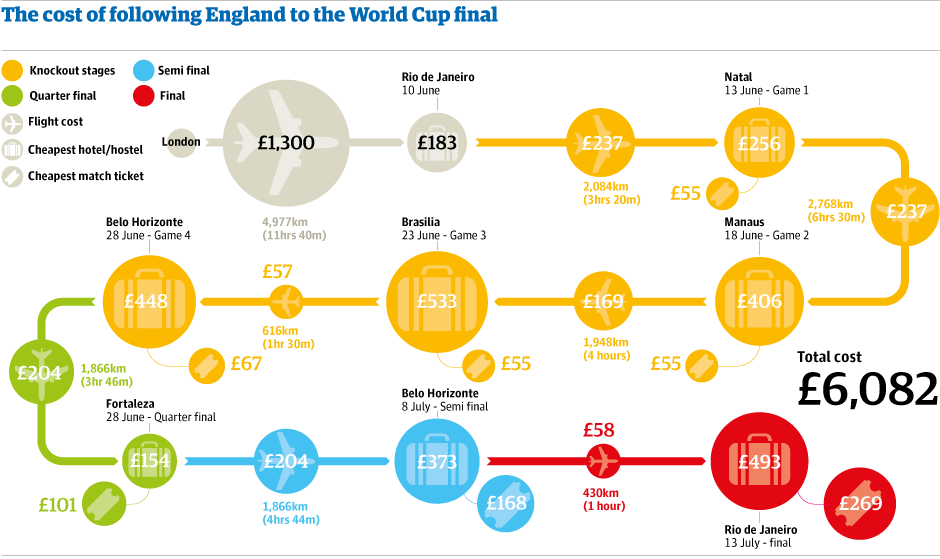
About 13,500 miles and more than £6,000. That is the daunting itinerary that awaits the English fan if Friday's World Cup draw installs the national team in the most geographically taxing berth on the Brazil 2014 schedule.
It begins with a game in the north-east on 13 June, requires thousands of miles of travel even in the group stage and then, if the team survive that marathon, obliges them to trek up and down the country via the heart of the Amazon, to the south-western resort of Rio de Janeiro, where the final will be held on 13 July.
This slot, known only as A4, is likely to be filled by the first team to be pulled out of the last pot, where England will probably find themselves. Roy Hodgson has already said this is the draw he wants to avoid because it will involve a game in Manaus, where the humid climate will prove a tougher opponent than any rival team.
Fans may well feel the same once they calculate the miles and dollars needed to travel from opening game to final in this most logistically challenging of World Cups.
Breaking with tradition, Brazil has made things unusually complicated and expensive by arranging the three group games in different cities. This would be challenging in any host nation, but in the world's fifth biggest country, it will mean staggering journey times and costs.
Fans of the team in the A4 slot travelling from Europe are going to have to think big. Very big. If they were to follow their team for all seven games to the final (admittedly a highly unlikely prospect in England's case), they will have to spend more than £6,000 and fly more than 13,300 miles – the equivalent of 75 trips between London and Manchester.
That is the relatively low-budget estimate for economy class flights, two-star (or cheaper) accommodation, the cheapest match tickets and a modest daily food and booze allowance of £18 for the month-long tournament, based on prices quoted online in the past week for travel and accommodation in the six cities, one of which is visited twice.
There are better and worse scenarios. Distances between games in most other groups are shorter. In some cases, long-distance buses may even be an alternative way to take in more of the country at a cheaper price. If England fails to advance to the knock-out stage, the price is halved.
But if you want more comfortable lodging or to leave your flight booking until nearer the time, the costs could surge. In the past week alone, the minimum London to Rio return, leaving Heathrow on 10 June next year, has gone up by more than 70% to £1,300.
The biggest single outlay, of course, is the 6,200-mile-plus round trip from Europe to Brazil. You could cut down the cost and travel time by flying via Portugal to Natal, in Brazil's far north-east tip, but many fans are likely to want their first stop to be Rio – England's base camp and one of the most famous resorts in the world.
Brazil Celebrates National Day Of SambaBrazil's party capital Rio is one of the most expensive cities in the world. Photograph: Mario Tama/Getty Images
After the 11-hour journey there, they'll want at least a couple of days to take the edge off the jet lag by sun-worshipping on an Ipanema beach or sipping caipirinhas in São Conrado, where the England team will stay before the tournament begins.
Fans will also need to acclimatise to sky-high prices because Brazil's party capital is one of the country's – and the world's – most expensive cities. The £180 estimate for a two-night stay in Rio is based on a private room for two in a hostel. A sex motel or a favela lodge would be cheaper, but anyone who wants starred accommodation in the famous Copacabana beach district should expect to pay two or three times more.
Fortified by the Atlantic sea breezes, you then fly three-and-a-half hours and 1,295 miles for A4's opening match in Natal. While the footballers labour in the tropical heat, fans will be able to enjoy some of Brazil's most magnificent beaches, buggy rides across the dunes and nightlife that is reputed to be the country's wildest.
Arena das Dunas stadiumThe Arena das Dunas stadium in Natal. Photograph: Caninde Soares/AP
After five nights in Natal and a thumping win for team A4 at the Arena das Dunas, which, as the name suggests, looks like something out of the science-fiction film Dune, our dedicated fan then takes the 1,700-mile, six-and-a-half hour flight (with two transfers) to the city in the middle of the Amazon, Manaus. This is hardly a hotbed of football culture – the biggest local team, Nacional is lucky to draw 3,000 supporters, but who cares when you can while away the days until game two with boat rides down the world's greatest river and swims with pink dolphins? Almost everything here has to be shipped from thousands of miles away so to save money on accommodation, our fan is bedding down in a shared room at a hostel.
Praia da Lua beachFans may want to soak up the sun on Praia da Lua beach in Manaus. Photograph: Mario Tama/Getty Images
Another victory and then it is time to move on to Brasilia, a mere 1,210 miles distant and four hours away by air, for the final group match. Brazil's modernist capital is what the future was supposed to look like back in the 1950s, when it was planned by Oscar Niemeyer and Lúcio Costa. Their architecture is still an impressive sight, but the best views are outside the city, where you can find some of the finest hiking trails in Brazil. Camping might help to reduce the accommodation budget, which is estimated here at almost £530 for five nights at a two-star hotel.
The stay is worth every penny for our fans because A4 have won again to storm through to the last 16 as group winners. That means the next game is a relatively short – 382-mile – hop away to Brazil's third-largest city, Belo Horizonte, capital of Minas Gerais state.
No shortage of things to do in this buzzing urban centre of art nouveau buildings and environs, which include the fabulous Inhotim institute of contemporary art and botanical gardens. The positive vibe gets even stronger when A4 triumph again and move into the quarter finals.
England teamWorth every penny? The England team. Photograph: Efrem Lukatsky/AP
That means a flight of 1,160 miles back up to the north east. But what's another three hours on a plane – and the associated economic cost and carbon footprint – when a fan can see their team play in a quarter final in Fortaleza?
This former Dutch colony is another of Brazil's beach-and-party capitals and is notorious for its sex industry. The capital of Ceará, one of the poorest states, it's also relatively cheap. Accommodation at a one-star hotel here is just £40 a night.
By now though, all thoughts of economic rationality are out of the window. A4 have clinched a place in the semi-final. What sort of supporter would abandon the team at this stage?
Fans may have to quit their jobs and take out a loan to make the journey back down to Belo Horizonte for this big game. But in our fictional scenario it is worth every penny. A4's unfancied heroes win in extra time to secure a place in the final against Brazil at Rio's Maracanã stadium.
Watching the final in this most hallowed venue will cost at least £269 for the cheapest match ticket, and about the same price for each night in a two-star hotel in Rio.
After more than 36 hours in planes and almost 10,000 miles of travel to this point, fans will need all the beach time they can get to recharge their batteries before the match they plan to tell their grandchildren about.
On the morning of 13 July, our fan spends the last of their cash on a ticket up to the Christ the Redeemer statue, where they secretly pray for an A4 victory – and then a final beer outside the stadium before kick-off. Two hours later, A4's plucky heroes lose on penalties. All our fan has left from this World Cup to end all World Cups are chewed finger nails and a neatly printed credit card bill waiting for them when they get home.
Was it worth it? The 11-hour return journey to Europe allows more than enough time to think up other ways to spend £6,000 and to reflect on how unaffordable the tournament must seem to Brazilians on the average wage of 1,911 reals (£492) a month.
And then, there are the plans for the next World Cup in Russia – an even bigger country – in 2018. Additional research by Anna Kaiser

Winter storm blasts western US prompting safety warnings for residents

Winter storm US
Snow and ice created hazardous driving conditions throughout the West, and were a factor in a four-vehicle crash in central Montana. Photograph: Mark Sauer/AP
A wintry storm pushing through the western half of the US is bringing bitterly cold temperatures that prompted safety warnings for residents in the Rockies and threatened crops as far south as California.
The jet stream is much farther south than normal, allowing the cold air to push in from the Arctic and drop temperatures by 20 to 40 degrees below normal levels, AccuWeather meteorologist Tom Kines said Tuesday.
Areas of Montana and the Dakotas were forecast to reach lows in the minus-20s, while parts of California could see the thermometer drop to the 20s. The icy arctic blast was expected to be followed by another one later in the week, creating an extended period of cold weather that hasn't been seen since the late 1990s, meteorologists said.
Officials warned residents to protect themselves against frostbite if they are going to be outside for any length of time.
"When it gets this cold, you don't need 30, 40 mile-per-hour winds to get that wind chill down to dangerous levels. All it takes is a little breeze," Kines said.
The storm hit the northern Rockies on Monday and Tuesday, dumping up to 2 feet of snow in the mountains and in Yellowstone National Park.
Snow and ice created hazardous driving conditions throughout the West, and were a factor in a four-vehicle crash in central Montana that killed 21-year-old Chelsea Stanfield of Great Falls. Authorities said Stanfield was driving too fast for the conditions.
The weather also closed a stretch of Interstate 90 on Tuesday between Sheridan and Buffalo, Wyoming. In eastern Oregon, authorities closed much of Interstate 84 as trucks jackknifed in the snow. Transportation authorities in Utah and Nevada reported dozens of crashes.
In the Dakotas, cattle ranchers who lost thousands of animals in an October blizzard were bracing for the latest wintry weather, with wind chills of 40 degrees below zero expected by week's end.
Cattle should be able to withstand the harsh conditions better than they did the October 4 blizzard, said Julie Ellingson, executive vice-president of the North Dakota Stockmen's Association.
"Cattle are a hardy species; they can endure a lot," she said. "With that October storm, they didn't have their winter hair coat yet. They've acquired some of that extra hair that will help insulate them better."
The cold was expected to keep pushing south and bring near-record low temperatures to parts of California. Citrus famers in the Central Valley checked wind machines and ran water through their fields in anticipation of temperatures at or below freezing Tuesday night, followed by even colder weather on Saturday.
However, farmers should not panic, said Bob Blakely of California Citrus Mutual, a trade association. Coldweather can be good for the crops, he said.
"Trees and fruits need some of that cold weather to harden off and prepare for late December and January," he said.
The system was pushing south, and Texans enjoying balmy 80-degree days should be seeing temperatures in the 40s by Thursday, Kines said.
The cold air is expected to linger until next week then move east, where it will bring less-drastic temperature changes, he said.