Sunday, 24 November 2013

Belt-tightening: Europe’s first ‘peer review’ highlights budget concerns

France was under particular pressure having been granted an extra two years, to 2015, to bring its public deficit back within the EU ceiling of 3% of gross domestic product. PHOTO: FILE
BRUSSELS: 
The euro-zone warned five countries led by Spain and Italy to deliver on promises to hit deficit and debt targets in national spending plans next year.
The Eurogroup of finance ministers and the European Commission put five countries, which also includes Finland, Luxembourg and Malta, in the spotlight after a first-ever peer review of national euro-zone budgets before being passed in national parliaments.
France too was told that it must accelerate a reform drive, including an assurance to open up labour markets next year.
The broad aim of the European Union (EU) Economic Affairs Commissioner Olli Rehn’s report and recommendations is to stimulate much needed growth and create jobs across the struggling European economy.
In a Eurogroup statement afterwards, ministers said they ‘broadly concur’ with the assessments produced by Rehn’s services.
“Both the Italian and Spanish colleagues made the point they are already preparing a number of additional measures” for 2014, Eurogroup chairman and Netherlands Finance Minister, Jeroen Dijsselbloem, told a press conference after the talks ended.
“These are not yet in the budget,” Dijsselbloem said, but will be subjected to further Commission assessment.
A week after the Commission’s verdict on budgeting among those countries not under bailouts, Dijsselbloem said the 17 eurozone states “head-on confronted each other with the risks still in our budgets, which proved to me that the whole approach, the system (of peer review) is working.”
Rehn said delivery on measures promised by countries under the most pressure, such as a raft of privatisations in Italy, or labour reform in Spain, had to be “concrete, convincing and credible.”
In an interview with German daily Handelsblatt earlier, Dijsselbloem said France was under particular pressure having been granted an extra two years, to 2015, to bring its public deficit back within the EU ceiling of 3% of gross domestic product.”It’s obvious France will have to do more,” Dijsselbloem said.
French Finance Minister Pierre Moscovici said that Paris was in fact classed in a pot of countries causing lesser concern, and insisted: “If we have to make adjustments, we will make these adjustments.”Rehn said last week that France has “no margin” for error in 2014.
Italy is under mounting peer pressure to reduce a public debt level currently some 134% of gross domestic product (GDP), compared with the EU ceiling of 60%.
Prime Minister Enrico Letta said on Thursday that Rome would sell stakes in eight companies including energy giant Eni in a raft of privatisations aimed at raising up to €12 billion ($16 billion).
Meanwhile, Dijsselbloem said that an extra Eurogroup meeting may be required to finalise talks on a ‘Banking Union,’ a new and comprehensive regulatory framework including provisions for winding up failed banks, meant to ensure the banking system can survive any fresh financial crisis.
Difficult coalition negotiations in Germany have so far failed to produce a government under Chancellor Angela Merkel, holding up work on major EU policy issues, including the banks.
Dijsselbloem said he was optimistic that an agreement would be reached by December and hoped the coalition negotiations in Berlin would make at least enough progress “for us to negotiate.”

Looking for a way out through the Kalabagh Dam

The Kalabagh Dam could produce up to 15 billion units of power every year at an average cost of Rs3 to 5 per kwh within the next five years. PHOTO: FILE
LAHORE: 
A series of speeches and lectures on “Economic Growth through Kalabagh Dam” summarised the importance of the project, stressing that it has the potential to bring an end to the load-shedding ordeal and increase industrial output by more than $5 billion a year.
It was also stated in the seminar, jointly organised by the Lahore Chamber of Commerce and Industry (LCCI) and the Sind Tas Water Council here on Saturday,  that the dam could help in eradicating rural poverty in Pakistan, help in increasing agricultural output by $10 billion a year and benefit all the provinces.
The speakers, which included former finance minister Dr Salman Shah and former chief minister Khyber-Pakhtunkhwa Shamsul Mulk, said that the Kalabagh Dam could produce up to 15 billion units of power every year at an average cost of Rs3 to 5 per kilowatt hour within the next five years. The annual cost of the endeavour will be around Rs22 billion. The option will save the economy billions of rupees, reducing the current account deficit, boost foreign reserves and strengthen the rupee.
In a telephonic address, Mulk said that he had been stressing on the issue but to no avail. “The dam is absolutely essential to irrigate 800,000 acres of cultivable land that is located 100-150 feet above the Indus river level in NWFP,” said Mulk. “This land can only be brought under cultivation if the river level is raised that is only possible if Kalabagh Dam is built.
“The other alternative is to pump the water which is very costly.”
Meanwhile, Dr Shah said that the Kalabagh dam is the ‘only project in Pakistan that can make power affordable for the masses in a short period of five years’. “It is also the only project that can make the economy competitive and sustainable without the crutches of bailouts and loss of sovereignty,” said Shah.
Meanwhile, LCCI President Engineer Sohail Lashari urged the government to focus on construction of water reservoirs in the country. “The country had already suffered a huge financial loss due to unavailability of electricity, gas but it is very unfortunate that Kalabagh Dam had been labelled as a political issue,” said Lashari. “It is not a political issue at all. It’s an economic issue and merits priority keeping in view the economic conditions. “Balochistan and Sindh would be the biggest beneficiary of the Kalabagh Dam.”
Dr Ibrahim Mughal added that the dam’s construction would help in bringing an additional 2 million acres of land under irrigation in Sindh, Badin, Thatta and other districts, while 800,000 acres in Dera Ismail Khan and Bannu in Khyber-Pakhtunkhawa. It would also help in irrigating 700,000 acres in Balochistan and also provide essential water to Punjab

Imran bent on ruining Pakistan's international relations: Pervaiz Rasheed

Federal Information Minister Pervaiz Rasheed. PHOTO: PID/FILE
LAHORE: Pakistan Tehreek-e-Insaf chairman Imran Khan is bent on ruining Pakistan’s relations with other countries, said Federal Information Minister Pervaiz Rasheed on Sunday.
He was speaking to media in Lahore.
Criticising the PTI chief for not naming the US in the FIR against drone strikes, Rasheed questioned if Imran does not know who is conducting the missile strikes.
Commenting on the PTI sit-ins to block Nato supply routes, the information minister said there is no point in holding protests on Saturday and Sunday as no truck passes through Pakistan on the weekends.
He further added that the supply routes are used to transport food and not ammunition.
The information minister had criticised PTI earlier as well, saying that the party should avoid a “contradiction” between words and deeds. “Imran Khan’s heart beats for the Taliban but his sword serves the US,” Rasheed had said.
The minister had added that projects worth millions of dollars were being run with US aid in K-P, adding that Imran was surrounded by people who had allowed drone attacks and celebrated a former dictator’s coup d’etat.

Investment: OPF to hold business conference for expats

OPF MD said that there are various projects and schemes of OPF where investors could benefit from. PHOTO: REUTERS
ISLAMABAD: 
Overseas Pakistanis Foundation (OPF) Managing Director (MD) Iftikhar Babar announced to hold an exclusive business conference of overseas Pakistanis following the government’s vision 2025.
Babar said that added incentives would be offered to attract overseas Pakistani investors including establishment of exclusive economic zones.
He said that there are various projects and schemes of OPF where investors could benefit from, including OPF housing, health and educational schemes.
“OPF has been serving in different walks of life involving welfare, health and education,” said Babar.
During the meeting, he discussed OPF’s desire to establish a hospital exclusively for overseas Pakistanis and their dependents.
He said that the OPF had requested the Capital Development Authority (CDA), Lahore Development Authority (LDA) and Karachi Development Authority (KDA) to reserve a quota for overseas Pakistanis in their housing and commercial schemes.
Meanwhile, speaking about the OPF’s development programme, he said that the educational and vocational institutes had been upgraded, along with efforts to provide skilled labour abroad.
The meeting was held to discuss the contributing role of overseas Pakistanis towards the economic growth in Pakistan. Along with the short and long term schemes the members also discussed the incentives that could be offered to investors.
Babar said that the continuity of policies, political stability and improvement of law and order situation in the country would pave ways for overseas investment.
Members of the OPF Board of Governors appreciated the efforts rendered by the company’s MD and ensured complete support towards future programmes

FATA tour: Kayani salutes anti-militancy fervour of troops

Chief of the Army Staff General Ashfaq Parvez Kayani. PHOTO: AFP/FILE
ISLAMABAD: 
A little over a week before he steps down, Army Chief General Ashfaq Parvez Kayani touched base with servicemen in the tribal areas and appreciate their efforts to counter militancy in the lawless regions.
This was Kayani’s last trip as the army chief to the Federal Administered Tribal Areas (Fata) before he retires on November 29.
According to the Inter-Services Public Relations (ISPR), the military chief visited troops deployed in Wana, Jandola and Miramshah. During his interaction with troops, Kayani lauded their spirit in the line of duty.
Appreciating the troops, Kayani said, “The entire nation acknowledged the sacrifices made by men of Pakistan Army and Frontier Corps as part of a national effort to eliminate the menace of terrorism and militancy.”
The army chief also reviewed the progress of development projects in Fata initiated by Army during the past few years including an under construction Central Trade Corridor and road network system in South and North Waziristan Agency.
The outgoing Army chief also visited Peshawar Corps Headquarters as part of his farewell trip. He laid a floral wreath at “Yadgare Shuhada.”
Addressing Garrison officers and troops, Kayani lauded their dedication, professionalism and high morale displayed while performing their duties under difficult circumstances.
He thanked each one of them for giving his best in meeting all contingencies may it be operations, internal security duties, reconstruction work or employment for calamities.

Trade-guild: Canada presses investors to enter joint ventures

Diplomat highlights mining, engineering, IT and education as potential areas. DESIGN: ASAD SALEEM
KARACHI: 
Canadian High Commission Political and Trade Counsellor Denis Chouinard has suggested that Pakistani and Canadian investors could invest and undertake joint ventures in different sectors particularly mining, medical, engineering, information technology and education.
“We want to create linkages between business communities of both countries,” he said, while talking to Karachi Chamber of Commerce and Industry’s Acting President Muffasar A Malik during a visit to the chamber.
Chouinard pointed out that although trade between the two countries had decreased slightly last year, the situation was improving and the Canadian government was keen to do more in this regard.
To a question, he said three visa application centres had been established in Karachi, Islamabad and Lahore in order to facilitate the visa process and provide hassle-free services to Pakistanis intending to visit Canada.
He said around 2 million people from this region were living in Canada, of which one million were from India and 300,000 from Pakistan. The rest were from neighbouring countries including Sri Lanka and Bangladesh among others.
“Canadians of Pakistani origin are contributing to the economy and enriching the multicultural fabric of the country,” he remarked.
“Canada is eager to boost trade ties with Pakistan and various measures have been taken for wooing foreign investment.”
KCCI Acting President Muffasar A Malik said the chamber had always supported the slogan, “We want trade not aid” and called for minimising trade barriers between the two countries.
He stressed the need for exchanging more trade delegations, individual visits of businessmen and officials, holding single-country exhibitions in each other’s country coupled with joint ventures and better travel facilities, which would lead to a rapid expansion in bilateral trade and investment.
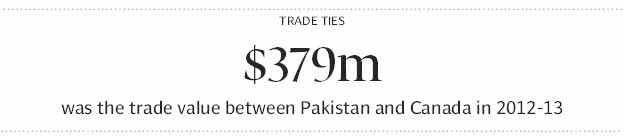
Trade volume between Pakistan and Canada stood at $379 million in 2012-13, of which Pakistan’s exports were $228 million against $225.80 million in 2011-12 and imports totalled $151 million against $365.10 million in 2011-12.
“The balance of trade remained in favour of Canada from 2006 to 2012. However in 2012-13, a drastic reduction in Pakistan’s imports turned the balance in favour of Pakistan,” Malik said. “This steep reduction was mainly driven by a decline in import of oilseeds, dried vegetables and coal

Catch-22: ‘Choking supply routes will affect thousands of traders’

"The US cannot be pressurised by such small moves, however, businessmen and thousands of families will definitely suffer," Pak-Afghan Transit Trade President Ziaul Haq Sarhadi. PHOTO: REUTERS/ FILE
PESHAWAR: 
The Pakistan Tehreek-e-Insaf (PTI) protest to halt Nato supplies saw tremendous support from the public on Saturday, but the situation turned from bad to worse for thousands associated with supplying or withdrawing goods from Afghanistan.
Around 20,000 to 25,000 vehicles are supplying goods to foreign troops in Afghanistan and are taking goods back to Karachi via Torkham in the withdrawal process, said Nato Vehicles Association (NVA) Khyber-Pakhtunkhwa (K-P) President Rafiullah Marwat.
Rafi said around 100,000 people are directly involved in this business in K-P and the Federally Administered Tribal Areas (FATA). The PTI’s stance to stop the supply lines would mean starvation for all these families, argued Rafi. He said it might not affect the US, however, it would prove lethal for Pakistan and its people.
Rafi added PTI and its allies are only politicising the matter to gather sympathies for upcoming local government elections. None of these parties – Pakistan Muslim League-Nawaz, Pakistan Peoples Party or PTI – can stop the supply lines because an agreement has been signed by the government of Pakistan, claimed the NVA K-P president.
If the federal government wants to pressurise the US, they should cancel the agreement at once and not halt supplies temporarily as this would not solve anything. “We condemn the drone attacks, but we are also in the business for the sake of our families.”
Rafi insisted the government should devise a policy to stop drones rather than politicising it through dual policies.
He argued the supply will not end up being stopped, but now everyone associated with this business would be targeted by militants. “If the K-P government can provide us all with alternate means of income, we will happily leave the supply business,” claimed Rafi.
K-P Dry Ports Standing Committee Chief and President of Pak-Afghan Joint Transit Trade, Ziaul Haq Sarhadi agreed halting the supply will not do the nation any good, but will badly impact the economy. The protests will prove even worse for transit trade; “No one knows which vehicles carry Nato supplies, and which are for transit trade.”
Sarhadi said the attacks on Nato vehicles, in which a large number of transit trade vehicles were also targeted, compelled traders to change their route. He claimed 80% of trade was now done via Iran, rather than the easier route of Torkham. The remaining 20% trade, which goes via Torkham, will now be in jeopardy, added Sarhadi.
He suggested the PTI should devise a policy to mark Nato containers so as to distinguish them from transit trade containers. Businessmen did not have money for insurance, nor were they economically stable enough to compensate for any losses they might incur, insisted the Pak-Afghan Transit Trade president.
About 200 transit trade trucks have been stuck at the dry port because of this issue, claimed Sarhadi. “The US cannot be pressurised by such small moves, however, businessmen and thousands of families will definitely suffer.