Sunday, 17 November 2013

Pennsylvania newspaper retracts 1863 criticism of Gettysburg Address

Abraham Lincoln
An 1865 portrait of Abraham Lincoln, the 16th US president. Photograph: Alexander Gardner/Bettmann/Corbis
As celebrations of the 150th anniversary of the Gettysburg Address begin around the US, a Pennsylvania newspaper has issued a retraction of its predecessor's criticism of Abraham Lincoln's speech.
Lincoln delivered the short address (of either 268 or 270 words, depending on which contemporary version is consulted) on 19 November 1863, at the dedication of a national cemetery for those killed in the battle of Gettysburg the previous July. On Tuesday 24 November 1863, the Harrisburg Patriot & Union published a lengthy editorial in which it lamented "the silly remarks of the President" and said: "… for the credit of the nation we are willing that the veil of oblivion shall be dropped over them and that they shall be no more repeated or thought of."
The Patriot & Union's descendant, the Patriot-News, retracted those remarks on Thursday, in an editorial cast to echo the words and tone of a speech which became a foundation stone of American democracy.
The Patriot-News's opinion editor, John Micek, told the Guardian: "Our panning of the Gettysburg Address has long been a part of the Patriot-News lore and always a bit of a nettle in our side, given our proximity to Gettysburg [about 30 miles away] and the huge place the battle has in the region's history. With the 150th anniversary of the address on Tuesday, the time seemed right to correct the record.
"But we also wanted to have some fun with it. We decided right away that it could not be any longer than the actual address and we wanted to echo its soaring language in a humorous way."
Matthew Zencey, the Patriot-News's deputy opinion editor, wrote the retraction, which will be included in Sunday's print edition of the paper. Zencey's retraction begins: "Seven score and ten years ago, the forefathers of this media institution brought forth to its audience a judgment so flawed, so tainted by hubris, so lacking in the perspective history would bring, that it cannot remain unaddressed in our archives."
"The work is all Matt's and it's genius," said Micek. "The response has been just amazing. News outlets from across the US and the world have been in touch. It's been a pretty great reminder of the power of journalism to touch people's lives and a vivid reminder of the justifiably important place President Lincoln's words occupy in our national consciousness."
Gettysburg addressAbraham Lincoln retakes his seat after delivering the Gettysburg Address. Photograph: Mathew B Brady/Bettmann/Corbis
Zencey concludes: "In the fullness of time, we have come to a different conclusion. No mere utterance, then or now, could do justice to the soaring heights of language Mr Lincoln reached that day. By today's words alone, we cannot exalt, we cannot hallow, we cannot venerate this sacred text, for a grateful nation long ago came to view those words with reverence, without guidance from this chagrined member of the mainstream media.
"The world will little note nor long remember our emendation of this institution's record – but we must do as conscience demands."
Among US commemorations of the 150th anniversary of the Gettysburg Address, the filmmaker Ken Burns, who made the landmark documentary series The Civil War, has filmed a number of public figures delivering the speech, including every living US president and the comedian Stephen Colbert.

If the rumours about Gore Vidal are true, what does this mean for his work?

Gore Vidal at 21
Gore Vidal aged 21. The writer stated in his memoir Palimpsest that he was 'attracted to adolescent males'. Photograph: Jerry Cooke/Time & Life Pictures/Getty Image
Aside from being an essayist, novelist and screenwriter, Gore Vidal was a grade-one gossip, his published writings and private conversation stuffed with rumour and conspiratorial hints. But now, less than 18 months after Vidal passed into history, he is himself subject to the most reputation-destructive scuttlebutt there is: the suggestion that he may have been a paedophile.
In connection with a new book about Vidal, his half-sister and a nephew have hinted that he may have had a secret passion for underage boys. And Vidal more or less admitted it himself, writing in his memoir Palimpsest that he was "attracted to adolescent males".
Given this context, an incident in 1977 will also now bring literary cops running. Martin Amis, interviewing Vidal for the Observer, was required to give him copy approval, and was asked to change Amis's description of "homosexual" to "pansexual". Vidal was prissily fastidious about the meaning of words and his suggested substitution can be taken as a confession that nothing and no one was erotically off-limits.
A sexual dirt file allegedly kept by one of Vidal's many enemies, the late conservative thinker William Buckley, is said to have been thrown away after Buckley's death, and so definitive proof will be tricky. It also seems odd that no one claiming to be a victim has come forward, especially as Vidal left an estate of $37m (£23m) – a possible source of ire from his relatives, as he bequeathed the lot to Harvard University, where he had never studied, rather than them.
It's possible, of course, that any young men involved would have had no idea that they were pleasuring the author of Myra Breckinridge and United States: Essays 1952-1992. Vidal spent much of his life abroad, living in Italy and taking regular vacations in Thailand, which must raise the possibility that, like many men with taboo sexual desires, he satisfied them in regions with looser laws.
But, even if definitive evidence of Vidal's pederasty were to emerge, it's unclear what our reaction should be. His defenders in the court of public opinion would cite the Richard Wagner precedent. We know that thecomposer was a virulent antisemite, whose work became the mood music of Nazism, but it is generally accepted that performers and audiences have a choice over whether this ideological toxicity invalidates his work: great Jewish musicians, including Daniel Barenboim, have concluded that it doesn't.
We must, though, be conscious of the risk of allowing artistic merit to excuse behaviour that would be condemned in the unknown or untalented. In the most testing contemporary example, the films ofRoman Polanski, a convicted rapist of an underage girl, continue to be shown to praise from critics, including me. And yet we know that, if Polanski were a children's TV presenter from the 1970s, networks here would not be cheerfully accepting new editions of Roman's Kiddie Funhouse, shot and edited in the foreign exile where he fled to escape to justice.
One possible mitigating difference between Vidal and the likes of Jimmy Savile is that it seems clear Savile used (and perhaps even pursued) his chosen profession in order to have access to potential victims, whereas it must be unlikely that Vidal, if guilty, lured his targets by inviting them to help with a New York Review of Books piece on Ambrose Bierce or Edith Wharton. So the work is not directly tainted in the way that it is with paedophile broadcasters or the artist Graham Ovenden, jailed last month for sexual offences against young girls who posed for his pictures.
And, if retrospectively proved encounters with underage males in foreign jurisdictions were to make a writer unpalatable, then there would be many gaps in the literary canon. For instance, Joe Orton's plays could never be performed again, as the diaries published after his death are explicit about why he found Tangiers in the 1960s such an agreeable location for vacations. And then there is the matter of Lewis Carroll, who, if photographing and writing today, would surely not have escaped the attentions of Operation Yewtree.
If Vidal's published sentences on his sexuality are as precise about words as he liked to be, then he almost certainly did have sexual interests or encounters we now consider unacceptable. But if his books were to be metaphorically or literally pulped because of this, then Polanski DVDs must be pulled from stores and productions of Alice in Wonderland banned. Faced with a "pansexual", culture must not become pan-hysterical.

Health insurers bemoan Obamacare 'fix' as adding confusion to rollout

US health insurance
Cinthia Orozco gets help signing up for health insurance from a healthcare specialist in Sacramento, California. Photograph: Rich Pedroncelli/AP
President Barack Obama was meeting top health insurers on Friday amid mounting concerns that the “fix” for his landmark health insurance plan had succeeded only in sowing more confusion.
The chief executives of insurance giants including Aetna, UnitedHealthcare and Wellpoint met Obama and senior aides a day after the president responded to a backlash over the Affordable Care Act (ACA) by announcing that insurers could continue offering policies that fall short of new standards for coverage. 
After millions of people with sub-standard plans started receiving cancellation notices, Obama admitted on Thursday he had “fumbled” the rollout of the healthcare reforms. The White House said insurers would be able to offer policyholders an extra year on plans that did not meet the ACA’s minimum standards. Previously people had until 15 December to find new policies that would cover them from the start of next year.
Insurers and state regulators are split on the move but all seem to agree that Obama’s volte face has further complicated the already troubled rollout. In a statement Aetna said: “We support efforts to allow people to keep what they have. However, we will need co-operation and expedited approval from state regulators to remove barriers that would make it difficult to make this change in such a short period of time. State regulators will need to allow us to update our policies and secure appropriate rates so we can get these plans back in the market.”
Insurers and some state officials are worried that the latest changes will further destabilise the implementation of Obamacare. In particular they worry that young people, who were the most likely to buy the cheap policies that do not meet the ACA’s standards, will have even less incentive to join the healthcare exchanges which are the centrepiece of the ACA.
The healthcare exchanges are an online marketplace where consumers can shop for health insurance. All 50 states will have their own marketplaces, some of which will be run by the federal government and some by individual states. If young, healthy people do not join the exchanges do not join, the pooled “risk” insured by the exchanges will rise and so will premiums.
“The entire underlying premise of the ACA – balancing costs of the young, old, sick and healthy – has been left adrift with this announcement,” said California Association of Health Plans president and CEO Patrick Johnston.
Jim Donelon, Louisiana’s insurance regulator and the president of the National Association of Insurance Commissioners said: “This decision continues different rules for different policies and threatens to undermine the new market, and may lead to higher premiums and market disruptions in 2014 and beyond.”
Donelon said he was particularly concerned about the way the reforms would impact premiums, the solvency of insurance companies, and the overall health of the marketplace. Allowing insurers to have different rules for different policies would be “detrimental to the overall market and result in higher premiums”, he said.
In addition he said it was unclear how the changes proposed by Obama could even be implemented. “In many states, cancellation notices have already gone out to policyholders and rates and plans have already been approved for 2014. Changing the rules through administrative action at this late date creates uncertainty and may not address the underlying issues,” he said.
Carl McDonald, insurance company analyst at Citigroup, wrote in a note to investors: “Extending all of the cancelled individual policies through 2014 may sound good in theory, but we believe it creates an enormous administrative burden for insurers. If this were happening back in June, it could theoretically be workable. However, the complexity of trying to un-cancel millions of cancelled individual policies with only six weeks left in the year is staggering. Insurers don’t have to extend the existing policies, but they now have the option. We suspect many insurers will choose not to avail themselves of this ‘opportunity’.” 
McDonald said the cancellation had left insurers with a lengthy “to-do list” and little time to do it. Among the issues insurers face they will now have to resubmit plans that were being cancelled for approval to state regulators. Before they can do that the insurers have to go back and calculate 2014 premium rates. In addition, insurers will have to reprogram computer systems in order to bring the cancelled policies back online. 
Obama’s announcement had little impact on the states that have already issued directives that allowed people to extend their existing insurance plans into 2014, including Arkansas and Utah.
But in other states the reaction has been more negative. California has the most successful state scheme. In November nearly 2,000 people a day enrolled for new coverage. “California needs to stay the course and transition people into the more comprehensive policies that meet the requirements of the Affordable Care Act,” said Johnston. The state has, however, allowed one million people who lost their insurance as a result of the implementation of the ACA to extend their policies into 2014.
Others are taking a harder line, including Washington state. Shortly after Obama announced his amnesty proposal, Washington state insurance commissioner Mike Kreidler said he would not allow insurance companies to extend policies in the state. 
“I understand that many people are upset by the notices they have recently received from their health plans and they may not need the new benefits today,” he said in a statement. “But I have serious concerns about how President Obama’s proposal would be implemented and more significantly, its potential impact on the overall stability of our health insurance market.”

Republicans attack president's 'phoney apology' over Obamacare rollout

Barack Obama
President Barack Obama looks sombre while speaking about his signature healthcare law earlier this week. Photograph: Charles Dharapak/AP
Obamacare once again dominated the Republican oppposition's weekly address on Saturday despite President Barack Obama's attempt to move the debate on to energy policy in his own address. While the presidentchose to discuss domestic oil production and energy efficiency, the GOP maintained its critical focus on his signature domestic reform, the Affordable Care Act. Senator Ron Johnson of Wisconsin, the sponsor of a Senate bill to let people keep their existing healthcare plans, called Obama's acknowledgement of a "fumble" over the rollout of his healthcare reforms a "phoney apology".
"It was like telling someone you're sorry their dog died, but refusing to acknowledge you ran over the dog," Johnson said. "Sorry Mr President, it didn't work. Millions of Americans are coming to realise that those are your tyre tracks on their cancelled policies."
Obama delivered his address a day after his administration announced lower quotas for the biofuel ethanol in gasoline, in a concession to the US oil industry. Obama said: "After years of talk about reducing our dependence on foreign oil, we are actually poised to control our own energy future."
By contrast, in his address, Johnson focused squarely on the problems of the president's healthcare reform. "We need long-term solutions to the Obamacare debacle," he said, "not short-term political fixes like those recently proposed by the president and Senate Democrats that simply will not work.
"Unfortunately, the implementation of Obamacare has progressed to a point where millions of cancelled plans cannot be reinstated. But the freedom of millions of Americans to keep doctors, treatments and health plans they do value can still be preserved if Congress acts swiftly and decisively."
This week has been another difficult one for the administration, in which the president offered a one-year extension to the more than 4 million people whose current health policies are being cancelled under the terms of the Affordable Care Act, a development which Republicans have repeatedly attacked.
Before the Obamacare rollout, which has been riddled with technical and political problems, the president repeatedly said that under the reforms, no one would lose their insurance plan if they wanted to keep it.
Johnson maintained the GOP's recent line of attack, saying such promises had been "fully vetted, coldly calculated and carefully crafted" by the administration.
"Those assurances weren't slight exaggerations or innocent shadings of the truth," he said. "It was a political fraud echoed relentlessly by House and Senate Democrats who should be held accountable for the disastrous consequences of their grand deception."
Obama has not addressed the issue of healthcare reforms in either of his last two Saturday addresses – last week he simply marked Veterans Day weekend.

FBI warns that Anonymous has hacked US government sites for a year

Anonymous
Campaigners say the Anonymous attacks were in retaliation for overzealous prosecution of hackers. Photograph: Alex Milan Tracy/Demotix/Corbis
Activist hackers linked to the collective known as Anonymous have secretly accessed US government computers and stolen sensitive information in a campaign that began almost a year ago, the FBI warned this week.
The hackers exploited a flaw in Adobe Systems Inc's software to launch a rash of electronic break-ins that began last December, the FBI said in a memo seen by Reuters, then left "back doors" to return to many of the machines as recently as last month.
The news comes a day after an Anonymous activist received a 10-year sentence for his role in releasing thousands of emails from the private intelligence firm Stratfor. On Friday Jeremy Hammond told a Manhattan court he had been directed by an FBI informant to break into the official websites of several governments around the world.
Hammond, who called his sentence a"vengeful, spiteful act", said of his prosecutors: "They have made it clear they are trying to send a message to others who come after me. A lot of it is because they got slapped around, they were embarrassed by Anonymous and they feel that they need to save face."
He also said the FBI had directed his attacks on foreign websites: "The government celebrates my conviction and imprisonment, hoping that it will close the door on the full story. I took responsibility for my actions, by pleading guilty, but when will the government be made to answer for its crimes?"
The FBI memo about the Adobe Systems attacks, which was distributed on Thursday, described the attacks as "a widespread problem that should be addressed". It said the breach affected the US army, Department of Energy, Department of Health and Human Services, and perhaps many more agencies.
Officials said the hacking was linked to the case of Lauri Love, a British resident indicted on 28 October for allegedly hacking into computers at the Department of Energy, army, Department of Health and Human Services, the US Sentencing Commission and elsewhere. Investigators believe the attacks began when Love and others took advantage of a security flaw in Adobe's ColdFusion software, which is used to build websites.
Investigators are still gathering information on the scope of the cyber campaign, which the authorities believe is continuing. The FBI document tells system administrators what to look for to determine if their systems are compromised.
An FBI spokeswoman declined to elaborate.
According to an internal email from Kevin Knobloch, chief of staff to the energy secretary, Ernest Moniz, the stolen data included personal information on at least 104,000 employees, contractors, family members and others associated with the Department of Energy, along with information on almost 2,0000 bank accounts. The email, dated 11 October, said officials were "very concerned" that the loss of the banking information could lead to thieving attempts.
An Adobe spokeswoman, Heather Edell, said she was not familiar with the FBI report. She added that the company has found that the majority of attacks involving its software have exploited programs that were not updated with the latest security patches.
The Anonymous group is a collective that conducts multiple hacking campaigns at any time, some with a few participants and some with hundreds. Its members have disrupted eBay Inc's PayPal after it stopped processing donations to the anti-secrecy site Wikileaks. Anonymous has also launched more sophisticated attacks against Sony Corp and the security firm HBGary Federal.
Some of the breaches and stolen data in the latest campaign had previously been publicised by people who identify with Anonymous, as part of what the group dubbed "Operation Last Resort". Among other things, the campaigners said the operation was in retaliation for overzealous prosecution of hackers, including the lengthy penalties sought for Aaron Swartz, a well-known computer programmer and internet activist who killed himself before a trial over charges that he illegally downloaded academic journal articles from a digital library known as JSTOR.
Despite the earlier disclosures, "the majority of the intrusions have not yet been made publicly known," the FBI wrote. "It is unknown exactly how many systems have been compromised, but it is a widespread problem that should be addressed."

Deflation could drag Ireland back into the eurozone crisis

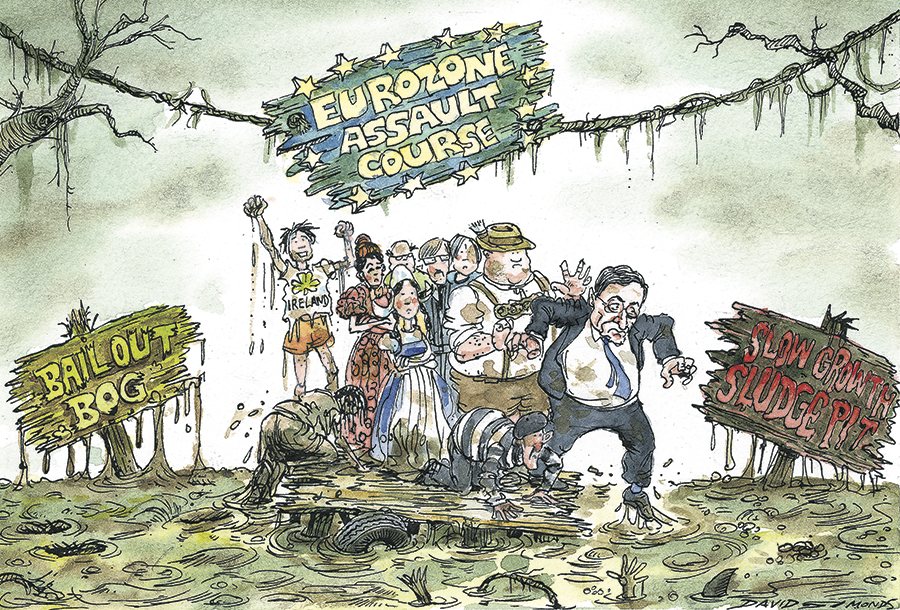
Cartoon by David Simonds, deflation threat to eurozone View larger picture
Click to enlarge. Photograph: Observer
For Ireland, it reads like a happy ending. Enda Kenny announced on Thursday that Dublin would make a clean break with its creditors next month, after a gruelling three-year economic fitness programme of tax rises, spending cuts and reforms.
Instead of requesting a precautionary credit line from the International Monetary Fund, to be triggered in the event of a future crisis – as most investors had expected – Ireland will kick out the hated "troika" of the IMF, the ECB and Brussels, and go it alone.
With Spain, too, signalling last week that it wouldn't need any more money from its eurozone partners to bail out its crippled banks, and Cyprus pledging to lift restrictions on cross-border capital flows that have been in place since its fumbled bailout last March, it would be tempting to think that the worst of the turmoil that has gripped the eurozone over recent years had come to a neat and tidy close, and that "normalcy", as Irish finance minister Michael Noonan calls it, had been restored.
Yet while Noonan was right to say that the eurozone currently looks quite tranquil – making it a good moment for Ireland to dip its toe back into the public debt markets, instead of relying on the troika to fund its deficits – last week brought a host of reminders that there may still be trouble ahead.
For one thing, the economic weather across the 17-member single currency bloc is deteriorating. While the 18-month eurozone recession came to an end in the second quarter of 2013, the latest data, published last week, showed GDP expanding by a paltry 0.1% in the third quarter, with the French economy recording a contraction.
Alongside that sluggish growth performance, there is an increasingly credible threat that the eurozone could slip into deflation: indeed, some of the hardest-hit peripheral economies are already there.
Across the eurozone as a whole, prices rose by a negligible 0.7% in the year to October. In Greece, they fell by almost 2%.
It was undoubtedly the fear of deflation that prompted Mario Draghi to cut European Central Bank interest rates to a record low earlier this month: it is most central bankers' worst nightmare.
If falling prices become entrenched, it can be extremely difficult to escape from a vicious cycle of declining profits, wages and growth – and unlike US Federal Reserve chairman Ben Bernanke, Draghi won't just be able to turn on the money taps and implement quantitative easing, as it's not clear the ECB even has the authority to do so – QE is certainly taboo in Germany, still haunted by memories of Weimar-era hyperinflation.
For debtors, of which there are many across the eurozone – households, companies and governments – deflation is particularly pernicious, as liabilities tend to be fixed, unlike the incomes from which they must somehow be paid. And when debtors get into trouble, so do banks – still the weakest link in the eurozone recovery story.
Meanwhile, the ECB is preparing to shine a light on banks' balance sheets through its asset quality review – and with negotiations about a eurozone-wide banking union still ongoing, no one quite knows what will happen if they find a black hole. Oh, and with the Federal Reserve contemplating withdrawing the $85bn-a-month of cheap money it has been pumping into world markets through QE, government bond yields worldwide – and thus their borrowing costs – are expected to drift higher over the next 12 months.
And just in case all that wasn't enough to fret about, Friday saw Brussels deliver its sinisterly named "fiscal surveillance package", part of the new co-ordination regime put in place in the wake of the crisis, which doled out homework to a whole list of countries. Spain and Italy were urged to revise their budgets or risk missing stringent debt targets; France was told to get its act together on structural reforms; and even Germany, which likes to see itself as a shining example to its eurozone neighbours, was criticised for ignoring the commission's calls for reform.
In other words, even if Dublin's politicians have made the right judgment and Ireland is fit enough to stand on its own, it could yet be sucked back into the mire by a eurozone-wide crisis not of its own making.

From On the Buses to on your bike

Forty-five years have passed since Reg Varney – aka Stan Butler in On the Buses – became the first person to withdraw cash from a hole-in-the-wall machine. It heralded a revolution in banking. No longer was cash accessible only from a teller sporting a rubber thimble between 9am and 3pm on weekdays and for a couple of hours on a Saturday morning. It was available 24/7. There have been other revolutions since – debit cards, telephone banking, call centres, which have all resulted in fewer high street banks and tellers. And now another is under way.
The proliferation and popularity of online banking means that an average customer now visits a branch just twice a month, while mobile banking services are used more than once every two days. A survey out on Friday showed that one in six of 18-to-30-year-olds had never stepped inside a bank branch.
So it is not exactly a shock that last week Barclays said it wanted 1,700 of its 33,600 branch staff to put their hands up for voluntary redundancy. That is just over one job going from every branch in the Barclays network. People are being replaced by iPads and smartphones: customers can sort out their bills and standing orders from their sofas. And even those who still venture inside branches are being encouraged to think digital, with iPads available for use there too. The labour and other costs of offering a retail banking service are, basically, being transferred to the customer.
There are other huge changes under way: customers can transfer cash directly to their friends in bars and restaurants with the Pingit app. The UK's three largest mobile phone networks, EE, Vodafone and O2, have joined forces to turn smartphones into virtual wallets. Shoppers will walk into a store, pick out a purchase, scan the barcode, and pay by tapping their phone on an Oyster-card-style reader, rather than at the till. There are even safety deposit boxes in the cloud.
Antony Jenkins, the Barclays boss, has been talking about automation ever since he took the top job a little over a year ago. Analysts believe he could slice 40,000 off the 140,000 workforce. It will be brutal. And it will be universal. Tellers could soon be history.

PPI scourge could do with a bank job

There was a bit of moaning when Natalie Ceeney was named chief financial ombudsman four years ago. What does this former director of the British Library know about the financial services industry, was the cry. She went on to treble the size of the Financial Ombudsman Service so it could tackle 500,000 cases a year – up from 150,000 – as it was swamped by complaints about mis-sold payment protection insurance. "The biggest clean-up in financial services history," is how she has described the scandal, refusing to heed the banks' whines that claims management firms are to blame for the high level of complaints. The banks are still cleaning up the PPI mess – and, knowing how the industry operates, we are no doubt not far away from another scandal. Now Ceeney has quit, those same banks might consider giving her a job sorting out their customer service operations.

Mark Carney hopes to perfect his balancing act if UK recovery continues

Bank of England Governor Mark Carney
Bank of England governor Mark Carney delivers the bank's quarterly inflation report last week. Photograph: Toby Melville/Reuters
''Unbalanced growth is better than no growth." This was not exactly what the Bank of England's governor Mark Carney said last week when delivering the Bank's quarterly inflation report. It was said by one of his illustrious predecessors, Eddie George, in a previous era. But that was Carney's hidden message, combined with a public expression of hope that growth in the British economy would indeed become more balanced.
The Bank is now confident enough to declare that a recovery is at last under way, but, for all the loud headlines about the timing of rises in interest rates, the true position of Bank officials is that they really do not know how sustainable this recovery will turn out to be.
The "forward guidance" initiated by Carney is that, provided inflation remains under control, there will be no need even to consider raising interest rates until unemployment, now calculated at 7.6% of the labour force, falls to 7%. Even then, the new governor goes out of his way to suggest that, for him, this would not necessarily mark a turning point.
He could hardly have been clearer at his press conference, although to listen to some commentators, you would think differently. He went out of his way to emphasise that there is "a substantial degree of slack" in the economy. What the Bank is really doing is seeing how it goes.
During the recovery phase after most postwar recessions, a growth rate of 3% to 4% was not unusual. This has been a recession – indeed, depression – to beat all previous postwar episodes, and output is still 2.5% below what it was in 2008, and some 17% below what it might have been by now if the historical trend had continued.
The economy appears, from recent data and surveys, to be growing at 2% a year. Unemployment is still far too high, and only time will tell how much spare industrial capacity there is to draw on. Although they don't know exactly how much capacity there is, Carney's use of the word "substantial" suggests to me that he may be nearer to the economic consultant Bill Martin's side of the debate – he calculates that there is plenty – than to the Office for Budget Responsibility, which is more dubious.
This matters because traditionally it is when the economy is operating at full capacity that inflationary tendencies manifest themselves – and, traditionally, the British economy is very good at manifesting inflationary tendencies.
While we are on the subject, I could not resist a wry smile last week when, amid all the concern about energy prices, the Office for National Statistics stated that one of the reasons for the "better than expected" monthly inflation figure was – wait for it – a fall in energy prices. I am not making this up.
But back to that unbalanced recovery. So far the driving force of rising consumer confidence and spending has been assisted by a resumption of borrowing and drawing on savings.
The Bank sees the recovery from now on becoming more balanced, with consumers spending out of income, and businesses investing more. Also it thinks the threat to our exports from the battered eurozone is less than it was. I wonder about this. My hunch is that the troubles of the eurozone are far from over, and could yet lead to disaster. This is not a wish, you understand: more of a fear.
Now we all know that real incomes have been badly squeezed. I hope I could be as confident as the Bank that they will suddenly become a driving force of recovery. But if they are right, then a recovery of around 2% a year could easily be sustainable.
What could wreck things is if the house-price boom that the chancellor is cynically encouraging produces the kind of bubble that Carney and co do not yet detect, and panic increases in interest rates become needed. One of the assumptions that lies behind forward guidance is the belief that micro measures (although they are officially called "macro-prudential") can control the property market and delay the need for any rise in rates.
So, we have a recovery of sorts, although Labour will rightly want the fruits to be more equally divided than in recent years. Meanwhile I have to take issue with certain writers on the Financial Times – not, I hasten to emphasise, Sir Samuel Brittan or Martin Wolf – who have been suggesting that we Keynesian critics, including shadow chancellor Ed Balls, did not want a recovery and have been proved wrong because there is now a recovery.
We all wanted a recovery. It is just that, although there were certainly other factors behind the depression, the recovery was seriously delayed by the introduction of austerity programmes all over Europe, and not least in the UK.