Sunday, 10 November 2013

Diplomatic debate: Pakistan opposes new members in UNSC

Masood Khan. PHOTO: NNI/FILE
UNITED NATIONS: 
The UN General Assembly concluded a two-day debate on Security Council reforms during which Pakistan opposed the creation of new permanent seats in the 15-member body.
“There should be no new centres of privilege,” Pakistan’s Ambassador to the UN Masood Khan told the 193-member assembly in the course of the debate in which some 80 delegations took part.
Quoting from Premier Nawaz Sharif’s address in the General Assembly, the Masood said, “We need a reform that carries the interests of all; not the ambitions of a few.”
The intended reform must plan for a dynamic future, not entrench or replicate historical patterns, based on prerogatives and privileges, he said. Pakistan, he said, would respect and understand Africa’s collective demand for the continent’s enhanced role in the Council, Masood added.
The Pakistani envoy said the group of four countries, G-4 (Brazil, India, Germany and Japan), who are pushing for permanent seats in the council, were trying to foist their position on the membership as an irreversible accomplishment.
“Their position is anchored in power politics. They seem to be saying that because of their political stature and economic prowess, they now qualify to have a special status at the UN, which the other UN members do not”.  Masood said the UfC has flexibility and was ready for negotiations.
Earlier, the G-4 complained during the debate in general assembly about the slow pace of reform in the UNSC.
The reform process started in 1993 but despite assurances from US, Britain and France, there has been no progress on the permanent seats.
The G-4, frustrated over the past setbacks, are mounting political pressure to force a decision that could coincide with the 70th anniversary of the UN falling in 2015.

Multibillion-dollar project: Progress on Iran pipeline project hinges on US talks


ISLAMABAD: 
Pakistan will press the United States to exempt the multibillion-dollar Iran-Pakistan (IP) pipeline project from sanctions during the revised strategic bilateral dialogue, which kicks off in Washington on November 12.
The $7.5-billion project has faced repeated delays since it was conceived in the 1990s to connect Iran’s giant South Pars gas field to consumers in Pakistan and India.
The Washington dialogue – which is a followup to Prime Minister Nawaz Sharif’s recent visit to the US – will focus on revising relations between the two countries, especially with regards to Pakistan’s energy needs.
The Pakistani delegation will be jointly led by Petroleum Minister Shahid Khaqan Abbasi and Power Minister Khwaja Asif.
Officials privy to the development told The Express Tribune that the delegation will raise the issue of possible US sanctions against the IP project because it is essential for meeting the country’s growing energy demands.
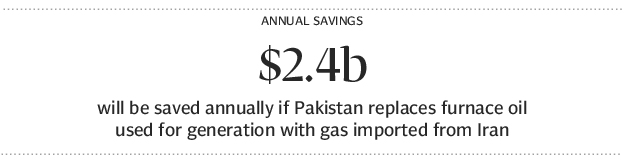
According to an analysis prepared by the petroleum ministry, replacing furnace oil used for power generation with gas imported from Iran will result in annual savings of $2.4 billion.
The officials said that progress on the IP project will depend on the outcome of the revised dialogue which would be the final round of deliberations on the issue.
The United States has steadfastly opposed Pakistani and Indian involvement in the project, saying it could violate sanctions imposed on Iran over nuclear activities Washington suspects are aimed at developing an atom bomb – a charge denied by Tehran.
Instead the US has been urging Pakistan to go for the Turkmenistan-Afghanistan-Pakistan-India (TAPI) project. US and European Union sanctions against Iran have also stalled progress on the IP pipeline since the country has not been able to import the technology needed to develop the South Pars gas field, the officials told The Express Tribune.
Meanwhile, the officials said that the Pakistani delegation will also discuss the possibility of striking a civil nuclear deal similar to the one the US has with India.
On the other hand, the US is expected to offer Liquefied Natural Gas (LNG) at cheaper rate in an attempt to discourage Pakistan from pursuing the IP project, according to sources.  Over the next few years, the US will emerge as a potential exporter of LNG after the discovery of shale gas reserves which have led to a decline in prices.

600,000 evacuated as typhoon nears Vietnam: Officials

An aerial view of the damage caused by Typhoon Haiyan. PHOTO: REUTERS
HANOI: More than 600,000 people were evacuated as super typhoon Haiyan bore down on Vietnam, authorities said Sunday, after the storm smashed through the Philippines leaving thousands feared dead and causing widespread devastation.
Residents of the Vietnamese capital Hanoi were braced for heavy rains and flooding, while tens of thousands of people in coastal areas were ordered to take shelter ahead of Haiyan’s expected landfall on Monday morning.
“We have evacuated more than 174,000 households, which is equivalent to more than 600,000 people,” an official report by Vietnam’s flood and storm control department said.
The storm is now expected to strike on Monday morning after changing course, prompting further mass evacuations of some 52,000 people in northern provinces by the coast, the VNExpress news site reported.
“People must bring enough food and necessities for three days… Those who do not move voluntarily will be forced,” the VNExpress report said, adding all boats have been ordered back to shore.
The Red Cross said in a statement Haiyan’s changed path meant the “the disaster area could be enlarged from nine provinces to as many as 15″, stretching the country’s resources.
“This is one of the challenges going ahead,” Michael Annear, Red Cross country representative, told AFP, adding that heavy rains and flooding were likely to hit Hanoi.
Reports on social media indicated many of the capital’s residents were rushing to markets to stock up on food and drinking water before the storm hit.
Many of the estimated 200,000 people evacuated in four south-central provinces initially thought to be in the storm’s path have been allowed to go back to their homes, according to a report on the government’s website.
Haiyan “is quickly moving north and northwest, travelling at a speed of up to 35 kilometres per hour”, the country’s weather bureau said in a statement.
The weather system – one of the most intense typhoons on record when it tore into the Philippines – has weakened over the South China Sea and is expected to hit as a category 1 storm, meteorologists added.
The typhoon’s epicentre is expected to make landfall around 7:00am local time on Monday, with winds of about 74 kilometres an hour.
At least four people were reportedly killed while preparing to escape the typhoon, disaster officials said.
By lunchtime on Sunday the typhoon had swept across Vietnam’s Con Co island, some 30 kilometres off the coast of central Quang Tri province, the Tuoi Tre newspaper reported.
“All 250 people on the island including residents and soldiers were evacuated to underground shelters where there is enough food for several days,” the report said, adding the storm brought three-metre waves.
Haiyan struck the Philippines on Friday with maximum sustained winds of 315 kilometres an hour, causing massive storm surges and cutting through entire towns.
The monster typhoon is believed to have killed more than 10,000 people in the Philippines and decimated vast areas of Tacloban, the capital of Leyte province, authorities there said.
Central Vietnam has recently been hit by two other typhoons – Wutip and Nari, both category one storms – which flooded roads, damaged sea dykes and tore the roofs off hundreds of thousands of houses.
At the time residents said Nari was the biggest typhoon since 2006, when Typhoon Xangsane barrelled through the region.

US Drone campaign: Senate panel approves beefed-up oversight

File photo of a drone. PHOTO: REUTERS
WASHINGTON: 
The US Senate Intelligence Committee has quietly approved a plan to step up both public and internal government oversight of the use of armed drones to kill suspected militants overseas.
The committee voted in closed session earlier this week to approve legislative language that would require US spy agencies to make public statistics on how many people were killed or injured in missile strikes launched from US-operated drones. The committee also approved language intended to bolster scrutiny of secret spy agency deliberations over decisions about targeting US citizens or residents for lethal drone strikes overseas.
The Obama administration has been under heavy pressure from foreign governments, the United Nations and human rights groups to be more transparent and rigorous in accounting for civilian casualties caused by drone strikes.
Though the committee did not release full details of its deliberations on the measures, sources familiar with the discussions said some committee Republicans were opposed to the drone-related clauses in the bill, which would authorise intelligence activities for the current government fiscal year which began on Oct. 1.
Ultimately, according to a press release issued by Senator Dianne Feinstein, the Democrat who chairs the intelligence panel, the committee approved the bill by a vote of 13-2. The two senators who voted against it were Republicans, a congressional source said.
The press release makes no mention of the language in the bill about drones. An official familiar with the matter said this was because some Republicans argued that, since drone attacks are officially covert actions by the US government, it would be inappropriate to set rules for such operations in a public law.
The bill approved by the committee now must go before the full Senate. The House of Representatives would also have to approve the bill, and the president will have to sign it, for it to become law.
If the language approved by the committee becomes law, once a year the president would be obliged to issue a report setting out the total number of combatants as well as the number of ‘non-combatant civilians’ killed or injured in US drone strikes abroad.
Exempted from the report would be any drone strikes that were launched in Afghanistan before the end of US combat operations there and any drone strikes conducted in a war explicitly authorised by Congress.
An official familiar with the matter said that Feinstein had been trying, unsuccessfully, to persuade the Obama administration to release such information voluntarily.
Administration officials have maintained privately that the numbers of non-combatant civilians killed or injured in US drone strikes against militants have been relatively minimal – in the low dozens. By contrast, respected human rights groups have produced much larger totals

Saudi MERS death toll reaches 53: Ministry

Like SARS, MERS appears to cause a lung infection, with patients suffering from a temperature, cough and breathing difficulty. PHOTO: FILE
RIYADH: Saudi health authorities announced on Sunday a new death caused by MERS, bringing to 53 the number of fatalities in the kingdom by the coronavirus.
The health ministry gave no details on the latest death in the country most affected by the disease that first appeared in the Gulf state in September 2012.
The Middle East Respiratory Syndrome Coronavirus (MERS-CoV) has so far cost 64 lives worldwide, according to a November 4 update by the World Health Organisation (WHO).
Experts are struggling to understand MERS, for which there is no vaccine.
It is considered a deadlier but less-transmissible cousin of the SARS virus that erupted in Asia in 2003 and infected 8,273 people, nine percent of whom died.
Like SARS, MERS appears to cause a lung infection, with patients suffering from a temperature, cough and breathing difficulty.
But it differs in that it also causes rapid kidney failure and the extremely high death rate has caused serious concern.
In August, researchers pointed to Arabian camels as possible hosts of the virus.

Kerry says world powers closer to nuclear deal with Iran

US Secretary of State John Kerry. PHOTO: REUTERS
GENEVA: US Secretary of State John Kerry said on Sunday that world powers had moved closer toward a deal during negotiations with Iran on reining in Tehran’s nuclear programme and that “with good work” the goal could be reached.
Kerry made the statement at a news conference after a three-day meeting between Iran and the six powers – the United States, France, Germany, Russia, China and Britain – that ended without an agreement. Both sides, however, said progress had been made and negotiators would meet again on Nov. 20.
Kerry said differences had been narrowed during the talks in Geneva, which were aimed at securing an agreement that would curb parts of Iran’s atomic activities in exchange for limited sanctions relief.
“Over the last two days a significant amount of progress was made,” Kerry said.
“There is no question in my mind that we are closer now as we leave Geneva than we were when we came, and that with good work and good faith over the course of the next weeks we can in fact secure our goal,” he said.
But he also cautioned that the window for diplomacy “does not stay open indefinitely”.
Both the United States and Israel have refused to rule out possible military action against Iran if diplomacy fails to resolve the decade-old nuclear dispute. Iran rejects Western accusations that it is seeking the capability to develop nuclear weapons.

A well-deserved policy win

GSP Plus status is expected to result in improved trade flows and thus support the creation of up to one million new jobs.. PHOTO: FILE
It was one of the least known positive aspects of the previous PPP administration, but the government’s decision to impose a moratorium on the death penalty appears to have not gone unnoticed in Brussels. The civilian part of Pakistan’s government, at least, appears to have won just enough praise for its human rights record that the European Union has decided to offer the country the Generalised System of Preferences (GSP) Plus status, a designation that will offer Pakistani exporters expanded access to European markets. The new status is welcome on multiple fronts. It is expected to result in improved trade flows and thus support the creation of up to one million new jobs. And, perhaps more importantly, it is a reflection of the progress that the country has made in moving from authoritarianism to democracy.
That the GSP Plus status took nearly a decade and a half to achieve, and that it could easily have been attained much earlier, is a subject for another day. For now, the government can rightly celebrate an achievement that will allow Pakistan to further expand trade with the European Union, already the nation’s largest trade partner and one with which we currently run a large trade surplus. But while this success is an important milestone, the challenge for the Nawaz Administration now will be to maintain momentum, a task that will not be easy. The prime minister’s trip abroad was supposed to have heralded a new foreign policy focus on trade and investment, but instead was hijacked by conversations about drones and terrorism. Having a clear terrorism policy should help move Pakistan’s foreign policy agenda in the right direction. Prime Minister Sharif has frequently talked about trying to make Pakistan into one of the most dynamic economies in Asia. We applaud his effort to try to make that happen, but we wish he would also realise that his reticence to confront the most regressive elements of the political spectrum is a large part of what is holding back the country from achieving that goal.