Wednesday, 6 November 2013

Tens of billions of planets out there are like Earth, study finds

Well, based on sheer numbers, there may be a planet just for you.
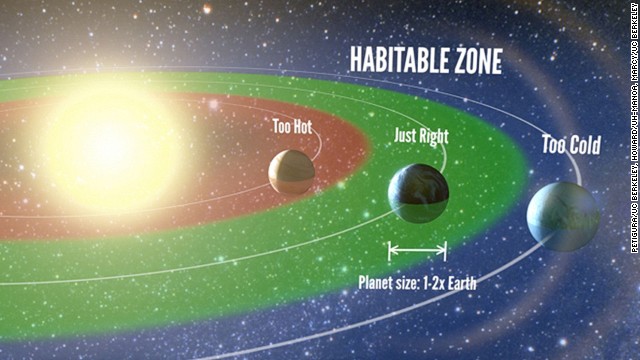
Astronomers at the University of California-Berkeley and the University of Hawaii, using data from NASA's Kepler space telescope, estimate there are tens of billions of Earth-size, possibly habitable planets in our Milky Way galaxy.
Given that there just more than 7 billion of us on this planet, that means a planet for each of us with some spares for your picky neighbors. Or a vacation planet or two for you, maybe.
And the closest may be circling a star you can see if you look up into the heavens tonight.
"When you look up at the thousands of stars in the night sky, the nearest sun-like star with an Earth-size planet in its habitable zone is probably only 12 light years away and can be seen with the naked eye. That is amazing," UC Berkeley graduate student Erik Petigura, the leader of the team that analyzed data from the Kepler, said in a press release.
To be sure, the astronomers haven't seen any of the planets themselves. They came to their conclusions like this:
Photos: Where life might live beyond EarthPhotos: Where life might live beyond Earth
The Kepler telescope photographed 150,000 of the 300 billion stars in the Milky Way every 30 minutes for four years. It looked for when orbiting planets passed between the camera and the star, causing a slight change in brightness of that star. Analyzing the data, the astronomers say, they found 3,000 planet candidates.
The astronomers narrowed that number by focusing on just 42,000 stars like our sun or a bit cooler. That brought the number of planets down to 603. But only 10 of those were about the size of Earth in the so-called "Goldilocks zone," just the right distance from the star where temperatures are suitable for life as we know it.
So how did they get a number of planets in the billions? By using a computer model with fake planets to test the validity of the algorithms used in the calculations.
"What we're doing is taking a census of extrasolar planets, but we can't knock on every door. Only after injecting these fake planets and measuring how many we actually found could we really pin down the number of real planets that we missed," Petigura said in the press release.
Using the data, the astronomers calculated that 22% of stars in the Milky Way similar to our sun have planets like Earth in their "Goldilocks zone." As there are about 20 billion stars similar to the sun in the galaxy, the possibilities add up quickly -- more than one for each of us Earthlings.
The researchers do caution, though, that despite being in the habitable zone, a planet could still not be right to host life.
"Some may have thick atmospheres, making it so hot at the surface that DNA-like molecules would not survive. Others may have rocky surfaces that could harbor liquid water suitable for living organisms. We don't know what range of planet types and their environments are suitable for life," Geoffrey Marcy, UC Berkeley professor of astronomy, said in a press release.
But the study gives researchers a number to work with.
"The primary goal of the Kepler mission was to answer the question: When you look up in the night sky, what fraction of the stars that you see have Earth-size planets at lukewarm temperatures so that water would not be frozen into ice or vaporized into steam, but remain a liquid, because liquid water is now understood to be the prerequisite for life," Marcy said. "Until now, no one knew exactly how common potentially habitable planets were around Sun-like stars in the galaxy."
The new study is published in the Proceedings of the National Academy of Sciences and was discussed this week at the second Kepler Science Conference, being held at NASA's Ames Research Center in Moffett Field, California.

Also at the gathering, scientists announced the Kepler telescope has found 833 new candidate planets, including 10 that are of the right size and right distance from their stars to host life, adding to ones previously confirmed. That brings the official list to 3,538 planet candidates found using Kepler, according to a NASA press release. Of those, smaller Earth-sized planets are most common, NASA said.

BOX OFFICE: Top 15 Openers; ‘Krrish 3′ At No. 7

KrrishBONew
MUMBAI: ‘Krrish 3′ – the superhero arrived, on the auspicious day of Dhanteras. While the entire country geared up for 5 days of festivity and celebration, the Roshan camp too has something to celebrate about.
Directed by Rakesh Roshan, ‘Krrish 3′ starring Hrithik RoshanPriyanka ChopraKangana Ranaut and Vivek Oberoi had a very good Day 1 at the Box office.
The film collected approximately Rs 190 million (Rs 19 crore) net (Hindi only) on opening day. This puts the film seventh in the list of All Time top opening days.
1. Chennai Express (2013) – Rs 330 million (Rs 33 crore)
2. Ek Tha Tiger (2012) – Rs 320 million (Rs 32 crore)
3. Agneepath (2012) – Rs 217 million (Rs 21.70 crore)
4. Dabangg 2 (2012) – Rs 210 million (Rs 21 crore)
5. Bodyguard (2011) – Rs 210 million (Rs 21 crore)
6. Yeh Jawani Jai Deewani (2013) – Rs 197.5 million (Rs 19.75 crore)
7. Krrish 3 (2013) – Rs 190 million (Rs 19 crore)
8. Besharam (2013) – Rs 189 million (Rs 18.9 crore)
9. Jab Tak Hai Jaan (2012) – Rs 152.5 million (Rs 15.25 crore)
10. Rowdy Rathore (2012) – Rs 152.5 million (Rs 15.25 crore)
11. Race 2 (2013) – Rs 150 million (Rs 15 crore)
12. Ra.One (2011) – Rs 147 million (Rs 14.70 crore)
13. Dabangg (2010) – Rs 145 million (Rs 14.50 crore)
14. Housefull 2 (2012) – Rs 137.5 million (Rs 13.75 crore)
15. Don 2 (2011) – Rs 135 million (Rs 13.5 crore)
With a long weekend looming ahead, and the history of Diwali releases doing well at the box office, the film looks poised to perform fantastically.

Bad news for BVB fans:Robert Lewandowski has confirmed he has decided who he will join in the summer:

Robert-Lewandowski-celebrates-after-scoring-f_3018635.jpg?20131013173304
Borussia Dortmund star Robert Lewandowski has confirmed that he has decided who he will be playing for next season.

The Polish star has long been linked to Bayern Munich and he is widely expected to move to the Allianz Arena next summer.

Last month, Lewandowski stated he still has a desire to play in England and that he was yet to choose his next club, but he now says that his decision has been made.

"I will reveal my future next year. No one needs to get in touch with me anymore," he told Sport-BILD weekly.

"I have decided what I am to do. I simply want to have a new challenge next season, despite the fact I am feeling very, very happy being at Borussia Dortmund."

The 25-year-old joined Borussia in 2010, but he is out of contract at the end of the season, meaning he is able to leave on a free transfer in the summer.

Casillas still has it

Casillas still has it
Iker Casillas' lack of activity in la Liga, as decreed by his coach, Carlo Ancelotti, did not show in Turin in the game against Juventus. The Champions League gave us a glimpse of a perfectly charismatic and agile goalkeeper. It is true that he conceded goals, but looking at the actions, Madrid's goalkeeper comes out very well.
He correctly guessed the direction of Arturo Vidal's shot in the penalty, but the Chilean launched the kick with a lift that made it impossible for Casillas to stop. The second was a close-range shot, with Llorente only a metre from the goal following Varane's failure to mark him.
Casillas left the Juventus stadium having made seven saves. The most memorable were those attempts made by Tevez (2), Marchisio (2) and Pogba.

New Sony 3D beamer en-route to Asia

(Credit: Sony)
If you are still not ready for an ultra high-definition home theater projector, perhaps the new VPL-HW55ES may be a more attractive option. Based on Sony's proprietary SXRD display technology and with a native full-HD resolution, this beamer can output a high 120,000:1 dynamic contrast ratio and 1,700 lumens to reproduce richer and brighter visuals.
With 1.6x optical zoom and wide lens shift support, the VPL-HW55ES is also much easier to install than its DLP counterparts. Other key highlights include active 3D technology and dual HDMI inputs. Meanwhile, an optional wireless HDMI adapter is also available. The Sony VPL-HW55ES will be launched in Asia Pacific this month, but pricing hasn't been announced yet

Lenovo Yoga Tablet 8 (MediaTek MT8389; 8-inch display; 3G)

Lenovo attempts to leverage its Yoga brand with new 8- and 10-inch Android 4.2.2 tablets. The tablets hit stores on Wednesday at US$249 for the 8-incher and US$299 for the 10.
Though aesthetically unique, the tablets' specs prove less than exciting. The Lenovo Yoga Tablet 8 and Tablet 10 feature quad-core 1.2GHz MT8125 Mediatek CPUs. MediaTek isn't known for making powerful tablet processors, and although I've yet to delve deeply into this one's capabilities, based on past performance, I'll be keeping my expectations low.
The tablet designs are also reminiscent of the Sony Tablet S and Xperia Tablet S with a cylindrical edge at one end.
Lenovo says it also moved most of the tablet's heavier internal components to the cylinder side of the tablet, giving it better balance and encouraging users to hold it by the cylinder where it's easier and more comfortable to hang onto.
The metal kickstand remains hidden until it's time to use it.
(Credit: James Martin/CNET)
The tablets do feel well-balanced and light when held this way -- especially true with the lighter 8-incher -- and the cylinder gives your hands something smooth and easy to grip.
There's an aluminum kickstand that allows you to stand the tablets up or lay them down at an angle, making them more comfortable to type on. The back is polycarbonate, and overall the tablets feel pretty well-built
The Yoga Tablet's refreshing take on a power button.
(Credit: James Martin/CNET)
The power button is large and easy to find, but also flush to reduce the chance you'll accidentally press it.
There's a Micro-USB port for charging, a 1.6-megapixel front camera, and a 5-megapixel back camera. Also included are a microSD storage expansion slot, a headphone jack, and a volume rocker.
Both tablets feature thin profiles and are pretty light.
(Credit: James Martin/CNET)
The 1,280x800-pixel-resolution screens are backed by IPS panels and are frankly low by today's standards, especially on the 10-incher. We've moved on to expect at least 1,920x1,200 resolutions, even on smaller tablets. That said, while the Tablet 10 looked dismal compared with most tablets on the market, the Tablet 8 was fairly sharp.
The Dolby Digital plus DS1 front-facing speakers sounded fine after only listening for a brief time, so it still remains to be seen if they're truly anything special.
Lenovo makes a big deal about the Dolby Digital front-facing speakers, but it remains to be seen if they hold up under scrutiny.
(Credit: James Martin/CNET)
Lenovo says the batteries in each tablet should last 50 percent longer than any other tablet on the market, which is saying something, as tablets on the market can last up to 13 hours.
Lenovo outfitted the Yoga Tablets with batteries usually intended for laptops -- 6000mAh for the 8-inch and 9,000mAh for the 10-incher -- so it'll be interesting to see how long they actually last.
The Yoga Tablet's US$70 keyboard accessory.
(Credit: James Martin/CNET)
And in order to further differentiate the tablets from others, Lenovo's added a media shortcut menu, called Smart Bar, that pretty much does just what you'd imagine a media shortcut button does: allow you to shortcut directly to your stored videos and music.
Also, expect accessories including a US$70 keyboard dock and a US$30 cover case that comes in four different colors for each tablet.
The Yoga Tablet 8 ships for US$249 with 16GB of storage, and the 10-inch costs US$299 for 16GB of storage.
It's difficult to muster much excitement for these tablets. Each seems to have plenty of useful features, and the design is unique and seems thoughtful, but it's the underwhelming screen resolution and inclusion of a MediaTek CPU that can only inspire indifference in me. I hope to be pleasantly surprised after we've spent some extended amounts of time with these new tablets. Look for full reviews of each tablet soon.

China Mobile expands 4G pilot program to Beijing

The Sony Xperia M35t is a China-only phone that works with the country's TD-LTE network.
(Credit: Sony)
The Chinese government has yet to issue 4G licenses to the country's telcom operators, but China Mobile has jumped the gun and announced the expansion of its "experimental" 4G program in the country's capital city, Beijing.
While the Chinese Ministry of Industry and Information hinted in March that 4G licenses would be issued in China before December 31, China Mobile, on Wednesday, has already started selling its first two TD-LTE compatible smartphone models. These include the Sony Xperia SP M35t and Samsung Galaxy Note 2, both exclusive to Beijing customers.
China Mobile assured existing China Mobile customers will not be required to change their phone numbers, though existing SIM cards will need to be replaced. At the same time, the 4G connection will be limited to an area within the Third Ring Road (Beijing is encircled by six ring roads) and specific locations including Tsinghua University, the Beijing China World Trade Center, and the city's Central Business District.
Amid a rare decline in quarterly profits of 8.8 percent in Q3, attributed to increasing competition from OTT apps including WeChat, and China Mobile's US$7 billion investment funneled into building the operator's 4G infrastructure, analysts have pinned China Mobile's soon-to-be-approved TD-LTE network to be the answer to its financial woes.
For now, smartphone manufacturers including Samsung, ZTE, Huawei, and Sony, have been awarded 4G permits to sell 4G handsets in China .
However, the news that China Mobile subscribers have been looking forward to is the highly anticipated 4G partnership with Apple to begin the sale of the iPhone 5S and 5C through China Mobile.
Till now, the iPhone and China Mobile's current TD-SCDMA network are not compatible. But a listing on the Web site of Tenaa (China's equivalent of the FCC) suggested that both smartphone models will support TD-LTE and TD-SCDMA. China Mobile has added fuel to the flames with an ad promoting 4G on the company's Web site, and leaked posters scattered around the country (although the authenticity of the posters have not been verified). Then there's a job posting published by Apple explicitly looking for a China Mobile specialist engineer.
These factors could mean 700 million China Mobile subscribers are that much closer to getting their hands on a 4G iPhone, among other 4G smartphones.