Sunday, 3 November 2013

Cultural exchange: Swiss cheese, chocolates centre of attraction

Families, especially children, enjoyed their food in the shade on a grassy knoll near the food stalls. PHOTO: WAQAS NAEEM/EXPRESS
Families, especially children, enjoyed their food in the shade on a grassy knoll near the food stalls. PHOTO: WAQAS NAEEM/EXPRESSFamilies, especially children, enjoyed their food in the shade on a grassy knoll near the food stalls. PHOTO: WAQAS NAEEM/EXPRESS
ISLAMABAD: 
The aroma of melted Swiss cheese, wafting through the air at the Swiss Embassy on Saturday, did not just excite the taste buds. It also appeared to accentuate the happiness and spirit of generosity which seemed aplenty at the Swiss Food Festival 2013.
With the festival, the Embassy of Switzerland in Islamabad continued its annual tradition of bringing authentic Swiss food and internationally renowned Swiss products to the federal capital.
Ambassador of Switzerland to Pakistan Christoph Bubb said food is an important part of cultural exchange.
“The food festival offers a unique opportunity for Pakistanis and expatriates to meet and learn about each other’s traditions,” the ambassador said.
Switzerland is famous worldwide for its dairy products and chocolates and, among the Swiss delicacies on offer at the festival, the stall serving Raclette — melted cheese with potatoes and pickles — saw the longest queue.
“The cheese is warmed so it melts and becomes creamy,” explained Laurent Gross, who works at the Swiss Agency for Development and Cooperation and supervised the Raclette stall. “It’s from Valais province in Switzerland, my hometown.”
Raclette got its name because of the manner in which it is served. The name of the cheese, Gross said, is derived from the French word racler which means to scrape off.
At the festival, Gross and his fellow servers warmed halves of cheese wheels in a device called a “Raclette oven” and then simply scraped off the melted cheese from the unmelted part with a knife, pouring it on boiled potatoes. Gross also proudly presented a “charcoal Raclette oven” which he said was the only one in the world, since he had designed and built it himself.
Other food items available at the festival included sausages, cheese cakes and several desserts. People were also seen buying varieties of packaged Swiss cheeses, chocolates, Buendnerfleisch — a kind of dried beef — and products such as Swiss army knives and mugs from different stalls. A lucky draw was also held during the event with Swiss watches and airline tickets being some of the top prizes.
An estimated 1,000 people, including guests from the business community, government officials, representatives from Islamabad’s civil society and members of the diplomatic community, attended the festival, which began in the morning and went on till the late afternoon.
Families, especially children, enjoyed their food in the shade on a grassy knoll near the food stalls and a kid’s corner offered activities such as face painting to keep the kids busy.
The sunny November afternoon provided an almost picnic-like setting for the food festival.
“It’s a very pleasant afternoon and everything at the festival is great,” Nari Suleman Khan, the wife of the Swiss Honourary Consul General in Lahore, said.
While Khan said she thought the cheese cake was “out of this world,” Harris Shafique said he loved the carrot cake.
Shafique, who works with New Era Watches, a dealer of the Swiss Omega watches in Pakistan, said he had visited Switzerland and was all praise for the Swiss.
Bubb said the proceeds from the festival would go to the Mashal Model School, a charity educational institute that educates underprivileged children near the Bari Imam shrine.
“We want to contribute in our modest manner to the work of the school’s laudable cause,” he said.
From the crowd’s response, it seemed the festival was on its way to raising a generous donation for the school. By 2pm, Marianne Baumeyer at the stall selling Swiss army knives said around 120 knives and most of the 200 mugs had already been sold.

Property: Real estate market in Lahore undergoes correction

Due to the depreciation of the rupee against the dollar and the resultant drop in costs, foreign investors have also purchased property in Pakistan.
LAHORE: After reaching new highs, the real estate market of Lahore has remained stagnant for the last couple of months. It is now going through a correction phase, tweaking down the prices by up to Rs2.5 million for plots in Defence Housing Authority (DHA).
Since DHA properties are the engine of the real estate sector in Lahore, changes in prices there affects prices in other areas too. Investors were waiting for this correction, terming it a positive sign for the real estate market.
Though the stagnation period is taking longer than expected, with minor fluctuations in between, experts are confident of a sharp recovery once the land deals, which have been stalled midway, are settled.
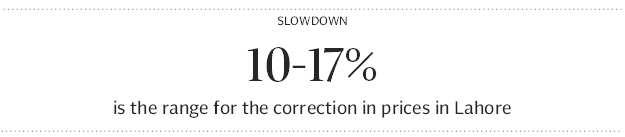
Property prices, primarily in phase six and seven, have already been slashed by up to Rs1.5 million on average, though the correction roughly ranges between 10-17% depending on the prices in different phases.
Property prices in phase six, for instance, were around Rs18.5 million at their peak, whereas phase seven saw prices as high as Rs13 million.
In areas where property prices are low, like phase nine where prices are below Rs5 million, will be connected to the main city through infrastructure investments, and investors are hopeful for a sharp increase in such areas.
The prices of real estate in other popular societies, like Bahria Town and Johar Town, are also stagnant, and are expected to gain momentum once DHA clears stalled property deals, reviving the process.
The depreciation of the rupee against the dollar has also contributed towards a boom in the market. Owing to the resultant drop in costs, foreign investors have also purchased property in Pakistan, though their share in the total is still small.
“If a foreign investor is investing in Pakistani market, after exchanging the currency let’s suppose at Rs100 per dollar, and making a profit and clearing the transaction he will want to buy back the dollars at the same rate,” said Ramzan Sheikh, Chairman of Mainland Husnain Limited, a construction company, while talking to The Express Tribune.
Since the rupee is relatively stable now, foreign investors are cautious as the currency could strengthen now, in which case their profits will be hurt.
However, the fluctuating exchange rate has also hurt property development firms who import most of the material required for their development schemes. This is also playing a role in stagnation of the real estate market, as companies put development schemes on hold. However, a majority of the private investors are now relying heavily on this sector, making it unlikely for the market to be stagnant for too long.

Looking ahead: Textile industry optimistic about growth prospects

While the standard GSP allows 176 developing countries and territories to enjoy easy access to EU markets, the upcoming GSP Plus will be limited to 89. PHOTO: FILE
KARACHI: 
The textile industry has seen a strong growth in recent months but most industry players are pinning their hopes on the expected approval of European Union’s (EU) Generalised System of Preferences (GSP) Plus status for Pakistan in January 2014.
For them, the GSP Plus is a game changer for the Pakistani textile industry, as it is expected to boost annual exports by $1 billion.
“Textile exports have increased by 4% in the first three months of fiscal year 2013-14 but this increase is below our expectations. What is more important for us is the expected grant of GSP Plus status by the EU. If we get that, our textile exports will jump by at least $1 billion a year,” All Pakistan Textile Mills Association (Aptma) Chairman Yasin Siddik told The Express Tribune.
Textile exports in September 2013 sharply increased by 16% compared to August 2013. Overall textile exports in the first three months (July to September) of 2013-14 jumped to $3.58 billion, up a significant 9% year-on-year (YoY) and a decent 4% quarter-on-quarter (QoQ).
“I am hoping to see more growth in exports in the ongoing quarter (October to December),” said Siddik, who believes that exports of both value added and non-value added products would see a decent rise in coming months.
Siddik added that textile exports must increase by at least $1 billion in case Pakistan wins the GSP Plus trade preference facility.
Analysts believe that the increase in textile exports is mainly aided by stable cotton prices – a key raw material – and depreciating rupee against the dollar over the last few months.
Any increase in cotton prices, they say, will increase profit margins of textile companies, especially in the second half of fiscal year 2013-14.
Analysts also stress that textile exporters that have higher share of finished or value added products will benefit more if Pakistan gets the GSP Plus status.
“Whatever increase we see in textile exports in coming months, it will never be comparable to the jump that we may enjoy after GSP Plus,” said Gul Ahmed Textile Mills Executive Director Ziad Bashir.
“Exports are expected to sustain themselves in the ongoing quarter but I do not think they will increase significantly,” added Bashir.
Pakistan has assured the EU that it is going to implement most of the international conventions required to qualify for the GSP Plus. Most importantly, Pakistan has told the Europeans that it will continue the moratorium on capital punishment – one of the most important EU demands before granting the GSP Plus facility.
GSP Plus is a trade arrangement that allows exporters from developing countries to pay lower or no duties on their exports to the EU.
Countries that want to get GSP Plus need to effectively implement as many as 27 international conventions on environment issues, good governance, labour rights and human rights.
While the standard GSP – which will stay in force until the end of 2013 – allows 176 developing countries and territories to enjoy easy access to EU markets through various duty reductions for certain product lines, the upcoming GSP Plus will be limited to 89 low and lower middle-income countries.
Since many of the countries that enjoy the GSP status are not expected to fall in the GSP Plus group, Pakistan would be in a position to export more of its products to the EU on low duties.

Did you know?: Mallika Sherawat washes her hair with mineral water!

Despite staying at a five-star hotel, Mallika demanded containers of mineral water to wash her hair. PHOTO:FILE
We have all read about starry tantrums by female leads but this one beats any other. Actor Mallika Sherawat, who is currently being seen on her reality TV show The Bachelorette India, seems to be bugging the makers with unreasonable demands.
According to the Times of India, even though Mallika was staying at a posh five-star hotel in the Indian city of Udaipur, she doubted the quality of water at the hotel. She said that the water was making her hair dry. Hence, in order to nourish her tresses, she demanded containers of mineral water!
However, this isn’t the first time that the controversial actor has made a peculiar demand. In fact, she is known to make unreasonable requests during film shoots and otherwise. For example, while promoting a reality show, the actor had demanded that she should only be given alphonso mangoes. Also during the shooting of her film Kismat Love Paisa Dilli with Vivek Oberoi last year, she insisted that six members of the staff should be allowed to travel in business class with her!
Royalty, much?

New taxes: Govt favours consultation with businessmen on property tax

No new tax to be introduced without keeping businessmen in the loop, official. CREATIVE COMMONS
FAISALABAD: 
Director General Punjab Excise and Taxation Department, Nasim Sadiq, informed members of the Faisalabad Chamber of Commerce and Industry (FCCI) on Saturday that no new property tax will be imposed without consultation with the business community, asking the FCCI to forward its proposals on proposed property taxes and valuation tables within a week.
He told the audience that he had been in close contact with businessmen in Faisalabad during his tenure at the District Coordination Office. He appreciated the social capital invested by businessmen, which he called a worthy example and a role model for the country.
He said during his tenure, approximately Rs8 billion was spent on development projects in the city, out of which Rs5 billion was contributed by the business community of Faisalabad.
He said Punjab Chief Minister Mian Shahbaz Sharif has instructed everyone to resolve all problems with regard to property taxation amicably. He assured the businessmen of consulting them during the decision-making process pertaining to new taxes.
He said that he is fully aware of the deteriorating condition of business in Faisalabad due to gas and electricity shortages.
While presenting his welcome address, FCCI President Engineer Suhail bin Rashid said that Faisalabad is the third industrial hub and second largest revenue generator in the country. He said that proposed tax rates for immovable properties are not acceptable to the business community.
He said that the declaration of valuation tables was not based on ground realities, stating that Faisalabad could not be classified in Category ‘A’ along with cities like Lahore. He said that the proposed increase in taxation has already disturbed factory owners, private schools, hotels, restaurant owners, hospitals and even the common citizens.
He said that owing to higher inflation, shortage of electricity and gas for the industries, higher prices of industrial inputs, new taxes being introduced by the Federal Board of Revenue and high bank mark-up rates have made it difficult for the business community to pay increased property taxes and called for the status quo to be maintained with some flat rate increase, if necessitated

Webber claims 13th career pole

Red Bull Racing's Australian driver Mark Webber drives during the qualifying session at the Yas Marina circuit in Abu Dhabi on November 2, 2013 ahead of the Abu Dhabi Formula One Grand Prix. PHOTO: AFP
ABU DHABI: 
Australia Mark Webber grabbed the 13th pole position of his career yesterday when he clocked the fastest lap in a tense qualifying session as Red Bull swept the front row of the grid for today’s Abu Dhabi Grand Prix.
The 37-year-old, who retires from Formula One at the end of the season, recorded one minute 39.957 seconds to edge out newly-crowned quadruple world champion teammate Sebastian Vettel.
Webber, who will start from the front of the grid for only the second time this season, equalled the Australian record of 13 poles set by Alan Jones, who was celebrating his 67th birthday yesterday.
In a thrilling finale to an intriguing day, the two Red Bull men crossed the line after the chequered flag to clock their best laps, but battling Briton Lewis Hamilton failed to do the same as he spun his Mercedes in the final part of his lap.
“Fantastic guys, thank you for a fantastic job,” said Webber on the Red Bull team radio.
“Not the smoothest path to the start of Q2 or Q1, we were not electric, but we changed the car quite a bit and I got more and more comfortable as the session went on.”
Hamilton ended up fourth and will start alongside his Mercedes teammate German Nico Rosberg, who was third fastest.
“Something broke at the rear of the car,” said a disappointed Hamilton, who has twice previously taken pole at the spectacular Yas Marina circuit.
Ferrari-bound Finn Kimi Raikkonen of Lotus was fifth ahead of German Nico Hulkenberg of Sauber with Frenchman Romain Grosjean seventh in the second Lotus.
Brazilian Felipe Massa was eighth fastest ahead of Mexican Sergio Perez of McLaren and 10th placed Australian Daniel Ricciardo of Toro Rosso.

Newcastle shock Chelsea in EPL tie

Newcastle United's Loic Remy (R) scores a goal against Chelsea during their English Premier League soccer match at St James' Park in Newcastle, northern England November 2, 2013. PHOTO: REUTERS
LONDON: Chelsea were prevented from taking over at the top of the Premier League table after being dealt a shock 2-0 defeat at Newcastle United.
Victory would have taken Jose Mourinho’s side above leaders Arsenal, who host Liverpool later today, but instead they fell to second-half goals by Yoan Gouffran and Loic Remy on a rain-soaked afternoon in northeast England.
It was Chelsea’s second defeat of the campaign and their second consecutive loss away to Newcastle, while Mourinho has now gone four league games without victory at St James’ Park in his two spells as Chelsea coach.
Chelsea’s best chances of the first half both came from corners and fell to John Terry, who saw one header come back off the crossbar and another headed off the line by a stooping Davide Santon.
The visitors were happy to cede possession to their hosts, but although Newcastle struggled to create chances in the first half, they began to make inroads in the second period.
Chelsea goalkeeper Petr Cech was called upon three times in five minutes to keep Newcastle at bay, thwarting Moussa Sissoko, Remy and Gouffran in quick succession as Alan Pardew’s men took the upper hand.
Mourinho reacted by sending on Willian for Juan Mata, only for Newcastle to open the scoring in the 68th minute when Gouffran converted Yohan Cabaye’s free-kick with a diving header.
Mourinho introduced Andre Schuerrle and Samuel Eto’o, and the Cameroonian felt he should have been awarded a penalty soon after coming on when his goal-bound half-volley struck the arm of Mapou Yanga-Mbiwa.
Nothing was given though, and after Willian, Eto’o, Schuerrle and Eden Hazard all went close to an equaliser, Remy swept home a neat cut-back from Vurnon Anita in the 89th minute to seal Chelsea’s fate.
Chelsea’s defeat saw them slip to third place, with Liverpool overtaking them on goal difference, while Newcastle climb to ninth.