Sunday, 3 November 2013

Lady Gaga facing lawsuit over 'Teeth' song

Lady Gaga facing law suit over 'Teeth' song. PHOTO: REUTERS
LOS ANGELES: Music producer Teddy Riley is planning to sue pop star Lady Gaga over her 2009 song “Teeth”, claiming he hasn’t received any payment for his involvement in creating the song.
Riley, who was a member of 1990s hip-hop group Blackstreet, has filed a lawsuit against the 27-year-old pop star, claiming he hasn’t received any of the payments he is owed after the song was included in her smash hit “The Fame Monster” EP (extended play).
The 46-year-old says he was promised 25 per cent of the writing fees for the song but hasn’t been paid at all, and he is now seeking $500,000 as well as punitive damages, reportstmz.com.
Gaga’s “Fame Monster” EP, which was released after her debut album “The Fame” , is credited with establishing her as one of the most popular music artists today. It also features hit songs such as “Telephone”, “Bad romance” and “Alejandro”

Spoiler alert: Ender’s Game explores complexity of youth, isolation and warfare

Based on Orson Scott Yard’s 1985 novel, the film depicts the mayhem caused by warfare. PHOTO: FILE
LOS ANGELES: 
Out in theatres on Friday, Ender’s Game follows the journey of young boy Ender Wiggin, played by Asa Butterfield, who is singled out from childhood for his superior intellect and put through advanced warfare training.
Ender is isolated from his comrades and manipulated by Colonel Graff (Harrison Ford) into commanding war against a hostile alien race. In doing so, Ender begins to garner a fascination and connection to the alien enemy known as Formics. “It’s about young people being asked to accept huge responsibilities, being trained for warfare because it’s proposed that they have this capacity to absorb information more quickly than older people,” commented Ford.
The movie stars Viola Davis, Ben Kingsley and Oscar-nominated rising star Hailee Steinfeld, among others. Based on Orson Scott Card’s 1985 novel, the film features prominent themes of the emotional impact of warfare on young people, who have been manipulated from childhood through propaganda to develop a hatred for the enemy, an alien race.
Ender’s warfare training comes from videogames and large-scale computer simulations, displayed with striking special effects in the film. Butterfield said that Ender’s Game, while written three decades ago, was “scarily accurate” in how it resonated with present day issues. Davis remarked that the film may lead audiences to consider the bigger human social connection. “We’ve gotten in this age of social media, where we’ve become desensitised, we’ve put things out in the world not knowing that they have an effect,” Davis said.

Jami’s Moor highlights lost livelihood in Balochistan

From being detained by the ISI to later being confronted by TTP members, Jami’s filming for Moor has not been hiccup-free. PHOTO: PUBLICITY
KARACHI: 
The journey of a director going from advertisements and music videos to the longer and more demanding medium of film, is not an easy one. A feature film takes much more time. It requires guts. You need months of planning and above all, a considerable amount of money to get a project completed.
This is probably why Jami Mahmood is uncertain today. Despite having the rough cut of his film, titled Moor (Pashto for mother), Jami is torn between producing quality content as well as making a film that will rake in money at the box office.
“The real dilemma faced by Pakistani cinema today is the battle between authenticity and commercialism,” says Jami, as he skims through the rough cut of his upcoming film, which has garnered attention after the release of its trailer. The visuals and score are haunting.

Produced by Nadeem Mandviwalla, the film is slated to release in April 2014. Moor is shot mainly in the Pashtun-dominated belt of the province of Balochistan, with most scenes filmed in Muslim Baagh, Khanozai and Shelabagh. The remaining sequences are shot in Karachi.
“I want to get more authentic with the issue that I am tackling,” he says. “But would it be too early or too much for the audience? It’s a question that boggles me,” he adds.
The storyline is based on the closure of the Zhob Valley railways in 1984. The film shows how a family is affected by growing corruption in the system.
“If you start walking on the railway track in Bostan, you will see that as the tracks eventually start to disappear, so does the population in the surrounding areas,” says Jami, who co-wrote the story with Nazira Ali. “It was their bread and butter. No one can gauge the magnitude of damage it has caused to their livelihoods,” he stated.
Although Jami has his heart in the right place, the closure of the railways is hardly Balochistan’s biggest problem.
From being detained by the ISI to later being confronted by TTP members, Jami’s filming for Moor has not been hiccup-free. PHOTO: PUBLICITY
“People of Balochistan might think that I have gone nuts by talking about a railway system, which has been non-functional for years at a time, when the entire province is at stake [due to an insurgency],” says Jami. “They will be right in saying that I should have portrayed the ‘real issues’ of Balochistan. But frankly, had I chosen to do so, the film would never have been cleared by the censor board,” he said.
Getting approval from the federal and provincial governments wasn’t easy for the director. Jami finally succeeded and travelled to the snowcapped highlands of Muslim Baagh with a crew of 150 people. But there were more hurdles awaiting him.
Jami was briefly detained by the Inter-Services Intelligence (ISI) when they first discovered that he was filming in the area and shooting was halted for three days. Later, he encountered members of the Tehreek-e-Taliban Pakistan (TTP).
“It was alarming to see that the Muslim Baagh railway station is under the control of the TTP with all of their stationary in use,” says Jami. “When we asked them to let us shoot, they were very accommodating and didn’t bother us at all. We shot there for 40 days with girls wearing tights and no one interfered,” he recalls.
Jami hopes to make the cycle of film production more systematic and accessible. For that to happen, he believes that young film-makers graduating from media and film schools have a key role to play. “So far, the fresh graduates haven’t disappointed me. The best thing about them is that at least all of their basics are covered and they are passionate about films. That is why they grow very fast with hands-on training, as compared to those who have not been formally educated,” he says.

Big B supports Dutt by shooting for his film

Bachchan shows benevolence by shooting a sequence for Dutt’s film. PHOTO: FACEBOOK
As a goodwill gesture, Bollywood megastar Amitabh Bachchan will appear in a film being made under Sanjay Dutt’s production house. Bachchan recently shot a sequence for the film despite complaining of physical “discomfort,” according to IANS and theIndian Express.
The 71-year-old actor posted on Facebook saying: “[Doing a] shoot today for a film being made by Sanjay Dutt… a gesture to be by his side in his time of trial… he is in jail but his wife and friends are running this production… and despite the pain of injury to [my] body, [I am] jiving it up… once the camera starts, it is difficult to stop…” According to reports, Bachchan will be playing himself in the film, which is reportedly titled Big B. Film-maker Rohit Shetty, who has to his credit the blockbuster Chennai Express, has been signed to direct the film.
After a four week-long furlough, Dutt recently returned to jail. He was originally released for 14 days on October 1 but requested a fortnight’s extension on medical grounds. It has been reported that Dutt had to get treated for blood clots, which had formed in his legs due to an ailment. The plea was granted to him by jail authorities.
“I still have a problem in my legs but it is a bit better than before. Pray for me, so that I can come out soon. Happy Diwali to all,” he said.  The Munna Bhai MBBS star will spend Diwali in prison, where he has been given the task of making eco-friendly bags that are sold through Non-governmental Organisations (NGOs). Dutt also expressed his thanks to the media for not violating his privacy during his parole period.
On his release, there had been speculation that Dutt may be granted a remission of sentence or a pardon. However, the rumours were debunked by state Home Minister R R Patil, who clarified that he had not received any such instructions. 53-year-old Dutt will now be serving the remaining 42 months of his five-year sentence.
Dutt was found guilty of possessing an automatic rifle and a pistol, which were part of a series of weapons meant to be used during the 1993 Mumbai bomb blasts. He insisted that he had the firearms only to protect his family but, to no avail. The actor’s latest release was Policegiri, which was screened after he was sent to jail.

Movie review: Prisoners - no right way to do wrong

Prisoners will place you in morally murky situations and force you to make a choice.
There is no escaping from Prisoners. This masterfully directed psychological thriller from auteur Denis Villeneuve is so intense that its haunting melancholy will hold you captive long after the film ends. This will especially hold true if you are a parent, in which case the film may leave you in a temporary state of paranoia.
The film forces you to think about uncomfortable questions such as the twisted depths to which a parent will sink, in order to save their abducted child. The answers are so uneasy, and the stakes so high, that it may break a lot of your convictions.
The film stars Hugh Jackman (Keller Dover) as a religious carpenter in a powerful performance that is truly magnificent, and easily the best of his career.
The film begins with Keller, a loving father, who alongside his wife Grace (Maria Bello), son Ralph (Dylan Minnette), and daughter Anna (Erin Gerasimovich), is visiting family friends and neighbors, the Birches, for Thanksgiving dinner. After dinner, Anna asks her parents if she can leave with Joy Birch (Kyla Drew Simmons) to play at the Dover home. Anna’s parents reluctantly agree on the condition that the kids be chaperoned by their elder siblings.
What follows is a parent’s worst nightmare, and a plot ripped straight from American headlines.
After both children fail to return after some time, Keller discovers to his alarm that they left unescorted. Alongside Joy’s father, Franklin Birch (Terrence Howard), Keller frantically combs the neighborhood until he realizes the children are truly missing. The only clue the two families have is an RV, spotted outside of the Birch home while the girls were playing outside.
Coming to the aid of the desperate families is Detective Loki (Jake Gyllenhaal), who backed by the local police, manages to locate the RV. Unfortunately, the RV carries no evidence that it was involved in the abduction.
Complicating the entire situation is the fact that the driver of the RV and the primary suspect, Alex Jones (Paul Dano), is a grown man with the I.Q. of a ten-year-old. Moreover, he provides Loki with no solid reason to suspect him. After he is released, however, he tantalizingly hints to Keller privately that he knows more than he has been letting on. Keller, frustrated with the release of Alex, kidnaps him, and later with Franklin’s assistance, tortures Alex using elaborate techniques.
With his nostrils often flaring, Hugh Jackman is stunningly convincing as a desperate father who must channel his inner psychopath in order to find his daughter. You feel torn between being sympathetic towards Alex and yet being able to relate to Keller’s agony, who is also held hostage by the situation.
Gyllenhaal, playing a detective so burdened by his job that he develops a very noticeable eye twitch, delivers a particularly powerful performance. The chemistry between Jackman and Gyllenhaal is also strong, with the detective looking to rein in the impatient father’s aggression, as the two main characters engage in a tug of wills.
Prisoners is a complex multi-layered film that does justice to its multiple themes. Matching the darkness of these layers is the film’s visually intoxicating cinematography, sporting simple backdrops that are given a suitably grim look by the gritty camerawork.
Prisoners’ narrative twists and turns like a maze, featuring surprises that will leave you guessing as often as the film’s principal characters. Disappointingly, some of the major set-pieces are foreshadowed a little too well, leaving little room for surprise. That being said, after a terrorizing ride, a little cheap satisfaction is somewhat welcome.
For more on Criminal takedown, watch
Silence of the Lambs (1991)
Starring Anthony Hopkins and Jodie Foster, the film won five academy awards, and put Hannibal Lector on the map as one of the greatest villains ever seen on film. The film started a trend, and established a blueprint for other psychological thrillers to follow.
Se7en (1995)
Starring Brad Pitt and Morgan Freeman, the film featured a richly dark narrative, and an ending that blew cinemagoers away. However what most people don’t know is that the director, David Fincher was initially sent the wrong script by mistake, but he remained adamant that the producers stuck to it.
Zodiac (2007)
Also directed by David Fincher, the film is based on a true story of a series of complex and perplexing murders which law enforcement officials to this day have not been able to solve. The killer, Zodiac, sent taunting letters to both newspapers and the police during his horrifying killing spree

The day the music died - why Karachi lost its groove during Ziaul Haq’s regime

An image of Karachi University students during the 1960s. (COURTESY SIBTAIN NAQVI)
Hotel Metropole (COURTESY SIBTAIN NAQVI)Star Cinema was built in 1918 in Karachi (CREDIT: ARIF HASAN’S WEBSITE)Ava Gardner at the Metropole Hotel in February 1955 en route to Lahore for the shooting of Bhowani Junction, Dawn reported in 2005. (COURTESY V MINWALLA DASTUR)An image of Karachi University students during the 1960s. (COURTESY SIBTAIN NAQVI)
KARACHI: 
Arif Hasan wants to talk about the stories we don’t talk about. He wants to talk about the time he bumped into singer Suleman Shah at the Islamabad airport. Military dictator Ziaul Haq had banned Shah from performing with his trademark ghungroos in a countrywide crackdown on artists.
“Shah saheb, without your ghungroos baat nahi banti,” Arif Hasan told the man. It just isn’t the same. Shah agreed and the two men embraced each other and wept.
They were weeping for a culture that was under attack. You will hear about it from nostalgic Karachi sectagenarians. There were night clubs, dance halls, cinemas, bars. Historian and architect, chronicler of Karachi, Arif Hasan, is the first to plead guilty. Many heads in the audience at the first international Karachi conference on Saturday nodded in sympathy.
“But it is a [nightlife] culture that could not have survived,” Hasan pointed out. It was a culture of a colonial port city with a colonial administration under the Empire. Karachi was a city with neighbourhoods that were ethnicity- and clan-based. “It was governed by a powerful empire so there was peace and harmony.”
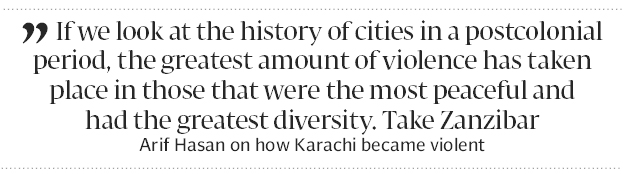
And then came the Freedom Movement, bringing with it, as all such movements do, a strong element of radicalism, progressive thinking and activism. The same was true of Karachi and the migrant intellectuals who came to it after Partition. The progressives had no problem debating, dissenting and enjoying the port city culture. “But if we look at the history of cities in a postcolonial period, the greatest amount of violence has taken place in those that were the most peaceful and had the greatest diversity,” said Hasan. Take the example of Zanzibar.
Why did these cities become so violent? The state became party to the conflict and supported one side or the other. Hasan presented more proof in the example of a colonial Bombay that died when the colonial administration changed. But because this city had developed strong consensus-making, it was spared a violent fate.
Back to Karachi, where trouble began soon after Partition. It surfaced in the shape of the PPP-PNA (Pakistan National Alliance) conflict in 1977 that led Zulfikar Bhutto to ban Karachi’s nightlife. “It also led to Zia’s dictatorship,” said Hasan, referring to its ideology that suppressed all forms of thinking and living apart from what it and its collaborators promoted. “This story has not been told,” said Hasan, “neither from the point of view of the elite and nor from the [point of view of the] working classes.”
But new research, Hasan said he has discovered that Bhutto was possibly involved in talks to end the cultural deprivation. “My research shows that it is more than possible that if the democratic process had continued [as in, Ziaul Haq had not taken over]… a less liberal but synthesis of the two political opponents would have emerged.” Conversations were taking place between banned entities and the Bhutto regime and they were already looking for compromises for these businesses to continue. But the July 1977 coup made this impossible. For Hasan, an examination of these policies is important to understand the Karachi of today.
Zia’s men drew up lists of artists. Fine arts, the performing arts were clamped down on. The PIA Art Academy had no budget. Unsuccessful attempts were made at banning Sufi music at shrines. Classical music wasn’t allowed on the radio.
A majority of Zia’s cabinet were members of the “anti-fahashi and anti-ayashi” movement, according to Hasan. How did the change happen? Zuhr prayers were made compulsory at government institutions. “Many non-government organisations and private ones adopted this to satisfy the demands of their new mentors,” said Hasan.
Zakat was instituted. “The Shias objected as previously Zakat was voluntary,” said Hasan. As a result people came to look at each other as Shias and Sunnis and this has since consolidated itself. “A process of discrimination and fragmentation began,” said Hasan.
The nazim-e-Salat was introduced by Zia. This was a person who wandered around neighbourhoods, calling people to prayer in the morning. If you didn’t go, you were visited politely in the evening and asked why. “In the elite areas,” said Hasan, “this did not really matter, but in low
income areas this had a major impact on social life, on norms and values.”
If this seemed cosmetic, the real blow was dealt when schools were told extra-curriculars could not be allowed. Student unions were also banned by Zia and thus, the institution that produced Pakistan’s most radical leadership, journalists, literary figures, sportsmen and women, vanished.
“International geography and history were discontinued from schools,” added Hasan. “Pak Studies was considered sufficient for an understanding of global issues.”
Most people are familiar with aspects of this history. But it was Hasan’s ability to explain how this affected the elite of Karachi and thus, the city of today, that delivered the absolute knock-out punch on the conference’s first day.
“Pakistan’s elite and upper middle classes are Westernised,” said Hasan, “but because of enmity with Bhutto’s populist [approach], they supported Zia.” This changed, however, when their children’s schools were affected. They stopped sending their children to government colleges, which thus ceased to be multi-class institutions. The elite stopped taking part in public life, the zoos, public spaces. “They formed their own world separate from Karachi and became depoliticised.”
The removal of the elite brought on a decline in the standards of colleges, the public sector real estate and recreation. “So today, the elite of Karachi as a class are no longer elite; they have become just rich people, uninterested and uninformed.” This is why when the elite become policy makers, they are emerging from educational institutions that are creating professionals who have no idea about the city and have a strong anti-poor bias.
How Karachi is changing now
According to Arif Hasan, the most important development that has taken place in the city is the emergence of a native bourgeoisie, a fiercely upwardly mobile middle class. What matters to them is getting their ID cards, birth and death certificates, getting friends released from custody, buying plots of land for their homes. “The disadvantaged people contact their ethnic or religious organization [in the absence of a strong government],” explained Hasan, and this in turn strengthens these organisations and gives them votes to perpetuate a system.
There are five other key ways Hasan said Karachi is changing. “We are seeing an increasing choice in marriage that never existed before,” said Hasan. “All this means greater freedoms and desire for these greater freedoms but also a conflict with tradition and aspirations – and that comes across very strongly in court marriages.”
Old low-income settlements are consolidating and they form the majority of Karachi. “They are acquiring middle-class values,” he said. This is why you will see more beauty parlours in katchi abadies, cyber cafes, wedding halls where segregation is ending.
More heartening is the trend of the educated upper middle class groups taking an interest in the city’s social and development. Recently, we have seen the rise of the formal sector entertainment for an elite who can pay for it. But we also see huge crowds of middle class Karachi’ites who turn up for the exhibitions and events at the Expo Centre.
Hasan was most worried about the creation of a new under-class living in settlements where it finds place. “The old migrants came because they wanted to come,” he said. “They came from stable societies where a government functioned. But the new ones are coming because they are forced to come for economic and social reasons.” He said he wasn’t sure how Karachi will absorb them.
“There can be no peace without equity and justice is possible in the world we are heading towards,” he said. “The city needs a vision but not the one outline in the 2020 Master Plan.” We don’t need a “world class” city but perhaps a vision for one that is commuter- and pedestrian-friendly to bring everyone together.

Quagliarella tight-lipped on new Juventus deal

Quagliarella tight-lipped on new Juventus deal
It has been rumoured that the 30-year-old forward could pen a contract extension that would see him finish his career in Turin, but he insists his focus is currently Real Madrid
Fabio Quagliarella was reluctant to discuss his future at Juventus after Saturday's win at Parma, preferring instead to focus on Tuesday's Champions League showdown with Real Madrid.

The 30-year-old forward came off the bench at the Tardini to set up the only goal of the game, as his looping shot struck the crossbar before then being converted by Paul Pogba.

It is not the first time that Quagliarella, who is under contract until 2015, has fulfilled the role of 'super-sub' for Juve and there has been talk of late that he could soon sign a new deal that would see him finish his career in Turin, but the forward maintains his only concern at present is the crunch clash at Santiago Bernabeu.

"Juve for life? I'm thinking about Madrid," the former Napoli striker told Gazzetta dello Sport. "I'm happy here. For the future, we'll see."

When then asked if he had done enough to secure a starting berth for Juve's must-win meeting with the Group B leaders, Quagliarella replied: "I'm more than ready. We'll see what [coach Antonio] Conte will decide."

The Italy international was delighted that Juventus had picked up a victory that moved them to within two points of Serie A leaders Roma, who take on Torino on Sunday night.

"They are three important points at this ground," he acknowledged. "It was a tough game.

"Parma have a great squad. As our coach said yesterday, they have strengthened well and will cause a lot of teams trouble.

"But we have passed this test with flying colours."