Sunday, 3 November 2013

Movie review: Prisoners - no right way to do wrong

Prisoners will place you in morally murky situations and force you to make a choice.
There is no escaping from Prisoners. This masterfully directed psychological thriller from auteur Denis Villeneuve is so intense that its haunting melancholy will hold you captive long after the film ends. This will especially hold true if you are a parent, in which case the film may leave you in a temporary state of paranoia.
The film forces you to think about uncomfortable questions such as the twisted depths to which a parent will sink, in order to save their abducted child. The answers are so uneasy, and the stakes so high, that it may break a lot of your convictions.
The film stars Hugh Jackman (Keller Dover) as a religious carpenter in a powerful performance that is truly magnificent, and easily the best of his career.
The film begins with Keller, a loving father, who alongside his wife Grace (Maria Bello), son Ralph (Dylan Minnette), and daughter Anna (Erin Gerasimovich), is visiting family friends and neighbors, the Birches, for Thanksgiving dinner. After dinner, Anna asks her parents if she can leave with Joy Birch (Kyla Drew Simmons) to play at the Dover home. Anna’s parents reluctantly agree on the condition that the kids be chaperoned by their elder siblings.
What follows is a parent’s worst nightmare, and a plot ripped straight from American headlines.
After both children fail to return after some time, Keller discovers to his alarm that they left unescorted. Alongside Joy’s father, Franklin Birch (Terrence Howard), Keller frantically combs the neighborhood until he realizes the children are truly missing. The only clue the two families have is an RV, spotted outside of the Birch home while the girls were playing outside.
Coming to the aid of the desperate families is Detective Loki (Jake Gyllenhaal), who backed by the local police, manages to locate the RV. Unfortunately, the RV carries no evidence that it was involved in the abduction.
Complicating the entire situation is the fact that the driver of the RV and the primary suspect, Alex Jones (Paul Dano), is a grown man with the I.Q. of a ten-year-old. Moreover, he provides Loki with no solid reason to suspect him. After he is released, however, he tantalizingly hints to Keller privately that he knows more than he has been letting on. Keller, frustrated with the release of Alex, kidnaps him, and later with Franklin’s assistance, tortures Alex using elaborate techniques.
With his nostrils often flaring, Hugh Jackman is stunningly convincing as a desperate father who must channel his inner psychopath in order to find his daughter. You feel torn between being sympathetic towards Alex and yet being able to relate to Keller’s agony, who is also held hostage by the situation.
Gyllenhaal, playing a detective so burdened by his job that he develops a very noticeable eye twitch, delivers a particularly powerful performance. The chemistry between Jackman and Gyllenhaal is also strong, with the detective looking to rein in the impatient father’s aggression, as the two main characters engage in a tug of wills.
Prisoners is a complex multi-layered film that does justice to its multiple themes. Matching the darkness of these layers is the film’s visually intoxicating cinematography, sporting simple backdrops that are given a suitably grim look by the gritty camerawork.
Prisoners’ narrative twists and turns like a maze, featuring surprises that will leave you guessing as often as the film’s principal characters. Disappointingly, some of the major set-pieces are foreshadowed a little too well, leaving little room for surprise. That being said, after a terrorizing ride, a little cheap satisfaction is somewhat welcome.
For more on Criminal takedown, watch
Silence of the Lambs (1991)
Starring Anthony Hopkins and Jodie Foster, the film won five academy awards, and put Hannibal Lector on the map as one of the greatest villains ever seen on film. The film started a trend, and established a blueprint for other psychological thrillers to follow.
Se7en (1995)
Starring Brad Pitt and Morgan Freeman, the film featured a richly dark narrative, and an ending that blew cinemagoers away. However what most people don’t know is that the director, David Fincher was initially sent the wrong script by mistake, but he remained adamant that the producers stuck to it.
Zodiac (2007)
Also directed by David Fincher, the film is based on a true story of a series of complex and perplexing murders which law enforcement officials to this day have not been able to solve. The killer, Zodiac, sent taunting letters to both newspapers and the police during his horrifying killing spree

The day the music died - why Karachi lost its groove during Ziaul Haq’s regime

An image of Karachi University students during the 1960s. (COURTESY SIBTAIN NAQVI)
Hotel Metropole (COURTESY SIBTAIN NAQVI)Star Cinema was built in 1918 in Karachi (CREDIT: ARIF HASAN’S WEBSITE)Ava Gardner at the Metropole Hotel in February 1955 en route to Lahore for the shooting of Bhowani Junction, Dawn reported in 2005. (COURTESY V MINWALLA DASTUR)An image of Karachi University students during the 1960s. (COURTESY SIBTAIN NAQVI)
KARACHI: 
Arif Hasan wants to talk about the stories we don’t talk about. He wants to talk about the time he bumped into singer Suleman Shah at the Islamabad airport. Military dictator Ziaul Haq had banned Shah from performing with his trademark ghungroos in a countrywide crackdown on artists.
“Shah saheb, without your ghungroos baat nahi banti,” Arif Hasan told the man. It just isn’t the same. Shah agreed and the two men embraced each other and wept.
They were weeping for a culture that was under attack. You will hear about it from nostalgic Karachi sectagenarians. There were night clubs, dance halls, cinemas, bars. Historian and architect, chronicler of Karachi, Arif Hasan, is the first to plead guilty. Many heads in the audience at the first international Karachi conference on Saturday nodded in sympathy.
“But it is a [nightlife] culture that could not have survived,” Hasan pointed out. It was a culture of a colonial port city with a colonial administration under the Empire. Karachi was a city with neighbourhoods that were ethnicity- and clan-based. “It was governed by a powerful empire so there was peace and harmony.”
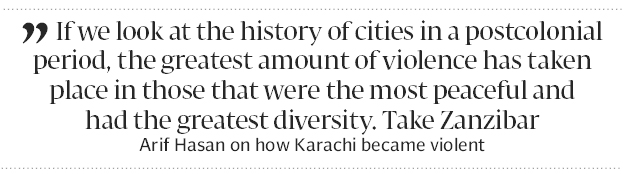
And then came the Freedom Movement, bringing with it, as all such movements do, a strong element of radicalism, progressive thinking and activism. The same was true of Karachi and the migrant intellectuals who came to it after Partition. The progressives had no problem debating, dissenting and enjoying the port city culture. “But if we look at the history of cities in a postcolonial period, the greatest amount of violence has taken place in those that were the most peaceful and had the greatest diversity,” said Hasan. Take the example of Zanzibar.
Why did these cities become so violent? The state became party to the conflict and supported one side or the other. Hasan presented more proof in the example of a colonial Bombay that died when the colonial administration changed. But because this city had developed strong consensus-making, it was spared a violent fate.
Back to Karachi, where trouble began soon after Partition. It surfaced in the shape of the PPP-PNA (Pakistan National Alliance) conflict in 1977 that led Zulfikar Bhutto to ban Karachi’s nightlife. “It also led to Zia’s dictatorship,” said Hasan, referring to its ideology that suppressed all forms of thinking and living apart from what it and its collaborators promoted. “This story has not been told,” said Hasan, “neither from the point of view of the elite and nor from the [point of view of the] working classes.”
But new research, Hasan said he has discovered that Bhutto was possibly involved in talks to end the cultural deprivation. “My research shows that it is more than possible that if the democratic process had continued [as in, Ziaul Haq had not taken over]… a less liberal but synthesis of the two political opponents would have emerged.” Conversations were taking place between banned entities and the Bhutto regime and they were already looking for compromises for these businesses to continue. But the July 1977 coup made this impossible. For Hasan, an examination of these policies is important to understand the Karachi of today.
Zia’s men drew up lists of artists. Fine arts, the performing arts were clamped down on. The PIA Art Academy had no budget. Unsuccessful attempts were made at banning Sufi music at shrines. Classical music wasn’t allowed on the radio.
A majority of Zia’s cabinet were members of the “anti-fahashi and anti-ayashi” movement, according to Hasan. How did the change happen? Zuhr prayers were made compulsory at government institutions. “Many non-government organisations and private ones adopted this to satisfy the demands of their new mentors,” said Hasan.
Zakat was instituted. “The Shias objected as previously Zakat was voluntary,” said Hasan. As a result people came to look at each other as Shias and Sunnis and this has since consolidated itself. “A process of discrimination and fragmentation began,” said Hasan.
The nazim-e-Salat was introduced by Zia. This was a person who wandered around neighbourhoods, calling people to prayer in the morning. If you didn’t go, you were visited politely in the evening and asked why. “In the elite areas,” said Hasan, “this did not really matter, but in low
income areas this had a major impact on social life, on norms and values.”
If this seemed cosmetic, the real blow was dealt when schools were told extra-curriculars could not be allowed. Student unions were also banned by Zia and thus, the institution that produced Pakistan’s most radical leadership, journalists, literary figures, sportsmen and women, vanished.
“International geography and history were discontinued from schools,” added Hasan. “Pak Studies was considered sufficient for an understanding of global issues.”
Most people are familiar with aspects of this history. But it was Hasan’s ability to explain how this affected the elite of Karachi and thus, the city of today, that delivered the absolute knock-out punch on the conference’s first day.
“Pakistan’s elite and upper middle classes are Westernised,” said Hasan, “but because of enmity with Bhutto’s populist [approach], they supported Zia.” This changed, however, when their children’s schools were affected. They stopped sending their children to government colleges, which thus ceased to be multi-class institutions. The elite stopped taking part in public life, the zoos, public spaces. “They formed their own world separate from Karachi and became depoliticised.”
The removal of the elite brought on a decline in the standards of colleges, the public sector real estate and recreation. “So today, the elite of Karachi as a class are no longer elite; they have become just rich people, uninterested and uninformed.” This is why when the elite become policy makers, they are emerging from educational institutions that are creating professionals who have no idea about the city and have a strong anti-poor bias.
How Karachi is changing now
According to Arif Hasan, the most important development that has taken place in the city is the emergence of a native bourgeoisie, a fiercely upwardly mobile middle class. What matters to them is getting their ID cards, birth and death certificates, getting friends released from custody, buying plots of land for their homes. “The disadvantaged people contact their ethnic or religious organization [in the absence of a strong government],” explained Hasan, and this in turn strengthens these organisations and gives them votes to perpetuate a system.
There are five other key ways Hasan said Karachi is changing. “We are seeing an increasing choice in marriage that never existed before,” said Hasan. “All this means greater freedoms and desire for these greater freedoms but also a conflict with tradition and aspirations – and that comes across very strongly in court marriages.”
Old low-income settlements are consolidating and they form the majority of Karachi. “They are acquiring middle-class values,” he said. This is why you will see more beauty parlours in katchi abadies, cyber cafes, wedding halls where segregation is ending.
More heartening is the trend of the educated upper middle class groups taking an interest in the city’s social and development. Recently, we have seen the rise of the formal sector entertainment for an elite who can pay for it. But we also see huge crowds of middle class Karachi’ites who turn up for the exhibitions and events at the Expo Centre.
Hasan was most worried about the creation of a new under-class living in settlements where it finds place. “The old migrants came because they wanted to come,” he said. “They came from stable societies where a government functioned. But the new ones are coming because they are forced to come for economic and social reasons.” He said he wasn’t sure how Karachi will absorb them.
“There can be no peace without equity and justice is possible in the world we are heading towards,” he said. “The city needs a vision but not the one outline in the 2020 Master Plan.” We don’t need a “world class” city but perhaps a vision for one that is commuter- and pedestrian-friendly to bring everyone together.

Quagliarella tight-lipped on new Juventus deal

Quagliarella tight-lipped on new Juventus deal
It has been rumoured that the 30-year-old forward could pen a contract extension that would see him finish his career in Turin, but he insists his focus is currently Real Madrid
Fabio Quagliarella was reluctant to discuss his future at Juventus after Saturday's win at Parma, preferring instead to focus on Tuesday's Champions League showdown with Real Madrid.

The 30-year-old forward came off the bench at the Tardini to set up the only goal of the game, as his looping shot struck the crossbar before then being converted by Paul Pogba.

It is not the first time that Quagliarella, who is under contract until 2015, has fulfilled the role of 'super-sub' for Juve and there has been talk of late that he could soon sign a new deal that would see him finish his career in Turin, but the forward maintains his only concern at present is the crunch clash at Santiago Bernabeu.

"Juve for life? I'm thinking about Madrid," the former Napoli striker told Gazzetta dello Sport. "I'm happy here. For the future, we'll see."

When then asked if he had done enough to secure a starting berth for Juve's must-win meeting with the Group B leaders, Quagliarella replied: "I'm more than ready. We'll see what [coach Antonio] Conte will decide."

The Italy international was delighted that Juventus had picked up a victory that moved them to within two points of Serie A leaders Roma, who take on Torino on Sunday night.

"They are three important points at this ground," he acknowledged. "It was a tough game.

"Parma have a great squad. As our coach said yesterday, they have strengthened well and will cause a lot of teams trouble.

"But we have passed this test with flying colours."

Benitez: Napoli still only at 75 per cent

Benitez: Napoli still only at 75 per cent
The Spanish coach says there is much more to come from his side and admitted he would welcome some new signings during the January transfer window
Napoli made it nine wins from 11 Serie A games by defeating Catania 2-1 on Saturday night but coachRafael Benitez believes his troops are still only performing at 75 per cent of their capabilities.

The Partenopei extended their unbeaten run at the San Paolo to 16 games courtesy of early goals from Jose Callejon and Marek Hamsik but their Spanish boss was less than impressed by their inability to close out the game, with Lucas Castro's strike having made life unnecessarily uncomfortable for the hosts.

"We are still at 75 per cent," the former Liverpool boss told Sky Sport Italia. "It can improve a lot. 

"Sometimes were were a bit unlucky in front of goal, sometimes the goalkeeper was good, but with so many opportunities, we should have closed out the game and I'd have been able to be more comfortable on the bench."

Despite his frustration, Benitez believes that Napoli, who are now just two points behind leaders Roma, are well in the Serie A title race.

"The Giallorossi can no longer hide," he argued. "We also have the Champions League but for the Scudetto there are five teams in the dance. Fiorentina and Inter can also have their say."

Napoli president Aurelio De Laurentiis has hinted at further transfer activity in January, with Maxime Gonalons of Olympique Lyonnais a prime target, and Benitez has admitted that he would welcome some new faces.

"Our squad is good, but Juve has invested for years and thus has an edge," he mused.

"This summer we lost a great striker [Edinson Cavani], while Conte's squad has many alternatives. 

"However, if we work well, we can get closer to Juventus. The president has confirmed that he is ready to intervene if necessary ..."

I've no issue with Bale's transfer fee, insists Rummenigge

I've no issue with Bale's transfer fee, insists Rummenigge
The former West Germany international feels Real Madrid have proven that they have the money to fund such lucrative moves despite financial problems for many European clubs
Bayern Munich CEO Karl-Heinz Rummenigge says he has no issue with the €100 million fee Real Madridpaid to sign Gareth Bale from Tottenham, arguing that it is other European clubs who are not complying with Financial Fair Play (FFP).

The Welshman's world-record transfer to the Santiago Bernabeu was the subject of much debate, with Arsenal boss Arsene Wenger claiming the deal made "a joke" of Uefa chief Michel Platini's plan to control spending on the continent.

However, Rummenigge does not believe that Madrid are the problem, as he believes that clubs like los Blancos and the European champions continue to spend within their means.

"I think [UEFA President Michel] Platini is helping a lot. He's hard at work, but still 60 per cent of clubs in Europe are in the red," he told Marca.

"We have to change owner mentalities. Bayern doesn't spend what it doesn't have. 

"If we signed Javi Martinez it was because we had €40m - we didn't request a loan and we don't leave a trail of unpaid debts. 

"Uefa shouldn't go against clubs, but rather try to stop them over-spending.

"It's up to everyone to do what they want, so long as it's within their means. Big clubs like us have the duty and are under pressure to have the best players.

"That's why I believe in Financial Fair Play, because everyone should only spend what they have. 

"If Real bought Bale for such a high price it's because they did well before that and sold players for over €100 million - that's how they were able to pay for it.

"I don't think Real is the problem - other clubs aren't compliant, not Real Madrid, which has cash. 

"Granted, these types of signings don't go down well in Brussels, because they feel the Spanish economy isn't in a state for that sort of money to be changing hands in football; it gives off a bad image socially.

"But I don't think Madrid is a problem financial health-wise

TV shoppers: Now is the time to buy a Panasonic plasma

The end of an era is official. On March 31, 2014, Panasonic "will end sales of plasma TVs for consumer use and PDP-related products for commercial use," in the company's own words.
Panasonic plasmas have been CNET's favorite TVs for years, and I've already explained why I think their disappearance is bad news for the TV buyers.
Now the most common question I get from readers is, "Should I buy a Panasonic plasma now?" My answer in general is almost always "yes," and now that I know they're going to be extinct soon, it's "YES!"
Panasonic will continue to honor the warranty on its plasma TVs, and will continue to support them as usual; the company itself isn't going anywhere. I consider a Panasonic plasma TV bought today as safe an investment as any other kind or brand of TV.
Worried about dimness, burn-in, short lifespans, extra heat or weight, buzzing, phosphor trails, or buying an "old," "dead" technology? You shouldn't be. Any disadvantages of plasma, real or imaginary, are outweighed in my book by its picture quality superiority over LCD.
Will Samsung continue making plasmas next year? What about LG? I don't know, but my guess is now that Panasonic has pulled out, those two already LCD-centric companies will also abandon the technology soon.
I tried contacting Panasonic to get an idea about questions like current and future inventory and possible discounts, but couldn't get a reply before press time. I'll update this piece when I hear back, but in the meantime, here's my take.
Now that the pull-out is official, I don't expect to see widespread, selloff-style discounts on Panasonic plasmas. Prices on the S60 and ST60 haven't budged much since June, and while the VT60 and ZT60 are significantly cheaper now, I doubt their sudden "last of the best" status will cause them to fall much further in price. For what it's worth, Mitsubishi didn't discount the last DLPs.
I do expect Panasonic plasma inventory to disappear sooner rather than later. People who've been waiting to pull the trigger on one are a savvy bunch, and they know that the holiday season brings the best prices. Some sizes and models are already sold out (or close), and supply has been intermittent on others all year. I'd frankly be surprised if popular models like the 50- and 60-inch S60 and ST60 were actually still available in March 2014. The company says it will manufacture its last plasma in December, then shut down the last factory, leaving three months to sell off the remainder.
If you've decided to buy a Panasonic plasma, the list below, originally compiled to answer the question "Which Panasonic plasma should you buy?", should help. It's arranged in ascending order of price, and prices are current as of press time.

S60 series: 42-inch (sold out), 50-inch ($679), 55-inch (sold out), 60-inch ($999), 65-inch ($1,298)
Best for: Tighter budgets, somewhat dimmer rooms, serious twitch video gamers.
The S60 represents the low end of Panasonic's 1080p plasma lineup, but its picture quality is simply phenomenal for the price. Its main downside is a screen finish that doesn't hold up well in bright rooms. It's not a full-fledged dumb TV, but the selection of just six apps -- Netflix, Amazon Instant Video, Vudu, YouTube, Hulu Plus, and CinemaNow -- is refreshingly simple and easy to access via a little pop-up menu and built-in Wi-Fi. Among the TVs on this list it also has the lowest input lag, making it the best choice for twitch gamers.
Read the full review of the Panasonic TC-PS60 series.

ST60 series: 50-inch ($979), 55-inch ($1,295), 60-inch ($1,449), 65-inch ($2,199)
Best for: Mainstream budgets, picture quality enthusiasts who aren't serious twitch gamers.
Until the ST60 came along, we'd never given a five-star review to a TV at CNET. It's just that good. The picture quality will please even the most persnickety videophile, although those who can afford better might be even happier with a VT or ZT below. Gamers who demand instantaneous response should avoid this laggy set, but more-casual gamers are unlikely to notice the difference. We gave the ST60 and S60 the same 10 in value, but the ST's superior antireflective screen makes it much more versatile under all kinds of lighting. If you're not on an extra-tight budget, it's worth stepping up to the ST even if you don't care about its added features like Smart TV and 3D.
Read the full review of the Panasonic TC-PST60 series.

VT60 series: 55-inch ($1,999), 60-inch ($2,299), 65-inch ($2,700)
Best for: Moneyed videophiles who don't demand the ZT60's picture, want better sound.
The VT60 costs quite a bit more than the ST60 at every size, and for TV shoppers with limited budgets, it's simply not worth it. On the other hand, if you've got the money, Panasonic's got the PQ for you. This plasma earned a 10 in image quality and outperforms every other TV we've ever reviewed, with the exception of legendary Pioneer Kuro (the VT60 basically tied it) and of course Big Zed below. It beats the ST60 in every way including daytime viewing, although if your living room is particularly bright, the ZT60 is an even better choice. In the dark the two are equal in every important way, however -- and when you throw in its superior sound quality and features, the VT is the better value, too.
Read the full review of the Panasonic TC-PVT60 series.

ZT60 series: 60-inch ($2,999), 65-inch ($3,799)
Best for: Those who want the best non-OLED picture available today.
Did we mention value before? OK, well, compared with OLED or 4K TVs, the ZT60 isn't a bad value at all. It's still crazy-expensive, however, and only high-end shoppers with a burning desire to own the best image quality we've ever tested need apply. It beats the VT60 in only one area, bright rooms, but on the other hand isn't quite as good in those situations as the ultrabrightSamsung PNF8500, or any of the brighter LED-based LCDs. The ZT60 trounces both in the friendly confines of a dark room, however, giving it an overall edge that deserves the "reference" hype.

Victor Valdes prefers Monaco millions to Arsenal challenge.

BURNjOrCUAAxsPi.jpg
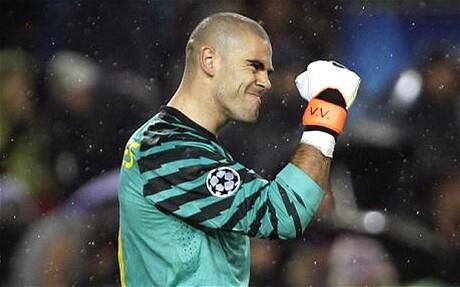
AS Monaco's tax-free millions have persuaded Victor Valdes to set aside an ambition of playing in the Premier League, with the Barcelona goalkeeper on the verge of completing a pre-contract agreement with the French League leaders. Valdes, who supplanted Iker Casillas as Spain's first-choice goalkeeper last week, had held extensive transfer discussions with Arsenal but is now ready to choose the more lucrative terms on offer at the Russian-owned club.

Valdes declared his intention to leave the Camp Nou last season and was prepared to move to Arsenal in the summer if the financial package sanctioned by Arsene Wenger was sufficiently generous. Barcelona, however, elected to hold Valdes to the final 12 months of a contract worth an annual €7million even though the 31-year-old rejected the offer of an improved deal.

It is understood that Valdes' readiness to leave one of the world's best supported teams for a club that rarely fills its 18,523-capacity stadium is primarily motivated by a desire to compensate for personal investment losses. The largesse of principal owner Dmitry Rybolovlev resulted in newly promoted Monaco securing the signings of Radamel Falcao, Joao Moutinho and James Rodriquez in the last transfer window.