Sunday, 3 November 2013

Benitez: Napoli still only at 75 per cent

Benitez: Napoli still only at 75 per cent
The Spanish coach says there is much more to come from his side and admitted he would welcome some new signings during the January transfer window
Napoli made it nine wins from 11 Serie A games by defeating Catania 2-1 on Saturday night but coachRafael Benitez believes his troops are still only performing at 75 per cent of their capabilities.

The Partenopei extended their unbeaten run at the San Paolo to 16 games courtesy of early goals from Jose Callejon and Marek Hamsik but their Spanish boss was less than impressed by their inability to close out the game, with Lucas Castro's strike having made life unnecessarily uncomfortable for the hosts.

"We are still at 75 per cent," the former Liverpool boss told Sky Sport Italia. "It can improve a lot. 

"Sometimes were were a bit unlucky in front of goal, sometimes the goalkeeper was good, but with so many opportunities, we should have closed out the game and I'd have been able to be more comfortable on the bench."

Despite his frustration, Benitez believes that Napoli, who are now just two points behind leaders Roma, are well in the Serie A title race.

"The Giallorossi can no longer hide," he argued. "We also have the Champions League but for the Scudetto there are five teams in the dance. Fiorentina and Inter can also have their say."

Napoli president Aurelio De Laurentiis has hinted at further transfer activity in January, with Maxime Gonalons of Olympique Lyonnais a prime target, and Benitez has admitted that he would welcome some new faces.

"Our squad is good, but Juve has invested for years and thus has an edge," he mused.

"This summer we lost a great striker [Edinson Cavani], while Conte's squad has many alternatives. 

"However, if we work well, we can get closer to Juventus. The president has confirmed that he is ready to intervene if necessary ..."

I've no issue with Bale's transfer fee, insists Rummenigge

I've no issue with Bale's transfer fee, insists Rummenigge
The former West Germany international feels Real Madrid have proven that they have the money to fund such lucrative moves despite financial problems for many European clubs
Bayern Munich CEO Karl-Heinz Rummenigge says he has no issue with the €100 million fee Real Madridpaid to sign Gareth Bale from Tottenham, arguing that it is other European clubs who are not complying with Financial Fair Play (FFP).

The Welshman's world-record transfer to the Santiago Bernabeu was the subject of much debate, with Arsenal boss Arsene Wenger claiming the deal made "a joke" of Uefa chief Michel Platini's plan to control spending on the continent.

However, Rummenigge does not believe that Madrid are the problem, as he believes that clubs like los Blancos and the European champions continue to spend within their means.

"I think [UEFA President Michel] Platini is helping a lot. He's hard at work, but still 60 per cent of clubs in Europe are in the red," he told Marca.

"We have to change owner mentalities. Bayern doesn't spend what it doesn't have. 

"If we signed Javi Martinez it was because we had €40m - we didn't request a loan and we don't leave a trail of unpaid debts. 

"Uefa shouldn't go against clubs, but rather try to stop them over-spending.

"It's up to everyone to do what they want, so long as it's within their means. Big clubs like us have the duty and are under pressure to have the best players.

"That's why I believe in Financial Fair Play, because everyone should only spend what they have. 

"If Real bought Bale for such a high price it's because they did well before that and sold players for over €100 million - that's how they were able to pay for it.

"I don't think Real is the problem - other clubs aren't compliant, not Real Madrid, which has cash. 

"Granted, these types of signings don't go down well in Brussels, because they feel the Spanish economy isn't in a state for that sort of money to be changing hands in football; it gives off a bad image socially.

"But I don't think Madrid is a problem financial health-wise

TV shoppers: Now is the time to buy a Panasonic plasma

The end of an era is official. On March 31, 2014, Panasonic "will end sales of plasma TVs for consumer use and PDP-related products for commercial use," in the company's own words.
Panasonic plasmas have been CNET's favorite TVs for years, and I've already explained why I think their disappearance is bad news for the TV buyers.
Now the most common question I get from readers is, "Should I buy a Panasonic plasma now?" My answer in general is almost always "yes," and now that I know they're going to be extinct soon, it's "YES!"
Panasonic will continue to honor the warranty on its plasma TVs, and will continue to support them as usual; the company itself isn't going anywhere. I consider a Panasonic plasma TV bought today as safe an investment as any other kind or brand of TV.
Worried about dimness, burn-in, short lifespans, extra heat or weight, buzzing, phosphor trails, or buying an "old," "dead" technology? You shouldn't be. Any disadvantages of plasma, real or imaginary, are outweighed in my book by its picture quality superiority over LCD.
Will Samsung continue making plasmas next year? What about LG? I don't know, but my guess is now that Panasonic has pulled out, those two already LCD-centric companies will also abandon the technology soon.
I tried contacting Panasonic to get an idea about questions like current and future inventory and possible discounts, but couldn't get a reply before press time. I'll update this piece when I hear back, but in the meantime, here's my take.
Now that the pull-out is official, I don't expect to see widespread, selloff-style discounts on Panasonic plasmas. Prices on the S60 and ST60 haven't budged much since June, and while the VT60 and ZT60 are significantly cheaper now, I doubt their sudden "last of the best" status will cause them to fall much further in price. For what it's worth, Mitsubishi didn't discount the last DLPs.
I do expect Panasonic plasma inventory to disappear sooner rather than later. People who've been waiting to pull the trigger on one are a savvy bunch, and they know that the holiday season brings the best prices. Some sizes and models are already sold out (or close), and supply has been intermittent on others all year. I'd frankly be surprised if popular models like the 50- and 60-inch S60 and ST60 were actually still available in March 2014. The company says it will manufacture its last plasma in December, then shut down the last factory, leaving three months to sell off the remainder.
If you've decided to buy a Panasonic plasma, the list below, originally compiled to answer the question "Which Panasonic plasma should you buy?", should help. It's arranged in ascending order of price, and prices are current as of press time.

S60 series: 42-inch (sold out), 50-inch ($679), 55-inch (sold out), 60-inch ($999), 65-inch ($1,298)
Best for: Tighter budgets, somewhat dimmer rooms, serious twitch video gamers.
The S60 represents the low end of Panasonic's 1080p plasma lineup, but its picture quality is simply phenomenal for the price. Its main downside is a screen finish that doesn't hold up well in bright rooms. It's not a full-fledged dumb TV, but the selection of just six apps -- Netflix, Amazon Instant Video, Vudu, YouTube, Hulu Plus, and CinemaNow -- is refreshingly simple and easy to access via a little pop-up menu and built-in Wi-Fi. Among the TVs on this list it also has the lowest input lag, making it the best choice for twitch gamers.
Read the full review of the Panasonic TC-PS60 series.

ST60 series: 50-inch ($979), 55-inch ($1,295), 60-inch ($1,449), 65-inch ($2,199)
Best for: Mainstream budgets, picture quality enthusiasts who aren't serious twitch gamers.
Until the ST60 came along, we'd never given a five-star review to a TV at CNET. It's just that good. The picture quality will please even the most persnickety videophile, although those who can afford better might be even happier with a VT or ZT below. Gamers who demand instantaneous response should avoid this laggy set, but more-casual gamers are unlikely to notice the difference. We gave the ST60 and S60 the same 10 in value, but the ST's superior antireflective screen makes it much more versatile under all kinds of lighting. If you're not on an extra-tight budget, it's worth stepping up to the ST even if you don't care about its added features like Smart TV and 3D.
Read the full review of the Panasonic TC-PST60 series.

VT60 series: 55-inch ($1,999), 60-inch ($2,299), 65-inch ($2,700)
Best for: Moneyed videophiles who don't demand the ZT60's picture, want better sound.
The VT60 costs quite a bit more than the ST60 at every size, and for TV shoppers with limited budgets, it's simply not worth it. On the other hand, if you've got the money, Panasonic's got the PQ for you. This plasma earned a 10 in image quality and outperforms every other TV we've ever reviewed, with the exception of legendary Pioneer Kuro (the VT60 basically tied it) and of course Big Zed below. It beats the ST60 in every way including daytime viewing, although if your living room is particularly bright, the ZT60 is an even better choice. In the dark the two are equal in every important way, however -- and when you throw in its superior sound quality and features, the VT is the better value, too.
Read the full review of the Panasonic TC-PVT60 series.

ZT60 series: 60-inch ($2,999), 65-inch ($3,799)
Best for: Those who want the best non-OLED picture available today.
Did we mention value before? OK, well, compared with OLED or 4K TVs, the ZT60 isn't a bad value at all. It's still crazy-expensive, however, and only high-end shoppers with a burning desire to own the best image quality we've ever tested need apply. It beats the VT60 in only one area, bright rooms, but on the other hand isn't quite as good in those situations as the ultrabrightSamsung PNF8500, or any of the brighter LED-based LCDs. The ZT60 trounces both in the friendly confines of a dark room, however, giving it an overall edge that deserves the "reference" hype.

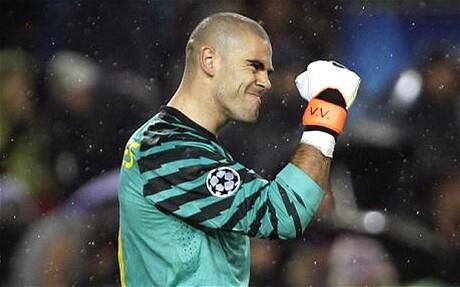
Victor Valdes prefers Monaco millions to Arsenal challenge.

BURNjOrCUAAxsPi.jpg
AS Monaco's tax-free millions have persuaded Victor Valdes to set aside an ambition of playing in the Premier League, with the Barcelona goalkeeper on the verge of completing a pre-contract agreement with the French League leaders. Valdes, who supplanted Iker Casillas as Spain's first-choice goalkeeper last week, had held extensive transfer discussions with Arsenal but is now ready to choose the more lucrative terms on offer at the Russian-owned club.

Valdes declared his intention to leave the Camp Nou last season and was prepared to move to Arsenal in the summer if the financial package sanctioned by Arsene Wenger was sufficiently generous. Barcelona, however, elected to hold Valdes to the final 12 months of a contract worth an annual €7million even though the 31-year-old rejected the offer of an improved deal.

It is understood that Valdes' readiness to leave one of the world's best supported teams for a club that rarely fills its 18,523-capacity stadium is primarily motivated by a desire to compensate for personal investment losses. The largesse of principal owner Dmitry Rybolovlev resulted in newly promoted Monaco securing the signings of Radamel Falcao, Joao Moutinho and James Rodriquez in the last transfer window.

Twitter’s “anti-Facebook” IPO tactics win over some investors

NEW YORK: Institutional investors who met with Twitter Inc. this week say they are optimistic about its initial public offering and see little sign of the irrational exuberance that preceded Facebook Inc.'s splashy coming-out party in 2012.
On Monday and Tuesday, Twitter Chief Executive Dick Costolo and Chief Financial Officer Mike Gupta met with large fund managers and analysts in New York and on the East Coast to sell them on an IPO that seeks to raise up to $1.6 billion for the loss-making social media company.
Closely watched by Wall Street and Silicon Valley, Twitter's relatively conservative offering has differed from Facebook's $16 billion IPO in panoply of ways, from its vastly smaller deal size to a decision to list on the New York Stock Exchange over Nasdaq.
“It definitely was different than when (Facebook CEO Mark) Zuckerberg came through...It's the right kind of buzz,” said one fund manager who met with Twitter on Monday.
“With Facebook, the buzz was just stupid,” said the manager, who declined to be identified because he was not authorized to speak to the media.
Twitter last week said that it would price its IPO shares at $17 to $20 a piece, valuing the online messaging company at up to about $11 billion. That is less than the $15 billion that analysts had expected, and far below the $100 billion valuation that Facebook received in its IPO last May.
However, Facebook had reported an annual profit of $1 billion and revenue of $3.7 billion before it went public, whereas Twitter reported a net loss of $79.4 million on revenue of just $316.9 million in 2012.
At the upper end of its IPO price range, Twitter would be valuing itself at 20 times trailing 12-month sales currently, and about 17 times at the lower end, according to Reuters' calculations from Twitter's IPO filings. But its outstanding share base could swell by tens of millions of stock as holders exercise options and restricted stock units, inflating the valuation.
In comparison, Facebook trades at about 24 times trailing 12-month sales and LinkedIn Corp at roughly 30 times.
Yet the Fund managers viewed Twitter's price range as relatively conservative, basing their perspective on earlier guesses that had pegged the company's range as $28 to $30. Twitter itself mentioned that it had internally valued its own stock at $20.62 as recently as in September.
That has attracted some investors who expect Twitter's shares to climb after they begin trading on the New York Stock Exchange on Nov 7.
Twitter “is getting a really warm welcome from people,” said Scott Sweet, CEO of research firm IPO Boutique. “Of all the individuals and institutions I've talked to – which include multi-billion dollar hedge funds – no one has said they aren't playing,” Sweet said.
Facebook's float was marred by an 11 per cent drop in the stock on its second day of trade and successive declines over the next few months as investors questioned the company's ability to grow revenue through mobile devices.
It didn't help that, before its debut, Facebook's underwriters raised the size of the IPO by 25 per cent and also hiked the price range. Finally, technical problems with Nasdaq trading systems delayed the start of trade, sowing confusion amongst nervous traders. It took over a year for Facebook shares to reclaim their IPO price.
Another investor, who owns shares in Facebook and LinkedIn, said his firm is approaching all the Twitter underwriters to ask for a 10 per cent allocation, with the hopes of getting between 1.5 to three per cent.
“It's a stupid game that is played...if you can get what you want, then you don't want it,” he said. Some investors say they believe management has learned from Facebook's mistakes and are pricing the deal in a more conservative manner.
“It's the anti-Facebook” said a second fund manager, who also spoke on condition of anonymity and is planning on meeting with management later this week.
Twitter will hold its first large investor lunch in New York on Wednesday, and investor interest is expected to build as the roadshow proceeds. After stops in Boston, Chicago, San Francisco, Los Angeles and Denver, the roadshow ends in New York next week with pricing scheduled for Nov 6 and trading on the New York Stock Exchange to commence a day later under the ticker symbol “TWTR.”
The company founders “are gazillionaires already. I think they're not going to want to spend the year after the IPO dominated by the argument about 'why we the IPO,'” the second fund manager said. “Life is short

Amazon tries free, on-time delivery to lure India online

Bangalore: Free shipping on a 100 rupee ($1.60) book. Delivery times guaranteed to the minute.
These are some of the incentives the world's biggest online retailer Amazon.com is using to entice Indians to shop on the web, a sector where growth has been stifled by payment problems, low Internet usage and a challenging logistics environment.
Amazon's investors are counting on its international business and expansion to help drive growth and support its $165 billion market value, one of the highest among US firms.
India is Amazon's third emerging market investment after Brazil and China, and one Vice President and Country Manager Amit Agarwal said would take time to pay off.
Most Indians do not own a credit card, and less than half the 152 million Internet users have shopped online. Then there are the bad roads, the snarled bureaucracy and the petty bribery that greases business.
The potential, however, is vast.
Online retail sales in India are forecast to grow more than a hundred-fold to $76 billion by 2021 from just $600 million at the end of 2012, retail consultants Technopak said. E-tail sales in China, by comparison, are expected to grow to $650 billion by 2020 from around $200 billion in 2012, consultants McKinsey predict.
"A lot of invention is required to capture the potential of this market and our focus is to build this," said Agarwal, who returned to India to head Amazon's business after 14 years with the company in the United States.
"We are going through a lot of trial-and-error to fix problems on the ground," he told Reuters at Amazon's India office in the technology hub of Bangalore.
Convincing Indians to Click
Indians, on average, spend between $24 and $35 per online transaction, a figure dwarfed by the $150-$160 spent by US shoppers online per transaction, according to data from US based analysts comScore and Retail Decisions.
Agarwal spent two years advising Amazon's founder Jeff Bezos at the company's Seattle headquarters, and believes Amazon's long-term strategy will work in India like it did in the United States, where the company ran up losses for years.
"Right now we are focused on giving customers great service and making sure they shop more," he added, sitting behind a large desk that he brought back with him from Seattle.
Amazon's biggest local rival is Flipkart, set up by two ex-Amazon employees in 2007 and which has yet to turn a profit.
Since July, Flipkart has raised $360 million from investors that include South Africa's Naspers Ltd. It said it aims to have $1 billion in sales by 2015.
Agarwal would not give any forecasts or figures, but said Amazon's investments in India have a 7- to 10-year horizon.
He said Amazon was building its own logistics network, which it can leverage when the rules change and it can sell directly to consumers. Indian regulations now prevent international e-tailers from making direct sales.
Made for India
Amazon's initial entry into India was through the 2012 launch of Junglee.com, a price comparison site that gave it insight on what consumers want to buy and are willing to pay.
Amazon's India website, set up in June, is currently a market place for other vendors, in line with regulations.
Amazon is working with these local vendors to ensure goods are packaged properly to speed up delivery, Agarwal said. It is also training local couriers to make good on its promised delivery times in Mumbai, New Delhi, Kolkata and Chennai.
"We receive items from sellers in all kinds of situations. Most of them are not packed properly, stickered properly and that increases the delivery time," Agarwal said.
"Even if you go to really large sellers they don't know how to describe their item because they have never had to have a digital catalogue."
An unstable Internet banking system means online payments often fail, frustrating buyers and leading to abandoned purchases. Agarwal said Amazon uses a made-for-India system that keeps orders active and allows the customer to try again. The option of cash on delivery is also offered.
To avoid shipments getting stuck at toll booths or held up by police demanding bribes, Amazon gets all the permissions and documents required, as well as extra permits, just in case.
"We are not cutting corners. It is taking a longer time to build things but compliance is important and that takes care of blockages on the road to a large extent," Agarwal added.

Google releases 1st phone powered by 'KitKat'

San Francisco: Google is selling a new Android smartphone that it hopes will become more like a clairvoyant friend than a piece of hardware.
The Nexus 5 phone unveiled Thursday is the first device to run on Kit Kat, the latest version of Google's Android operating system.
As with previous Nexus phones, the latest will be sold only at full retail price, without subsidies that come with two-year contract agreements. It goes on sale Thursday in Google's online Play store starting at $349, undercutting many rival phones at contract-free prices. The phone will work on most US wireless networks, but not Verizon's. A Nexus 5 model also is available for European markets.
The Nexus 5 and Kit Kat software underscore Google's ambition to ingrain its search engine and virtual assistant, Google Now, even deeper into people's lives. In the process, Google hopes to gather more insights that will enable it to sell more advertising, which generates most of its revenue.
It'll be easier for Google to learn about a person's habits and needs so it can display helpful information, such as an online post from a favorite blog or a suggestion to use Fandango's movie-ticketing service when standing in a long line at a movie theater.
When visiting a tourist attraction such as Yellowstone National Park, Google Now might automatically show information about geysers from the Web.
 
"We want to get to the point where you glance at your phone and it always delights you with what you need,"
said Sundar Pichai, a Google executive who oversees Android.
The new phone's $349 price threatens to lure more cost-conscious consumers away from Apple Inc.'s iPhone, which retails for $649 for the 5S and $549 for the 5C when sold without a traditional two-year service agreement.
In an unusual twist for a software upgrade, Google built Kit Kat so it would work on cheaper smartphones equipped with less computing memory than top-of-the-line devices.
The move reflects the Mountain View, California company's desire to broaden use of the most recent version of Android. More than 1 billion Android devices have been activated, but a significant number are still using a 3-year-old flavour known as Gingerbread. That version remains popular because it works on those cheaper phones.
The mishmash of Android systems has made it tougher on app developers, who haven't been able to fully embrace the new features in previous upgrades without risking older phones not being to run their software. By contrast, Apple makes its iOS upgrades free all at once to several recent models. With Kit Kat, Google has a chance to bring older and cheaper phones up to date.
Google plans to make Kit Kat available for other devices within the next few weeks, but it will be up to individual manufacturers and their wireless carrier partners to decide if and when they will make the update available.
With the release of Kit Kat, Google also has improved its voice recognition technology so it can engage in more meaningful dialogue with users.
Kit Kat also showcases a new feature in Google's search technology to fuse results from the Web and applications installed on a phone. For instance, a request for a certain restaurant will show information drawn both from the Web and the app for the reservation service OpenTable Inc. Initially, only OpenTable and nine other mobile app makers have enabled this, but more are coming. This feature will also show up on other devices, including the iPhone, but for now it works best on the Nexus 5.
The new phone features a screen that measures nearly 5 inches diagonally - about an inch longer than the iPhone - and weighs about 4.6 ounces. That's about the same as the cheaper iPhone 5C, but more than the iPhone 5S's 4 ounces.
The Nexus 5 also includes a feature, called the "dialer," that will display phone numbers pulled directly from the Web instead of just a person's contact list