Sunday, 6 October 2013

PIA Story.. from famous to disaster.

In this picture, you can see Jacqueline Kennedy disembarking a PIA carrier in 1962. PIA was her favourite airline.
A rapid drop in altitude, deafening noise, sheer chaos, emergency alarms going off, doors and walls shuddering violently and people crying out loud!
This is not an account of a plane crash. Rather, it’s about a whole airline company coming crashing down; an organisation which has completely lost direction. Pakistan International Airlines (PIA), once soaring high in the skies of the aviation industry, has fallen into an abyss of financial and image crisis.
So this is an account of our national flag carrier that used to be the nation’s pride; it is about Pakistan International Airlines.
I still remember the time when PIA was one of the few things we could talk about with our heads held high. We felt pride not at the condition of the age-old planes or technology; not at the in-flight entertainment system or even the food. It was not pride in the basic comfort and facilities provided. Rather, this pride, was for the people working in PIA – the quality and finesse of the pilots, the expertise and competence of the technical staff and engineers, the knowledge and capability of the cabin crew, and of course their grace and beauty.
My aunt was a PIA air hostess and I remember the awe she struck when she entered the house after coming back from a flight; in her sleek uniform with that trade-mark ‘dupatta’ on her head, looking absolutely  exquisite and thoroughly graceful. Well-educated, cultured, intelligent and service driven – these were some of the qualities that were synonymous with the majority of PIA’s crew and staff.

Crew of a PIA Super Constellation (AP-AJZ) led by Capt. Raja Zia with Thailand’s royal couple at Dacca Airport, East Pakistan, on March 21, 1962. Photo: Ahmed Saeed Siddiqi’s collection
My father was also part of the travel and airline industry and the fascinating stories he told me about PIA’s performance during the mid-1960s and early 1980s, always made me wonder. Sadly, today many of those stories might sound unreal.
A glimpse of the past
My father would tell me about Air Marshal Nur Khan, Managing Director of PIA, under whose exemplary leadership there were frequent surprise checks in the odd hours of night or early morning. He would personally check, not just the aircrafts but also other minute details such as the cleanliness of the staff’s uniforms and the condition of the check-in counters. The image of PIA, as the national flag carrier, was taken very seriously.
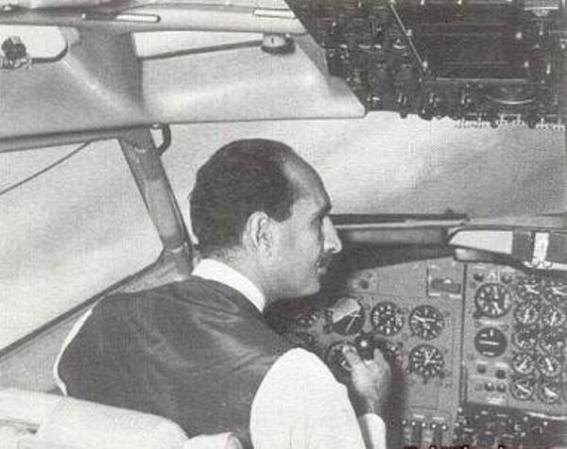
PIA’s very first jetliner Boeing 707-321 is under the command of Malik Nur Khan. Photo: Abbas Ali’s Collection
PIA made it compulsory for these passengers to be presentable and be properly dressed, as each of them was an “ambassador” of Pakistan. At times, had to report several hours prior to departure at the Karachi airport, where the sales manager would take them personally in shuttle buses to “Lunda Bazaar” and each would be bought a set of dresses, mostly suits, for them to change into before boarding an aircraft to London.
I still remember when PIA began to help set up a new airline for a country known as the United Arab Emirates (UAE) where I used to live,  in the mid-1980s. I read in the newspaper that PIA pilots and engineers were training and grooming the staff of this new airline called Emirates and I still recall the pride I felt at being a Pakistani.
It was fascinating to learn that in 1975, PIA selected its new uniforms through an open competition. The winning entry was designed by Sir Hardy Amies, the designer of Her Majesty, Queen Elizabeth II. The very fact that designers like Sir Amies and Pierre Cardin considered it prestigious enough to attach their names with PIA is heart-warming and heart-breaking at the same time.

Famous Hollywood stars Ava Gardner and Stewart Granger arrive at Lahore Airport, 1954. The actors arrived in Lahore with a full filming crew to shoot a major portion of the film ‘Bhowani Junction.’
The road to decline
Growing up in Dubai, I saw the emergence of Emirates Airlines over the years as one of the best airlines in the world, winning numerous global awards and establishing itself as a multi-billion dollar profit-making brand with one of the largest and most modern aircraft fleets.
I gradually felt my loyalties shifting towards Emirates and at the same time felt guilty for choosing it every time I had a choice. Honestly, I felt like a step-son when travelling by PIA – losing my luggage, eating tasteless food or staring at a TV-less seat in front of me during the entire journey, despite paying the same or higher air fare. On the other hand, increasingly I noticed that Emirates did not compromise on beauty, service or the grace of their crew.  As PIA continued on its downward spiral, I felt it was too much to ask for loyalty.
With the decline in service and quality, PIA got trapped into endless scandals and losses, not just in dollar value but in goodwill and reputation. It’s hard to believe that the airline that was Asia’s first to acquire a jet plane in its fleet back in the 1960s, has fallen behind all its peers in the race to upgrade, update and improve its image.
How does one explain that the first Asian airline ever to receive maintenance approval by the US Federal Aviation Administration (FAA) in the past has been banned by the European Union in 2007 based on safety concerns for its aging fleet?
Who would believe that the first airline ever to show in-flight movies on international routes and to use the first computer ever in Pakistan, would someday lose its customer base because people would perceive it as archaic and out-dated.
What went wrong?
Although there is a lot of information on the reasons for PIA’s downfall, I would rather not quote boring statistics. For me, all those negative numbers and record losses are merely a symptom and not the cause. The recent incident of a PIA pilot being arrested at Manchester airport for being drunk was an all-time low in the history of an organisation that has a glorious past.
Any iota of pride that Pakistanis had for its national carrier or its highly responsible and competent pilots was snatched away, thanks to the son of some military general with a few bad habits. Even if there were any loyal souls left in the European countries where PIA flights cannot land, who were trying to convince foreigners that banning PIA is unfair and based on unfounded fears, they would surely be eating up their words after this incident.
How do you explain the stupidity of one person which puts the safety standards of the entire organisation at risk? This incident, along with the case of the three stewards who were arrested on charges of harassing a female passenger, might be among the few instances that came to light. There may be many such things that go unreported on a daily basis. Sadly, such instances are merely a reflection of the low self-esteem of the people attached to an institution that lost its esteem years ago due to corruption, poor judgement, weak decisions and above all, complacency.

Saturday, 5 October 2013

Dell New story

Neil Hand, the executive in charge of Dell's tablet business, shows off the company's new devices during an event Wednesday in New York. They don't include any Windows RT products.
(Credit: Shara Tibken/CNET)
NEW YORK -- Microsoft's Windows RT operating system just lost another proponent.
Neil Hand, head of tablets at Dell, on Wednesday said his company won't be releasing a new Windows RT device to follow up its XPS 10 device from a year ago.
"We are not planning to refesh our current line of RT products," Hand said at a Dell tablet and PC launch event here. "We're really focused on full Windows products. ...The full Windows experience provides great capability."
Windows RT is the version of Microsoft's operating system that runs on chips typically used in cell phones. The software has failed to gain traction with users, in part because traditional Windows programs won't run on the operating system. Many companies have dropped Windows RT in favor of full Windows 8Surfacetablet running RT.
Microsoft has tightly controlled the development process for Windows RT devices, limiting the number of companies the chipmakers could work with, in order to make better products. That's meant that few products have hit the market, and some companies in the initial development program ultimately decided to abandon Windows RT.
Hewlett-Packard and Toshiba, for instance, never brought their Windows RT products to market, andSamsung never released its Windows RT device in the US. At this point, it appears that only Microsoft continues to push Windows RT.
We've contacted Microsoft for comment and will update the report when we have more information.
Hand told CNET in April that Windows RT sales were lower than expected. At that time, however, he said Dell remained committed to Windows RT and said it was working on future products.
Hand on Wednesday told CNET that Dell is phasing out its current Windows RT product, the XPS 10. All inventory is gone in the US, and it's only a matter of weeks before the device sells out in the rest of the world, he said.
"We are very good at understanding our true customer demand and adjusting our supply chain to fit that in real time," Hand said.'
Dell on Wednesday released a couple of new Android tablets, including the Dell Venue 7.
(Credit: James Martin/CNET)
Microsoft, meanwhile, took a charge of US$900 million earlier this year for excess Surface RT inventory, parts, and accessories. The company overestimated how many tablets it would sell, hurting its financial results. It continues to offer the first version of its Surface RT device at a discounted rate alongside thesecond-generation product and the new Windows 8.1 Surface Pro.
Hand and Sam Burd, vice president of Dell's PC business, blamed a lack of apps as one factor that hurt Windows RT, as well as its inability to run traditional Windows programs. In addition, Dell can now offer full Windows products for the same price as its Windows RT product, making the RT device less appealing to customers.
"For the same range of price, you can get a full Windows 8 tablet," Burd said. "If you want to run the new Windows 8 interface, you can, but you can also run all the old apps as before. That's hard to compete against. Unless you're [priced] far below that, there's just not space."
Hand noted that while Dell's Windows RT product wasn't successful, Dell did learn how to better price its other Windows products and what accessories to offer. One of its new Windows 8.1 products unveiled Wednesday, the Venue 8 Pro, is priced at US$299, the same level for Dell's older RT device. And theVenue Pro 11 includes a removable keyboard, much like the keyboard offered with Dell's XPS 10 Windows RT device.
"I think Microsoft made a bold move, and sometimes moves like that take quite a long time to actually happen," Hand said. "It's just not quite ready for us at this point for us to add more products with RT.


Republicans rip White House in shutdown reprisal


WASHINGTON: Republicans launched a furious counter-attack on the White House as the US government shutdown dragged deep into a fourth day, but no fresh path to ending the crisis was offered.
With lawmakers heading into the weekend, Congress appeared no closer to resolving the impasse, even as a far more challenging fiscal hurdle – the need to raise the US debt ceiling or suffer a catastrophic credit default – was barely 12 days away.
“This isn’t some damn game,” boomed House Speaker John Boehner, the top Republican in Congress, seeking to seize the moral high ground, after a report cited an unnamed official saying that the White House is benefiting from the shutdown, which has sent hundreds of thousands home without pay.
“This morning, I get the Wall Street Journal out and it says, ‘well, we don’t care how long this lasts, because we’re winning,’” Boehner said, theatrically waving a copy of the paper.
“The American people don’t want their government shut down and neither do I,” he added.
“All we’re asking for is to sit down and have a discussion, reopen the government and bring fairness to the American people under ‘Obamacare,’” the health care law that is President Barack Obama’s signature domestic achievement.
The White House on Friday tried to contain the damage from the Journal quote, which dominated the media messaging war raging between Obama and his Republican foes on Capitol Hill.
Obama even staged a photo op – a rare stroll outside the White House to a nearby sandwich shop – to try and arrest the fallout.
“There’s no winning when families don’t have any certainty over whether they are going to get paid or not,” he said of the first shutdown in 17 years.
“This shutdown could be over today,” Obama added, calling on Boehner to call a vote on a temporary funding measure to reopen government.
Both the House of Representatives and the Senate will convene rare Saturday sessions.
But some Republican pragmatists who have signaled they would vote to pass a fresh spending bill worried that such a resolution is no longer achievable.
“I think that ship has sailed,” congressman Michael Grimm said.
“We’re getting too close to the debt ceiling vote. It looks like the only thing that’s going to work right now is a dialogue.”
Obama is refusing to negotiate with Republicans over budget issues until they pass a temporary bill to open the government and agree to raise the $16.7 trillion US statutory borrowing limit – without which Washington could default on its debts for the first time ever later this month.
But Republicans are demanding the president enter into talks on their goal to defund or delay his health reform law – a step Obama refuses to take.
“I was at the White House the other night and listened to the president some 20 times explain to me why he wasn’t going to negotiate,” Boehner complained.
Obama meanwhile digested an embarrassing setback to his foreign policy and the US image abroad after he was forced to cancel plans to head to Asia for two diplomatic summits.
On Thursday he took the decision to cancel his visit to Bali for the APEC summit and Brunei for the East Asia summit, in what analysts described as a blow to his signature policy of shifting more diplomatic and military weight towards rising Asia.
The shutdown has forced hundreds of thousands of federal workers to stay home without pay, while monuments such as the Statue of Liberty have been barricaded and national parks closed.
Amid the acrimony over who is to blame, Democrats quietly acknowledged that the two sides had opened lines of communication, after the White House meeting with Obama and top congressional leaders went nowhere.
“There are talks going on,” Senator Chuck Schumer said, but he would not elaborate.
Grimm said he would like to see a “grand bargain” emerge, which would include entitlement and tax reform.
But Schumer said crafting such a massive package while government is shut down “is virtually an impossibility.”
The House of Representatives voted Friday on a string of mini bills to open favored areas of the government, including the Federal Emergency Management Agency (FEMA) and nutrition programs for low-income women and children.
But the White House has warned that in the unlikely event the bills make it through the Democratic-led Senate, the president would veto them.

Paul McCartney bans meat, Facebook on sets


LONDON: Legendary Beatles star Paul McCartney has forbidden his production team from having meat, scrolling through social networking sites and consumption of non-prescription drugs throughout the shoot of a new video.
The 71-year-old, who has been a lifelong supporter of animal rights, is shooting for his new track “Queenie eye” at Abbey Road Studios here, reports femalefirst.co.uk.
“It was meant as a joke but, still, you would be out on your ear if you ignored the memo. Anyone found on Twitter, Facebook or nibbling a ham sandwich would be rejected immediately,” a source told The Sun newspaper.
“Drug consumption might be harder to prove, but still,” the source added.
Actors Johnny Depp and Sean Penn will also make a cameo appearance in the video.

Movie review: Runner Runner fails to hit the jackpot

In the world of gambling, “Hard work does not guarantee success and nobody plays for free”. So would be the case in the world of entertainment too. Director Brad Furman should have known it by now.
Runner Runner is a synthetic tale of an aspirant’s journey to impress and follow the path of his idol and mentor only to realise that his idol has abused his faith and turned him into a mere pawn in his scheme of things.
Set in the backdrop of high stakes in the world of online gambling, a Wall Street dropout and a promising Masters in Finance student Richie Frust (Justin Timberlake) is struggling for his tuition fees at Princeton University. So, in order to make a quick buck, he turns to gambling and thereby ropes in the student community on campus.
But soon, the university officials catch up with him and he is threatened with expulsion unless he stops this nefarious activity.
After scrutinising the gambling site Midnight Black, in his last and desperate bid to make it big, he gambles his entire savings. Unfortunately, he loses. Unable to digest this fact, he consults the computer expert on campus and realises that he was cheated.
Determined to retrieve his lost money, Richie heads to Costa Rica to meet Ivan Block (Ben Affleck), the promoter of the online casino and confronts him.
Unperturbed, Ivan apologises and offers Richie two alternatives; a refund or to work with him. Richie takes the offer to work with him and soon realises that everything is not picture perfect in this gambling den.
The plot points in Runner Runner seem to have been often witnessed in movies like Wall StreetThe Devil’s AdvocateBoiler Room and The Social Network hitting the same graph points along the way.
Also, the momentum of the script and the screenplay loses its charm when, what starts off as an online gambling issue, gradually slides into the brick-and-mortar gambling mafia zone. Also, these scenes do not evoke the adrenaline rush that one notices in casinos.
With dialogues like “The eternal truth, the house always wins,” and “At Princeton, you’re either bred for it, or you bleed for it” by writers Brian Koppelman and David Levien, it seems like an effortless corny job dished out in a hurry.
On the performance front, except for Justin Timberlake who seems sincere in his performance and proves himself a competent actor, the rest of the cast just sleepwalk their parts.
The worst is Ben as Ivan, the suave smooth talking website promoter. He does not make any effort to emote. He is more comical than threatening, especially in the menacing scenes where he feeds crocodiles. And Gemma Arterton as Ivan’s moll, does not add anything exclusive to her character either.
The glossy cinematography by Mauro Fiore is splendid. He has managed to capture the external shots beautifully but the real gambling scenes are staid. The background score with Spanish music is appealing.
Director Brad Furman’s Runner Runner will appeal only to a select audience who are technologically savvy and those interested in discussing mind-boggling financial numbers. The others may just lose interest within the first few minutes.


KARACHI: Despite not having a massive budget or a well-known local cast, Zinda Bhaag has swept away audiences with its robust depiction of loud and artistic Punjabi culture. With its relatable take on culture, class divides and relationships, the independent film has managed to bag the coveted title of Pakistan’s first Oscar submission in 50 years.
The sudden success and hype surround the film brought directors Meenu Gaur and Farjad Nabi and producer Mazhar Zaidi to meet a curious audience for a small group discussion held at The Second Floor (T2F) on Thursday evening.
Although the trio has collaborated on four projects previously, which includes a documentary, it is the first time that their partnership has come into the limelight. However, despite being rather low-profile, they managed to bag veteran actor Naseeruddin Shah for a role.
“It was next to impossible,” said Zaidi. “None of us knew him but we managed to trace the number and left a text on his cell phone – we heard from him after a while.”
“After sharing the initial details and only five pages of the script, out which Shah only read two, he liked the script and agreed to be a part of the film,” he said.
They were modest enough to admit that they learnt a lot during the process of making this film. “[We learnt] scripts should be completely ready before you hit the floor,” said Nabi. “In a day, we used to shoot two scenes, but we came to know that we have to be slow and have it on paper first.”
Shot extensively on the streets of Lahore, the absence of a star-studded cast worked in the movie’s favour, as it helped the film-makers bring out the real essence of Lahori culture. “Had we taken big stars, we wouldn’t have managed to bring across the effect we were aiming for. Many auditions were conducted across Lahore and we were certainly looking for young Lahoris who could naturally act out their roles,” asserted Gaur. “These three boys had to have a personality that closely matched their roles.”
Calling the movie “quintessentially Lahori”, Gaur also explained that the decision of casting new faces was deliberate. “95% of our crew comprises fresh graduates, with no hands-on experience. It’s a huge collective achievement at our end as a team – if we can do it, so can everybody else,” stressed Gaur.
The Zinda Bhaag team also revealed that the post-production of the film was done in India. “Since Pakistan lacks such technical expertise, we had either an option to go to Thailand, Malaysia or India. We opted for India because of pure budgetary constraints,” said Nabi.
KARACHI: 
“Plan9 was one of the best things to have happened to our company.”
These are the words of Ali Rehan, CEO of Eyedeus Labs, a company that released an app called ‘Groopic’ into the market in July. This is an app that allows every member to be part of a picture, even the photographer, without the use of a tripod. Rave reviews have followed this app in the global market and Eyedeus lab has established a place for itself in the tech world. According to Ali, Plan9 turned Groopic in to a reality. So how did it all start?
It was at the launch pad of Plan9 where Ali and his team presented an idea to a panel that found the concept to be strong. Plan9 then incubated Ali and his team; they provided him, amongst other things, mentorship, an office space, laptops, a stipend of Rs20,000 per team member and feedback on their product.
After an incubation period of six months, Ali and his teammates were on their own, but what they took with them was a business model, motivation and even more determination than ever before.
This, in effect, is the aim of Plan9: to nurture talent to create a culture of tech entrepreneurship and endless energy. It all started in 2012 when Dr Umair Saif came up with the idea of a Tech Incubator and made the Punjab Government believe in this idea. Thus, Plan9 is an initiative taken by the Punjab Information Technology Board that aims to facilitate technological entrepreneurship in Pakistan.
Having successful startups such as Hometown Shoes to their name, Plan9 is now in its second incubation cycle and is overseeing many new exciting projects.
Nabeel A Qadeer, the Programme Manager for Plan9, states that although the engineers in Pakistan are good, they lack business sense.
“They have little idea of what to do after a product is created, how to market it, who to sell it to and what to price it at, are questions they do not know how to address even if they are graduates from Lahore University of Management Sciences,” he states. “That’s where Plan9 comes in.”
Aside from providing mentorship, the project aims at introducing young innovators to investment channels. Danish Lakhani of Nosh Genie, from the first incubation cycle, expressed his gratitude to Plan9 by praising Plan9’s Angel Investors’ Club.
“Babar Ali and Hussain Dawood visited us and they even gave one team $5,000,”he stated excitedly.
Although Danish’s startup did not succeed because his team disintegrated, the youngster vehemently emphasised the need of programs such as Plan9 to continue for at least 50 years.
“Silicon Valley wasn’t built in a day,” he put it succinctly.
Qadeer calmed these fears by stating that the Punjab Government has approved the plan till 2015, and with the success the company is showing, he doesn’t see any difficulty in guaranteeing further approval.
For the current incubation cycle, some exciting projects are underway. I-Track,
for example is a startup that is working toward generating a solution for disabled people to use computers. The team is trying to design a lens that can work as a mouse for those who cannot use a mouse due to disabilities.
Technolsys is another interesting new startup from the current cycle that is aiming towards developing anti-theft apps for phones and tablets − a real need in Pakistan in times of today.